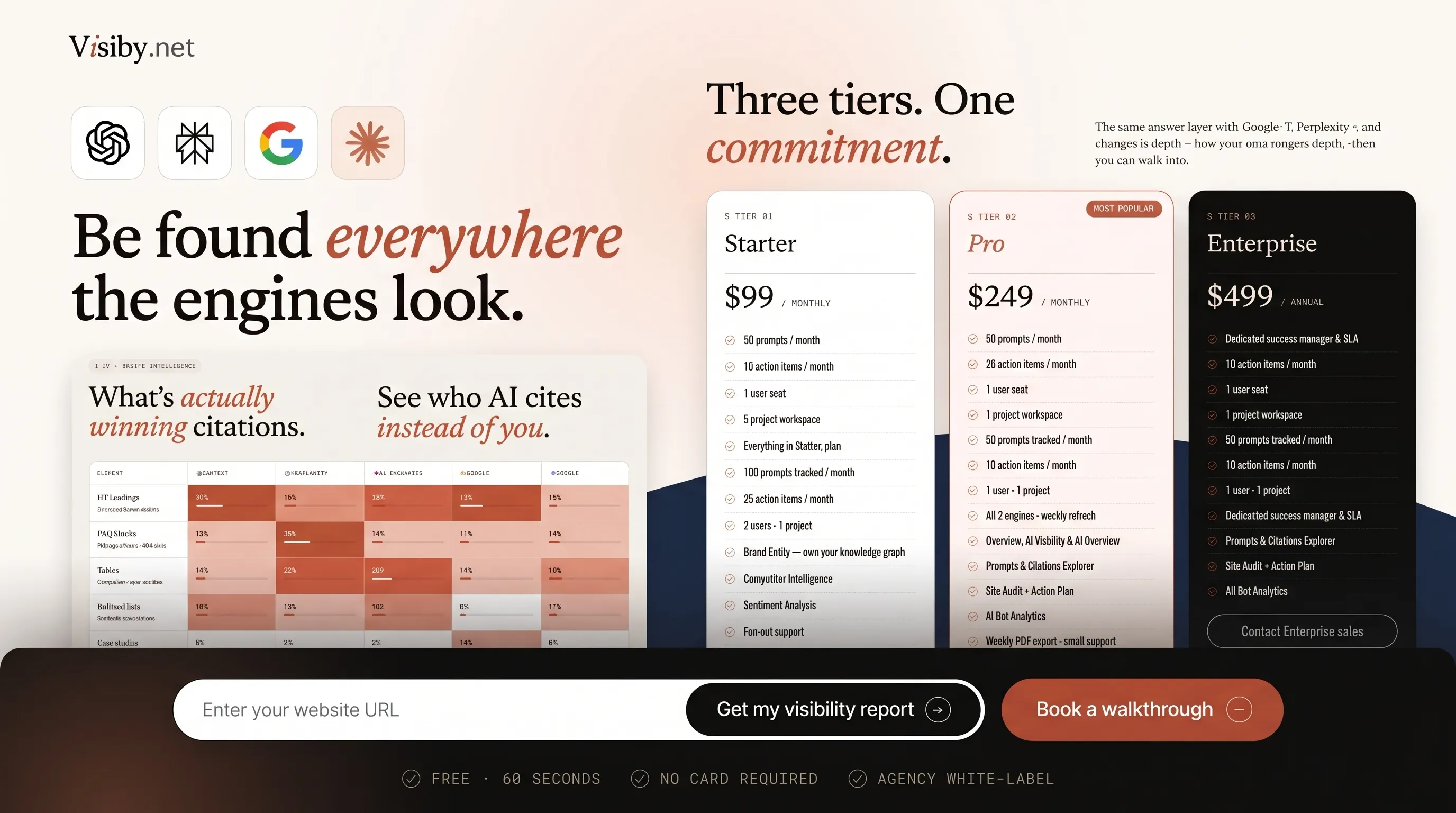

Key Takeaways: Digital discovery is shifting from traditional ranked links to synthesized AI search answers and Map Packs. To remain findable, modern businesses must manage both their Generative Engine positioning and their local SEO foundations. Visiby acts as the unified visibility layer, automating directory synchronization and tracking real-time LLM citations.
The digital marketing space is experiencing a tectonic shift. Traditional search engines, which once served as the absolute gatekeepers of online information, are rapidly sharing the stage with generative AI platforms. Millions of users now turn to tools like ChatGPT, Perplexity, and Google AI Overviews to get direct, synthesized answers rather than scrolling through pages of blue links.
This evolution has led to a profound impact on organic traffic, leaving many marketers and business owners scrambling to adapt to declining click-through rates. If you are struggling to understand where your brand stands in this new era, you need to learn how Visiby provides the visibility layer for AI search and local discovery.
Visiby is uniquely designed to bridge the gap between your digital content, directory listings, and the Large Language Models (LLMs) that now dictate information discovery. In this complete guide, we will explore how Visiby works, why AI search changes the rules of the game, and how you can align your brand for the future of digital discovery.
The New Frontier: Why AI Search Changes Everything
For over two decades, search engine marketing relied on a relatively predictable set of rules: target specific keywords, build authoritative backlinks, and ensure your website is technically sound. However, the difference between GEO and traditional SEO (Generative Engine Optimization) is staggering.
Traditional SEO focuses on ranking web pages in a linear list. GEO, on the other hand, focuses on ensuring your brand, products, and content are understood, trusted, and ultimately cited by artificial intelligence models during conversational queries.
Today, a common and frustrating question among business owners is: "Why is my website not cited by ChatGPT?" The answer lies in how these models retrieve and process information. AI engines do not merely crawl and index; they synthesize. To remain competitive, brands must actively invest in AI search formatting and complete AI search alignment.
Without adjusting your strategy to accommodate how LLMs "read" the internet, your brand risks becoming invisible to a massive segment of your target audience.
02 — Introducing VisibyEnter Visiby: The Ultimate AI Search Tracking Tool
To navigate this complex new environment, marketers need purpose-built solutions. Visiby provides a leading AI search visibility tracking tool, delivering clarity into how AI platforms perceive your brand.
But what exactly makes it so essential? It all comes down to measuring brand presence in generative search—a nuanced metric that old-school keyword trackers simply cannot capture.
When analyzing the Visiby platform versus traditional SEO tools, the distinction becomes clear. Traditional tools track search volume, backlinks, and static SERP rankings. Visiby, conversely, tracks brand mentions, sentiment analysis, and direct citations generated by LLMs in response to user prompts. Through advanced generative analytics, Visiby makes AI search tracking straightforward, quantifiable, and highly actionable.
03 — Core CapabilitiesCore Capabilities for Modern Marketers
As the market for AI search engine visibility tracking tools expands, Visiby stands out by offering a full suite of AI search visibility management tools. Here is what sets it apart:
- Live Citation Tracking: Visiby acts as a real-time AI citation monitoring tool, notifying you when and how an AI engine pulls data from your site to answer a user's question.
- Attribution Clarity: A massive challenge in the generative era is understanding AI search attribution data. Visiby breaks down exactly which prompts, context windows, and source materials trigger your brand's appearance in an AI response.
- Deep Marketing Insights: With detailed LLM citation analytics for digital marketers, you can pinpoint exactly which pieces of content resonate most with AI algorithms, allowing you to double down on what works.
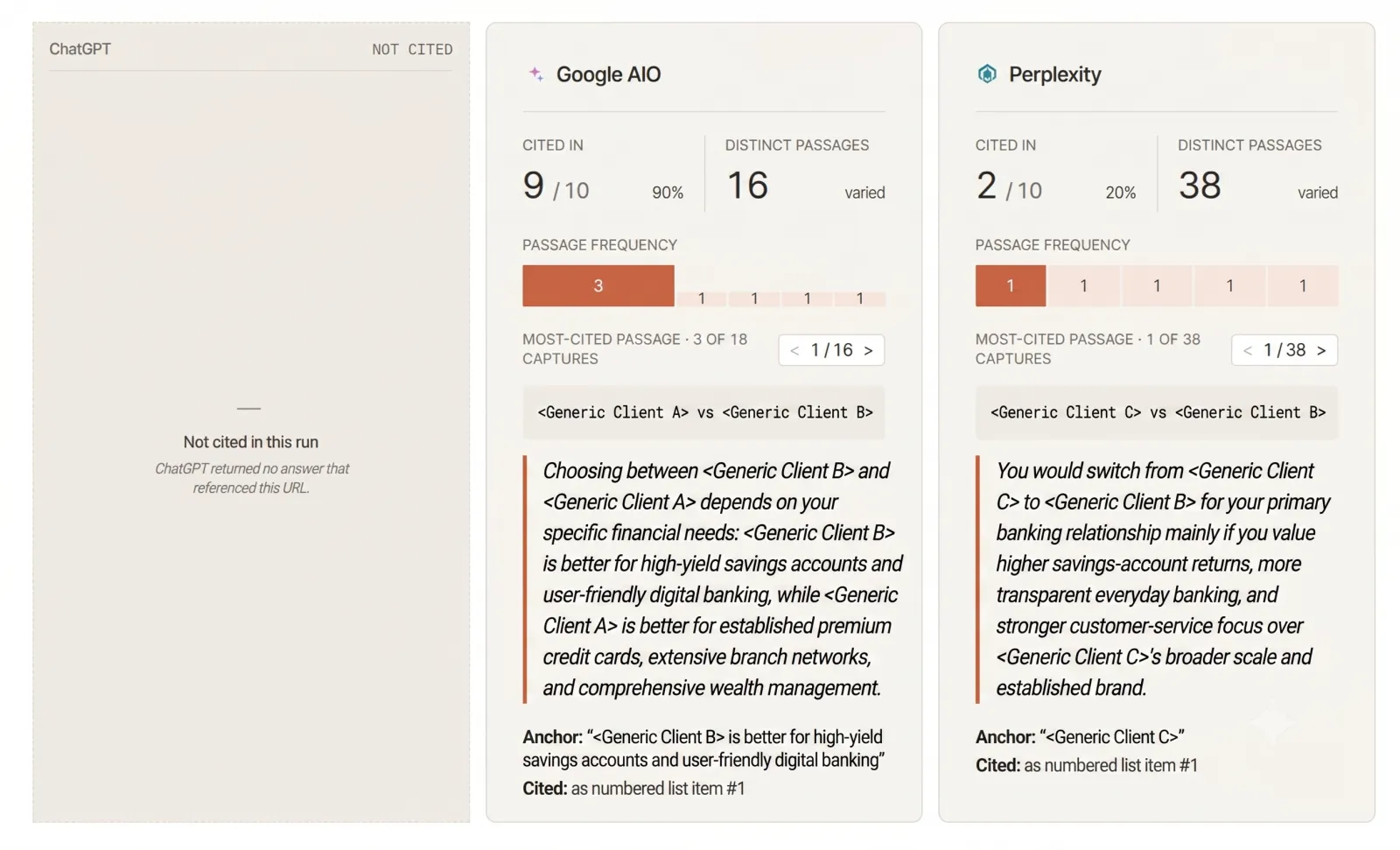
04 — Improvement GuideHow to Track and Improve Your AI Search Visibility
Knowing how to track AI search engine rankings is just the first step. Once you have integrated Visiby into your tech stack as your primary AI search tracking tool, it is time to refine your web presence.
If your dashboard reveals a lack of presence, you are likely focused on fixing low brand mentions in AI answers. Doing so requires a shift in how you create and structure your content. Below are core Generative Engine Optimization best practices to elevate your brand's AI visibility.
1. Master Retrieval-Augmented Generation (RAG) Dynamics
Modern AI search engines do not rely solely on their training data; they use RAG to pull in real-time, up-to-date information from the web before generating an answer. Therefore, improving brand authority for RAG systems is essential. To do this, your content must be highly authoritative, frequently updated, and cited by other high-trust domains. When a RAG system searches the live web for an answer, you want your domain to be the most credible source it finds.
2. Format Content for Large Language Models
Formatting content for Large Language Models requires moving away from keyword stuffing and focusing entirely on entity relationships, natural language, and factual accuracy. LLMs crave structure. Use clear headings, structured data (Schema markup), bulleted lists, and concise summaries at the top of your articles. State facts clearly and unequivocally so the AI can easily extract the information. This alignment strategy is detailed in the 2023 GEO: Generative Engine Optimization paper, Princeton/AI2/Georgia Tech/IIT Delhi.
3. Target the "Perplexity" Standard
Many marketers are currently asking how to increase visibility in Perplexity results, as Perplexity is rapidly becoming the gold standard for citation-backed AI search. To rank here, your content must directly answer complex user queries with cited facts and original research. Proprietary data—such as industry surveys, unique case studies, and original statistics—makes your site highly citable.
05 — Content StrategiesActionable Guide to AI-First Content Marketing Strategies
Transitioning your marketing efforts to appease both human readers and AI crawlers requires a refined approach. Consider this your guide to AI-first content marketing strategies:
- Focus on Conversational Long-Tail Queries: AI users ask full questions (e.g., "What are the top three CRM platforms for small healthcare clinics in 2026?"). Your content should mirror and directly answer these highly specific, conversational prompts.
- Build Unshakable Topical Authority: AI models prioritize expert sources. Instead of writing shallow content on a hundred different topics, build deep, interconnected content clusters around your core niche.
- Prioritize Readability and Formatting: Break complex ideas down. Use tables, glossaries, and FAQ schemas compliant with Schema.org standards. The easier it is for a machine to parse your page, the more likely it is to use your page as a source.
- Use Expert Services: The AI environment changes weekly. If your internal team is overwhelmed, consider partnering with agencies that offer dedicated AI search alignment services. Here is what an AI visibility team does each week. These experts can help you interpret the data pulled from AI search visibility tracking tools and implement high-level technical fixes.
06 — Local AI DiscoveryWelcome to the AI Search Era for Local Businesses
We are currently witnessing a massive shift in how consumers find local information. Traditional search engines are evolving, and the rise of AI search has completely transformed the user experience.
When a modern consumer wants a recommendation, they no longer just type a few keywords. Instead, an AI searcher might type a highly specific, conversational prompt like, "Find a highly-rated emergency plumber near me open right now who fixes water heaters." When users search with AI, the engine does not just match keywords; it synthesizes data from across the web to provide a direct, tailored answer.
This new era of AI powered search relies heavily on the accuracy, breadth, and depth of your online presence. If your business information is scattered, inconsistent, or missing, the AI algorithms will bypass you in favor of a competitor with a clearer digital footprint.
07 — AI ReadinessMeasuring Your AI Readiness
Because AI searching behaves differently than traditional search, you cannot rely on old metrics alone. You need to know if the artificial intelligence summarizing the web actually knows who you are. This is where utilizing an AI search visibility checking tool becomes essential. By actively monitoring your AI search visibility, you can ensure that language learning models and AI-driven search engines are pulling the correct data about your services, hours, and location, keeping you relevant in this next-generation digital economy.
08 — Local BedrockMastering the Bedrock: Local Search Engine Optimization
While AI is the future, traditional local search engine alignment remains the bedrock of your online presence. Local SEO is the process of refining your online footprint to attract more business from relevant local searches.
One of the most effective ways to establish trust with both search engines and potential customers is by maximizing online visibility through directory listings. Getting your business listed on high-traffic platforms like Yelp, Bing Places, Apple Maps, and industry-specific directories builds digital authority.
09 — NAP ConsistencyThe Critical Importance of NAP Consistency
When submitting your business to directories, accuracy is non-negotiable. This brings us to the importance of NAP consistency for search rankings. NAP stands for Name, Address, and Phone number.
If your business is listed as "Main Street Cafe" on one site, but "The Cafe on Main" on another, search engines get confused. A mismatched phone number or an old address can completely derail your local rankings. Fixing incorrect business information on directories is historically one of the most tedious tasks for business owners, but it is absolutely vital. If search algorithms spot discrepancies, they lose confidence in your business data and will drop you from the search results.
This is exactly why manual updates are a thing of the past. By using automated local listing synchronization, platforms like Visiby ensure that the moment you update your holiday hours or change your phone number, that information is instantly pushed out to dozens of directories simultaneously, maintaining perfect consistency across the web.
10 — Map Pack TacticsDominating Google and Local Map Packs
When potential customers search for local services, they are usually greeted by a map displaying three top business listings. This is known as the "Local Pack" or "Map Pack." Getting into this top-three spot is the holy grail of local marketing.
Here are proven strategies to rank higher in local map packs:
- Claim and Verify: Ensure you have full ownership of your listing.
- Keep Hours Accurate: Few things anger customers (and search engines) more than arriving at a closed business that was listed as "open."
- Add High-Quality Media: Upload interior and exterior photos, team pictures, and images of your products. Listings with photos receive significantly more requests for directions.
- Utilize Posts: Share updates, offers, and events directly to your profile.
To achieve this, you need to know how to align Google Business Profile for search. This means completely filling out every available field in your profile. Select the most accurate primary category, add relevant secondary categories, list your specific services, and write a compelling business description naturally infused with your core offerings.
11 — Scaling OperationsScaling Your Brand: Managing Multiple Locations and Platforms
Growth brings complexity. What happens when your business expands to two, five, or fifty locations?
Managing digital presence across multiple platforms becomes exponentially harder as you grow. A single location might require updating 50 directories; ten locations mean managing 500 individual listings. This is where multi-location business listing management software becomes a requirement rather than a luxury.
If you were to do a local citation building services comparison, you would quickly find that many manual services fall short because they lack real-time API integrations. Visiby stands out by offering a centralized dashboard. Whether you have one coffee shop or a nationwide chain of fitness centers, you can update information globally with a single click, ensuring your brand messaging and data remain perfectly synchronized everywhere.
12 — Reputation ManagementBuilding Trust: Online Reputation Management
Your business data might be perfectly accurate, but what are customers actually saying about you? Search engines factor in both the quantity and the quality of your online reviews when determining local rankings.
Implementing online reputation management best practices is essential for converting searchers into paying customers:
- Ask for Reviews: Do not be shy. Create a systematic process for asking satisfied customers to leave a review.
- Respond to Everything: Reply to every single review—both positive and negative. Thank happy customers for their time. For negative reviews, remain professional, apologize for the poor experience, and offer to resolve the issue offline.
- Spot Trends: Use your reviews to identify operational issues. If multiple people complain about slow service, you know exactly what needs fixing.
Engaging with your reviews signals to search algorithms that you are an active, customer-focused business, which can give you a noticeable boost in visibility.
13 — Performance MetricsTracking and Measuring Your Success
You cannot improve what you do not measure. To truly maximize your online presence, you must commit to tracking local search performance metrics.
When looking at the best local SEO tools for small business owners, you want software that provides clear, actionable data. You should not need a degree in data science to understand how your marketing is performing. Key metrics to monitor include:
- Discovery vs. Direct Searches: Are people finding you by searching for your brand name (Direct), or are they finding you by searching for a product/service category (Discovery)? An increase in discovery searches means your local SEO efforts are working.
- Customer Actions: Track how many people clicked to call you, requested driving directions, or visited your website directly from your listings.
- Profile Views: Monitor how often your listing appears in traditional search results versus map views.
Conclusion: Take Control of Your Digital Footprint
In today's hyper-competitive market, invisibility is not an option. From the rapid adoption of AI-driven answers to the foundational necessity of perfect NAP data, the digital ecosystem requires active, intelligent management.
Stop wondering why your competitors are getting all the foot traffic. By utilizing automated synchronization, aligning your profiles, actively managing your reputation, and keeping a close eye on your performance metrics, you can completely transform your business trajectory.
It is time to take the friction out of digital marketing. Embrace the future of search, implement the right tools, and choose Visiby — Be found everywhere. Because when your customers are looking, your business deserves to be the first thing they see.
14 — FAQFrequently Asked Questions
Raunaq Arora is a senior software and AI engineer at Visiby, where he builds the AI-visibility measurement pipeline and dashboard. He writes about how AI-visibility tracking is measured and tooled. View full profile →