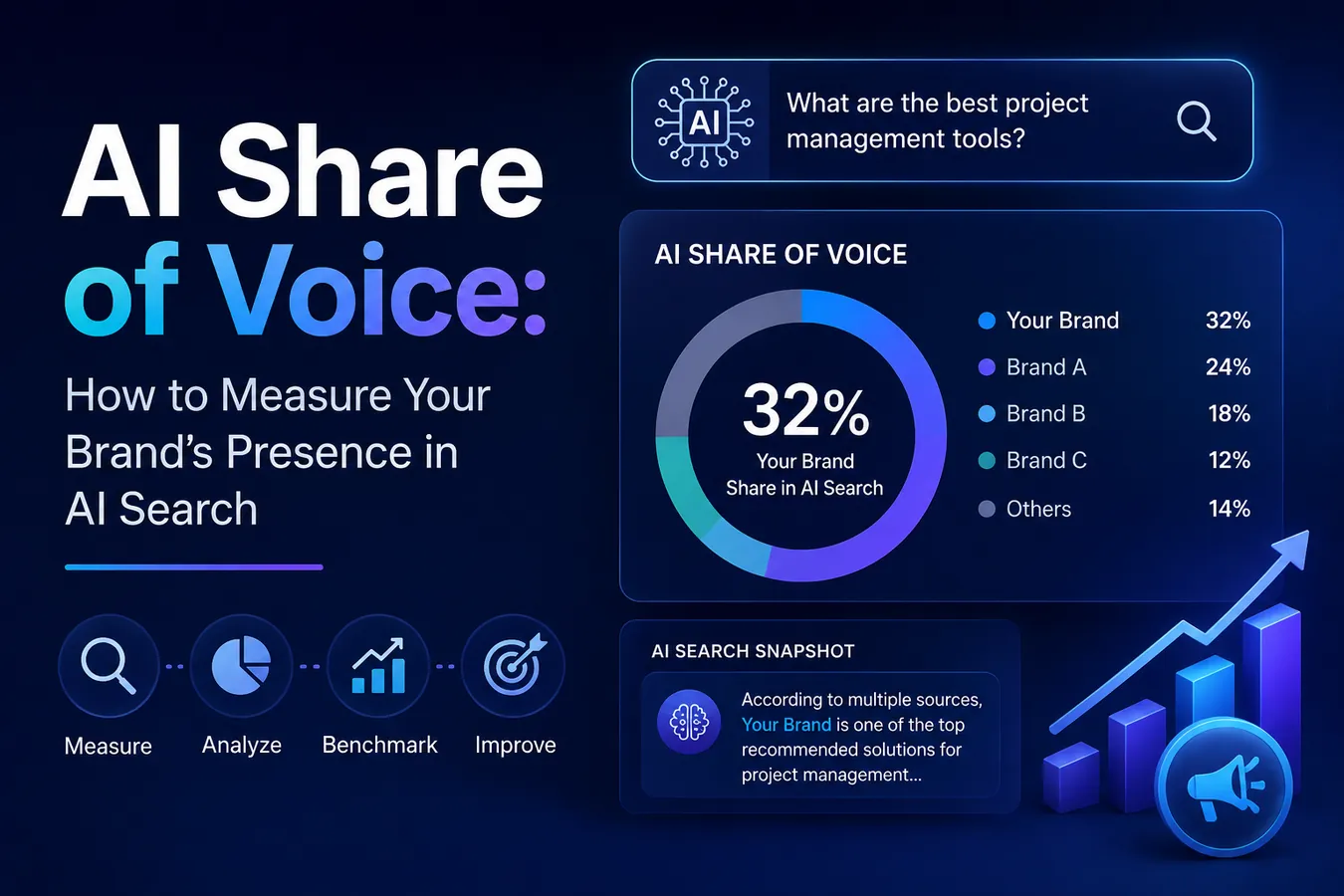

Key Takeaways: AI Share of Voice is the percentage of AI-generated answers in your category that mention your brand. It is the primary metric for tracking GEO performance — capturing both whether you are cited at all, and whether you are gaining ground against competitors. AI-referred visitors convert 4.4× better than organic. SOV is the upstream number that drives that result.
Related Guides: What Is AI Visibility · Answer Engine Optimization (AEO) · robots.txt for AI Crawlers · How to Write llms.txt
Every marketing metric has a North Star — the one number that tells you, at a glance, how you are really doing. For paid search it is impression share. For PR it is earned media reach. For GEO, it is AI Share of Voice.
Most brands tracking their AI presence are looking at the wrong thing. They check whether ChatGPT mentions them once in a while. They screenshot a Perplexity response when someone on the team notices it. That is not measurement. That is anecdote.
AI Share of Voice turns that into a number you can track, trend, and act on.
01 — DefinitionWhat is AI Share of Voice?
AI Share of Voice is the percentage of AI-generated responses in your category that mention your brand. The formula is simple:
AI Share of Voice (%) = (Brand Citations ÷ Total Category Citations) × 100
If 100 relevant AI answers are generated in your space and your brand appears in 28 of them, your AI SOV is 28%.
Simple to understand. Genuinely difficult to improve without a systematic approach — which is exactly what makes it a useful metric.
It captures two things simultaneously: absolute performance (are you being cited at all?) and relative performance (are you being cited more than your competitors?). A brand can have strong technical SEO foundations and still sit at 5% AI SOV if a competitor is doing the same thing better and more consistently. AI SOV surfaces that gap in a way that page rankings simply cannot.
In Visiby's August 2026 benchmark across 172 buyer prompts, the median AI SOV for a brand in a competitive SaaS category was 18%. The top performer in the same category had 44%. Both had comparable domain authority scores. The difference was almost entirely content structure and entity consistency — not traditional SEO strength.
02 — Why SOV > Rank 1Why AI SOV replaced "rank 1" as the visibility metric that matters
Traditional keyword rankings measure one thing: where your page sits in a list of ten blue links. That model is increasingly disconnected from how people find information in 2026.
When a user asks ChatGPT which project management tool is best for their team, there is no ranked list. When they ask Perplexity to compare two fintech platforms, there is no position 1. There is a synthesized answer — and either your brand is in it or it is not.
Here is the thing about that shift: it is not gradual. ChatGPT has 910 million weekly active users. Google AI Overviews reach 2 billion monthly users. The zero-click rate on Google searches is now 58% — and 93% in Google AI Mode specifically. Organic click-through rates have dropped 61% for results beneath AI Overviews.
Rank 1 used to mean you won the query. It increasingly means you won a metric that fewer people are triggering.
AI SOV measures the thing that replaced it. The metric becomes significantly more powerful when tracked over time and benchmarked against competitors. A single AI SOV reading tells you where you stand today. Monthly tracking tells you whether the work you are doing is moving the needle. Once you have the numbers, here is how to read an AI visibility report. Competitor benchmarking tells you whether you are gaining or losing ground against the brands your customers might choose instead.
03 — The FormulaHow to calculate AI SOV across multiple platforms
The challenge with calculating AI SOV manually is scale. You need enough prompts to be statistically meaningful, across enough platforms to be representative, run consistently enough to be trackable. Here is how to approach it.
Step 1: Define your prompt set
Build a list of 20–50 prompts representing the queries your target customers are most likely to ask AI platforms in your category. Mix three types:
- Informational: "what is the best X for Y," "how does Z work for teams"
- Comparison: "X vs Y for enterprise," "alternatives to [product]"
- Recommendation: "recommend a tool for Z," "best [category] for [use case]"
These should mirror real user intent — not just your SEO target keywords. The People Also Ask box in Google and top-voted threads in relevant subreddits surface the exact natural-language questions your audience is already asking.
Step 2: Run prompts across each platform
Each platform has distinct citation behavior, so tracking them separately matters.
- ChatGPT: Weights consistent cross-web brand mentions. Responses can vary between sessions — run each prompt at least twice and average results.
- Perplexity: Recency-heavy reranking model. Citation patterns shift faster here than on other platforms — brands with fresh content tend to outperform.
- Gemini: Draws from Google's index and YouTube. Brands with strong Google authority and video content perform disproportionately well.
- Google AI Overviews: Search each prompt in Google and record which domains appear in the AI Overview when one triggers. Note which prompts trigger an Overview and which do not.
Step 3: Calculate SOV per platform and in aggregate
For each platform: (your brand's citation count ÷ total citations across all brands) × 100. For aggregate AI SOV: combine citations across all platforms and apply the same formula.
An aggregate SOV can look healthy while you are completely invisible on Perplexity or Google AI Overviews. Tracking each platform separately prevents aggregate numbers from masking critical channel gaps.
Step 4: Decide when to automate
Manual SOV calculation works for a quick initial baseline. For ongoing measurement at meaningful scale (20–50 prompts across 3+ platforms on a weekly cadence), manual calculation breaks down fast. AI response variance means single-session checks are statistically unreliable, and the time cost compounds quickly across platforms.
Visiby's AI citation tracking runs your full prompt set across ChatGPT, Perplexity, Google AI Overviews, Google AI Mode, and Claude simultaneously — returning per-platform and aggregate AI SOV, trending it over time, and tracking competitor citation rates against yours.
04 — Competitor BenchmarkingHow to benchmark competitor AI SOV
Your AI SOV in isolation is informative. Your AI SOV relative to the three brands your customers compare you against is actionable.
Competitor AI SOV benchmarking runs the same prompt set, but records citation counts for each competitor alongside yours. The output is a clear competitive breakdown: which brands are dominating AI responses in your category, which are underrepresented, and where the prompt-level gaps are.
A few things competitive benchmarking typically reveals that aggregate numbers hide:
Category leaders are not always who you would expect. In AI-generated answers, citation frequency reflects content structure, entity authority, and freshness — not just brand size or traditional SEO dominance. Smaller brands with well-structured content and strong community presence regularly outperform larger brands with weaker GEO foundations. We have seen this in Visiby's data repeatedly, where a brand with a DA of 45 outperformed a DA 80 competitor on 60% of tracked prompts because their FAQ structure and schema markup were more extractable.
Gaps are prompt-specific. A competitor might have 40% overall AI SOV but only 15% on the specific prompts that matter most to your conversion funnel. Prompt-level benchmarking shows you exactly which queries you need to win and which ones your competitor currently owns.
SOV shifts faster than rankings. Traditional SEO rankings move slowly — weeks or months. AI SOV can shift meaningfully within days when a competitor publishes fresh content, earns significant press coverage, or deploys schema improvements. Monthly tracking catches these shifts before they compound into a sustained gap.
05 — Revenue LinkHow AI SOV connects directly to revenue
AI Share of Voice is not just a visibility metric — it connects directly to revenue in a way that traditional SEO metrics often struggle to demonstrate.
Here is the chain: AI-referred visitors convert 4.4 times better than standard organic traffic. A user who arrives at your site after an AI platform cited you as a recommended source has already received a form of pre-qualification. The AI answered their question, mentioned your brand, and they chose to click through. That is a fundamentally different intent signal than someone who clicked a blue link from a ranked list.
Higher AI SOV means more of this high-intent traffic. More high-intent traffic means higher conversion rates on sessions that already showed purchase intent. The ROI case for GEO investment becomes concrete: SOV leads to AI-referred sessions, which leads to conversion rate, which leads to measurable revenue contribution.
For marketing and CMO teams justifying GEO investment to leadership, this chain is the narrative that works. AI SOV is the upstream metric; AI-referred conversion rate is the downstream proof.
Track AI-referred sessions in GA4 by setting up custom channel groups that capture traffic from chat.openai.com, perplexity.ai, gemini.google.com, and claude.ai as distinct channels. Then compare conversion rates between AI-referred sessions and standard organic. The gap typically validates the investment quickly.
06 — SentimentSentiment analysis: going beyond citation count
AI SOV measures how often you are mentioned. Sentiment analysis measures how. The difference matters more than most brands realize.
A brand that appears in 40% of AI responses but is consistently framed as expensive compared to alternatives or better suited for enterprise than SMBs has a sentiment problem that raw SOV data does not surface. Worse — AI sentiment signals are self-reinforcing. If AI systems have learned to associate your brand with certain qualifiers from existing web content, those qualifiers show up repeatedly in AI responses until the underlying signal changes across multiple third-party sources.
The fix for negative or neutral sentiment is almost never changes to your own website. Because AI systems synthesize sentiment from multiple third-party sources (reviews, community discussions, editorial coverage), improving brand sentiment in AI responses requires improving the signal across those sources.
Practical sentiment tracking means classifying each citation as positive, neutral, or negative, and flagging specific language patterns that appear consistently. Neutral mentions that acknowledge your brand without actively recommending it are immediate opportunities. They mean you are in the answer but not being chosen. That is a different problem than absence, and it has a different fix.
07 — BenchmarksWhat good AI SOV looks like: a reference benchmark
There is no universal "good" AI SOV because it depends on category competitiveness and how many brands AI systems are actively citing. But a reference frame is useful:
| AI SOV Range | What It Signals |
|---|---|
| Under 15% | Significant citation gap. Brand is being overlooked on most relevant queries. |
| 15–25% | Emerging presence. Cited on some queries but losing most to competitors. |
| 25–40% | Competitive range. Strong in some areas, gaps in others. |
| Above 40% | High AI visibility. Category leaders rarely exceed 60% — AI systems naturally diversify citations. |
What matters most is your trend over time and your position relative to the specific competitors your customers compare you against. A brand moving from 12% to 22% in 60 days while a key competitor drops from 35% to 28% is winning, regardless of absolute level.
In empirical research on Generative Engine Optimization (GEO) published by researchers from Princeton, Georgia Tech, and Allen AI, systematic content optimization—such as adding verified citations, statistics, and authoritative quotation—boosted source visibility across generative engines by up to 40%. Structuring owned content and establishing cross-web consistency directly drives measurable gains in AI recommendation frequency.
08 — MistakesCommon AI SOV mistakes that keep brands stuck
I have audited enough brand AI presence through Visiby's platform to see the same patterns consistently. These are the errors that keep AI SOV flat despite genuine effort:
- Tracking the wrong prompt set. Brands often track brand-name prompts ("what is [brand]?") instead of category prompts ("best tool for [use case]"). Brand prompts inflate your SOV reading because you are almost always cited when someone asks about you by name. Category prompts are where the actual acquisition opportunity lives.
- Single-session manual checks. AI responses vary significantly between sessions. A single run of a prompt is not a data point — it is an anecdote. Reliable SOV measurement requires multiple runs per prompt, averaged.
- Ignoring platform variance. A brand with 35% SOV on Perplexity and 4% on Google AI Overviews has a very specific problem to solve. Aggregate-only tracking hides this completely.
- Measuring SOV without measuring sentiment. A rising SOV with worsening sentiment framing is a warning sign, not a success metric. Track both.
- Treating AI SOV as a one-time audit. AI citation patterns shift quickly. A quarterly SOV reading is not measurement — it is archaeology.
09 — FAQAI Share of Voice: frequently asked questions
Arun Pandit is the founder of Visiby, an AI-visibility tracker by FNA Technology that measures how often ChatGPT, Perplexity, and Google AI Overviews cite a brand. He writes about generative engine optimization from the data Visiby collects across the brands it tracks. View full profile →