

- GEO wins citations inside AI answers, not ranked links — measured by citation share, not position.
- Answers are built in two stages: retrieval then synthesis. You must win both.
- The unit that wins is the quotable passage, not the page.
- The strongest levers are cited statistics, named-source quotes, and clear structure — not keywords.
- It runs as a layer on top of SEO, not a replacement for it.
Last updated: 23 June 2026
GEO (Generative Engine Optimization) is the practice of structuring content, evidence, and authority so AI engines cite your brand inside their answers. Where SEO competes for a ranked link, GEO competes to be the source the model quotes, measured by citation share rather than rank.
Related Guides: Learn how to optimize other layers of the search funnel in our guides on Answer Engine Optimization (AEO) and foundational Search Engine Optimization (SEO).
Generative Engine Optimization (GEO) is the practice of shaping your content so that AI engines (ChatGPT, Perplexity, and Google AI Overviews) cite, mention, or recommend your brand when they generate an answer. Where classic SEO competes for a ranking position in a list of links, GEO competes to be the source the model trusts and quotes. This guide explains what GEO is, how it works, how to do it step by step, what it costs, what tools and best practices teams use, and how it differs from the SEO you already run.
The short definition: GEO is search visibility for the era when the search result is an answer, not a list. The term is no longer niche. "Generative engine optimization" now draws 5,400 US searches a month (DataForSEO, June 2026), up from near-zero in 2024. If your buyers are asking AI assistants questions about your category and your brand never appears in the reply, GEO is the discipline that fixes it.
01 — DefinitionWhat does generative engine optimization mean?
Generative engine optimization means tuning your content, structure, and authority signals so generative AI engines select your brand as a source when they compose answers. The "generative engine" is the large language model behind ChatGPT, Perplexity, or Google AI Overviews, the system that generates a written response rather than returning a ranked list. GEO is the work of becoming part of what that system says.
The term comes from a 2023 research paper, GEO: Generative Engine Optimization, written by researchers from Princeton, the Allen Institute for AI, Georgia Tech, and IIT Delhi. They ran controlled tests on what content changes increased a source's presence inside generative answers, and reported gains in visibility of up to 40% from the strongest tactics. Those strongest levers were adding cited statistics, quoting credible sources, and using clear authoritative language. Keyword stuffing did little and sometimes reduced visibility. That finding is the backbone of modern GEO: write content a model can trust and quote, not content stuffed with keywords.
GEO is sometimes called AI SEO, LLM optimization (LLMO), or AI visibility. They point at the same goal of being present in AI answers, but GEO is the most precise label because it names the target: the generative engine.
02 — Plain EnglishWhat is generative AI engine optimization, in simple terms?
In simple terms, GEO is getting your brand into the answer instead of just into the search results. Imagine a buyer types a question into ChatGPT instead of Google. ChatGPT does not show ten links; it writes a paragraph. GEO is everything you do to make sure your brand is named in that paragraph and your page is one of the sources behind it.
Three things decide whether you make it into the answer: whether the engine can find and read your page, whether your content answers the question in a clean, quotable way, and whether the model trusts your brand as an authority on the topic. GEO is the practice of getting all three right, on purpose, and then measuring whether it worked.
The Visiby GEO Framework
Every tactic in this guide rolls up to one of four stages. We call it the Visiby GEO Framework, and we run every client audit against it in order, because a later stage cannot rescue a broken earlier one.
| GEO Stage | The Goal | The Mechanism |
|---|---|---|
| 1. Discoverability | Get found | AI crawler access: GPTBot, PerplexityBot, and Google-Extended unblocked |
| 2. Citability | Get quoted | Short, self-contained, answer-first passages backed by evidence |
| 3. Authority | Get trusted | Original data, named sources, and a clear human author entity |
| 4. Measurement | Stay visible | Track citation share per engine against named competitors |
Run it top-down. A brand with a blocked crawler (stage 1) never benefits from brilliant passages (stage 2), and authority (stage 3) compounds only once the first two hold.
03 — MechanismHow does generative engine optimization work?
GEO works by aligning your content with how generative engines build answers, which happens in two stages: retrieval and synthesis. First the engine retrieves a set of candidate sources for a query, from its training, from a live search index, or both. Then it synthesises an answer by selecting and paraphrasing the passages it judges most relevant and trustworthy. GEO targets both stages: you have to be retrievable, and you have to be the passage worth selecting.
That two-stage pipeline explains why GEO content looks the way it does:
- To be retrieved, AI crawlers must be able to reach your page (GPTBot, PerplexityBot, Google-Extended must not be blocked), and your page should rank or be indexed well enough to enter the candidate set, which is why strong SEO feeds GEO, especially for Google AI Overviews.
- To be synthesised in, your content must contain self-contained, quotable passages that directly answer the question, supported by evidence the model can verify: statistics, named sources, clear claims. The model lifts the chunk that reads like a confident, sourced answer.
Earned media authority: the off-page side of GEO
A large part of whether a model trusts your brand is decided off your own site, through earned media authority, the mentions, citations, and references your brand collects across the wider web. Generative engines build their sense of "who is authoritative on this topic" from patterns across many sources, not from your homepage alone. If credible third-party sites, publications, and communities consistently mention your brand in your category, the model learns to associate you with it and is more likely to name you.
This is the GEO analogue of off-page SEO, but the currency is mentions and associations rather than just backlinks. Third-party mentions in industry publications and reputable comparison content teach the model your brand belongs in the category's answer set. Consistent entity signals (describing your brand the same way across your site, profiles, and external references) help the model resolve who you are and what you do. Community and review presence on credible platforms contributes to the model's picture of your reputation and sentiment.
The practical takeaway: on-page structure and evidence get you quoted once you are in the candidate pool, but earned authority is part of what puts you in the pool and what makes a model comfortable naming you. GEO is on-page structure plus off-page authority, measured by whether the engines actually cite you.
04 — Under the hoodHow AI search engines actually work
AI search engines work by retrieving candidate sources and then synthesising an answer from them, a two-stage pipeline that is the key to understanding GEO. Knowing the stages tells you exactly where to intervene.
Stage one: retrieval. When a user asks a question, the engine assembles a pool of candidate sources. ChatGPT draws on its training data and, in browse mode, retrieves live pages. Perplexity runs a live search and pulls a wide set of sources. Google AI Overviews builds its candidate pool largely from pages already ranking in classic search. If your page is not in the candidate pool, whether because it is blocked to AI crawlers, not indexed, or not ranking, the engine cannot use it, no matter how good the content is.
Stage two: synthesis. The engine reads the candidate passages and writes an answer, selecting and paraphrasing the chunks it judges most relevant and trustworthy. It favours passages that directly answer the question, carry verifiable evidence, and come from sources it associates with authority on the topic. This is where structure and evidence decide whether you are quoted or skipped.
GEO is the practice of winning both stages: be in the candidate pool (retrieval) and be the passage worth quoting (synthesis). Most brands that are invisible in AI answers fail at one specific stage, and the fix differs depending on which.
05 — StrategyHow the two-stage citation pipeline shapes your content
Because citations flow through retrieval then synthesis, your content has two jobs that map directly onto those stages. Get either wrong and you lose the citation.
For retrieval, the work is technical and structural: keep GPTBot, PerplexityBot, and Google-Extended unblocked in robots.txt; keep the page fast and indexable; and keep your classic SEO strong so the page ranks well enough to enter Google AI Overviews' candidate pool. Retrieval is a gate. Pass it or nothing else counts.
For synthesis, the work is editorial: write answer-first, break content into self-contained passages, add statistics and named-source quotes, and use formats engines parse cleanly. Synthesis is a competition. Among the retrieved candidates, the most quotable, best-evidenced passage wins.
The reason teams audit their citation gap before writing is that it tells them which stage is failing. If competitors are cited and you are not even in the candidate set, you have a retrieval problem (crawlers, indexing, rankings). If you are retrieved but never quoted, you have a synthesis problem (structure, evidence, clarity). Treating both as one vague "we need more GEO" wastes effort on the wrong stage.
06 — FormatWhy listicles and comparison formats dominate AI citations
Listicles and comparison pages get cited disproportionately because their structure matches how engines extract fragments. A model building an answer wants a clean, self-contained chunk it can lift; "best X" lists and "X vs Y" comparisons are made of exactly those chunks. Each list item or table row is effectively a pre-packaged passage with a clear claim, which the engine can quote without dragging in surrounding context.
This is the fragment-extraction effect: engines do not read your page like a human reading top to bottom. They extract the most useful fragment for the specific question. A well-built listicle offers many extractable fragments; a flowing essay offers few. That does not mean every page should become a list, but it does mean the article format needs restructuring for GEO.
The article format is not dead; it needs restructuring. A traditional long-form article can still be cited heavily if you break it into liftable units: question-style headings, a direct answer under each, short self-contained paragraphs, and embedded tables or FAQs where they fit. The change is simple: stop writing articles as one continuous argument and start writing them as a series of standalone answers. The brands winning citations from articles are the ones that restructured the format, while those that abandoned it lost ground.
07 — SignalsWhat gets cited in AI answers — and what doesn't?
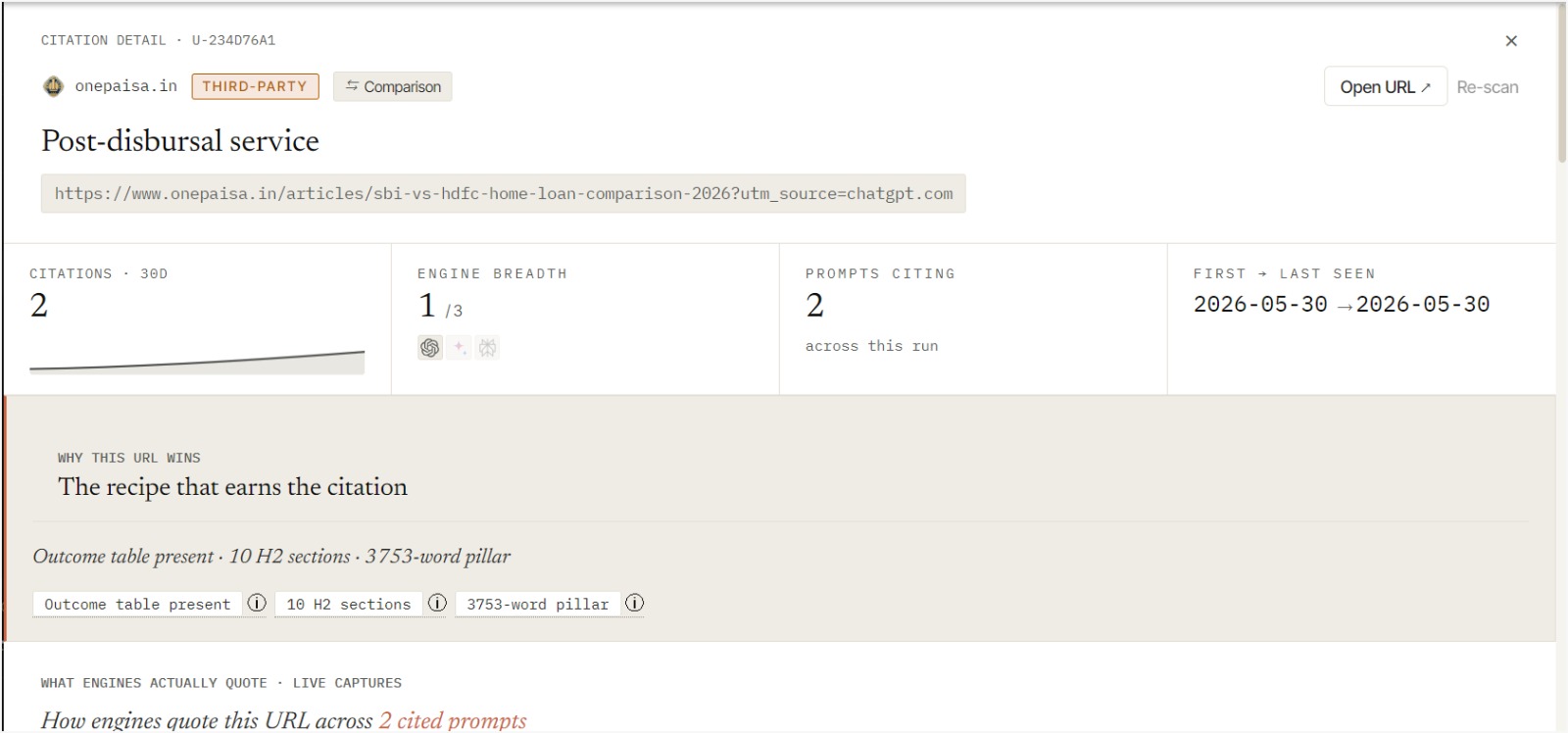
AI engines cite content that is structurally legible and demonstrably authoritative; they skip content that is buried, vague, or unverifiable. The pattern is consistent across engines.
What gets cited:
- Direct answers placed first. A section that opens with a one- or two-sentence answer to a real question.
- Self-contained passages. Chunks that make sense without the surrounding context, ideally under 120 words.
- Verifiable evidence. Cited statistics and named-source quotes, the strongest levers in the original GEO research.
- Structured formats. Comparison tables, FAQ blocks, numbered steps, and clearly-labelled lists that a model can parse cleanly.
- Listicle and comparison framing. Engines fragment-extract well from "best X" and "X vs Y" structures, which is why those formats appear repeatedly among cited pages.
- Entity clarity. Content that makes unmistakable what your brand is and what it is known for, so the model attaches the right associations.
What gets skipped:
- Keyword-stuffed copy with no real answer.
- Long arguments where the conclusion only arrives after heavy setup.
- Unsourced claims a model cannot verify.
- Pages AI crawlers are blocked from reading.
- Generic content with no entity signal, where the model cannot tell which brand to credit.
08 — PrioritisationThe GEO citation factors, ranked by priority
Not every GEO factor carries equal weight. It helps to group them into tiers so you fix the highest-impact items first and treat the rest as polish.
Tier 1, the factors that get you cited at all. These are non-negotiable. AI-crawler access (GPTBot, PerplexityBot, Google-Extended unblocked), retrievability (indexed, and for Google AI Overviews, ranking), and answer-first passages with verifiable evidence. Miss any Tier 1 factor and the rest cannot save you. You are either invisible to the engine or unquotable once found.
Tier 2, the factors you build in next. Once you are reliably retrieved and quotable, Tier 2 widens your share: comparison tables and FAQ blocks for fragment extraction, FAQPage and Article schema, question-style headings matched to real prompts, and entity clarity so the model credits the right brand. These turn occasional citations into consistent ones across more prompts.
Tier 3, the compounding factors. Earned media authority, third-party mentions, review and community presence, and sentiment. These move slowly and depend partly on others, but they compound: the more the wider web treats you as a category authority, the more readily every engine names you. Work Tier 3 continuously, but never at the expense of Tier 1.
The sequencing matters because teams routinely invest in Tier 3 brand-building while a blocked crawler (Tier 1) keeps them out of every answer. Audit top-down: confirm Tier 1, then Tier 2, then compound with Tier 3.
09 — DiagnosisThe two criteria every cited source meets: structural legibility and earned media authority
Underneath the tier list sit two criteria that a model is really judging, and every tactic in this guide rolls up to one of them. The first is structural legibility: can the engine cleanly extract a self-contained answer from your page? The second is earned media authority: does the wider web treat your brand as a credible source on this topic? A passage that scores high on both is the safe pick; a passage weak on either gets passed over. Holding these two criteria in mind is the fastest way to diagnose why a page is or is not getting cited.
Criterion 1: structural legibility
Structural legibility is how easily a model can lift a correct, self-contained answer out of your page without parsing narrative. It is the on-page criterion, and it is almost entirely under your control. A structurally legible page leads each section with the answer, phrases headings as the questions buyers ask, keeps quotable passages short and whole, names its entities so a chunk reads correctly in isolation, and renders facts as tables or tight lists rather than burying them in prose. When a page fails the synthesis stage despite being retrieved, structural legibility is almost always the culprit: the answer exists somewhere on the page, but the model cannot extract it cleanly enough to quote with confidence. The fix is editorial, not promotional. You rewrite the passages until each one stands alone.
The reason this criterion carries so much weight is that the model is reading a chunk in isolation and managing its own risk of being wrong. Given two passages that say the same thing, it reaches for the one it can verify and reproduce without distortion. A statistic stated under a question heading with a named source is the most legible thing on most pages, which is why it is the single strongest lever in the original GEO research. Structural legibility is, in plain terms, doing the model's extraction work for it.
Criterion 2: earned media authority
Earned media authority is the off-page criterion: the pattern of mentions, citations, and references that teaches an engine your brand belongs in the category's answer set. It is slower to move and only partly in your control, but it compounds. When credible third-party publications, comparison content, and communities describe your brand the same way in your category, the model builds a stable association between you and that topic, and it grows more comfortable naming you. This is the GEO analogue of off-page SEO, but the currency is consistent mentions and clear entity associations rather than raw backlink counts.
The two criteria interact. Earned authority helps you clear retrieval and makes a model comfortable citing you; structural legibility makes the actual passage quotable once you are in the pool. A high-authority brand with illegible pages gets named in prose but rarely gets its pages cited as the source; a legible page from an unknown brand may get quoted occasionally but struggles to become the default answer. The brands that win consistently invest in both. They earn the authority and they structure the page so the citation has somewhere clean to land.
10 — PlaybookThe 7-step generative engine optimization process
You do GEO by running a repeatable loop: find the prompts, audit the gap, restructure the content, add evidence, clear the crawlers, build entity signals, and measure citations. Here is the process in order. For a full breakdown of the terminology used, see our complete AI Search Glossary.
- Build a prompt library. List the real natural-language questions buyers ask AI engines in your category, across awareness, consideration, and brand-evaluation stages. These are your GEO targets, the way keywords are your SEO targets.
- Audit the citation gap. For each prompt, run it through ChatGPT, Perplexity, and Google AI Overviews and record which brands and URLs get cited. Where competitors appear and you don't is your roadmap.
- Restructure for lifting. Rewrite pages so each section leads with a direct answer, breaks into self-contained passages, and uses question-style headings. The goal is liftable chunks, not a single long argument.
- Add verifiable evidence. Insert cited statistics and named-source quotes. This was the single strongest lever in the GEO research and remains the fastest way to earn citations.
- Add structure and schema. Build comparison tables and FAQ blocks where they fit, and mark them up with FAQPage, Article, and Service schema so engines parse them cleanly.
- Clear the AI crawlers. Confirm GPTBot, PerplexityBot, and Google-Extended are allowed in robots.txt. If they are blocked, none of the above matters. The engine never sees the page.
- Measure citations over time. Track per-engine citation share and brand mentions on a schedule. Rankings and citations move independently, so you need a scorecard for each. You can read more about how our AI Visibility Platform tracks these metrics.
The loop repeats: measure, find the new gap, fix it, measure again. GEO is iterative, like SEO, but the metric is share of the answer rather than rank.
11 — Best practicesWhat are generative engine optimization best practices?
The best practices for GEO come straight from how engines select and trust sources: answer first, prove every claim, structure for parsing, and earn authority. The high-impact list:
- Lead with the answer. Put a direct, quotable answer in the first sentence under each heading.
- Use question-style headings. Match the way buyers actually phrase prompts.
- Keep passages self-contained and short. Aim for chunks under roughly 120 words that stand alone.
- Cite statistics and name your sources. Verifiable evidence is the strongest visibility lever found in the research.
- Build tables and FAQs. Engines extract cleanly from structured formats; comparison and FAQ blocks earn outsized citations.
- Add schema markup. FAQPage, Article, and Service JSON-LD help engines understand and lift your content.
- Strengthen entity signals. Be consistent and explicit about what your brand is and is known for across your site and the wider web.
- Don't block AI crawlers. Audit robots.txt for GPTBot, PerplexityBot, and Google-Extended.
- Keep your SEO strong. Ranking pages are far more likely to be pulled into Google AI Overviews.
- Measure per engine. Track ChatGPT, Perplexity, and Google AI Overviews separately, because citation share differs sharply across them.
12 — In practiceCan you give a generative engine optimization example?
Here is a concrete GEO example. A B2B analytics company wants to be cited when buyers ask, "What's the best way to measure marketing attribution for a small team?" In an SEO-only world, they publish a long guide and try to rank it. In a GEO world, they restructure that guide so a model can lift it: a question-style H2 ("How should a small team measure marketing attribution?"), a two-sentence direct answer underneath, a comparison table of attribution models, a supporting statistic with a named source, and an FAQ covering the exact sub-questions buyers ask.
The result: when a buyer asks Perplexity, the engine pulls that clean answer paragraph and cites the page; when they ask ChatGPT, the model names the company as a credible option; and because the page also ranks, it becomes eligible for Google AI Overviews. One restructured page, three engines, measured by citation share rather than a single rank. That is GEO in practice: rebuilding an existing page to be quotable and trusted, rather than writing fresh content for its own sake.
13 — ToolingWhat tools do generative engine optimization companies use?
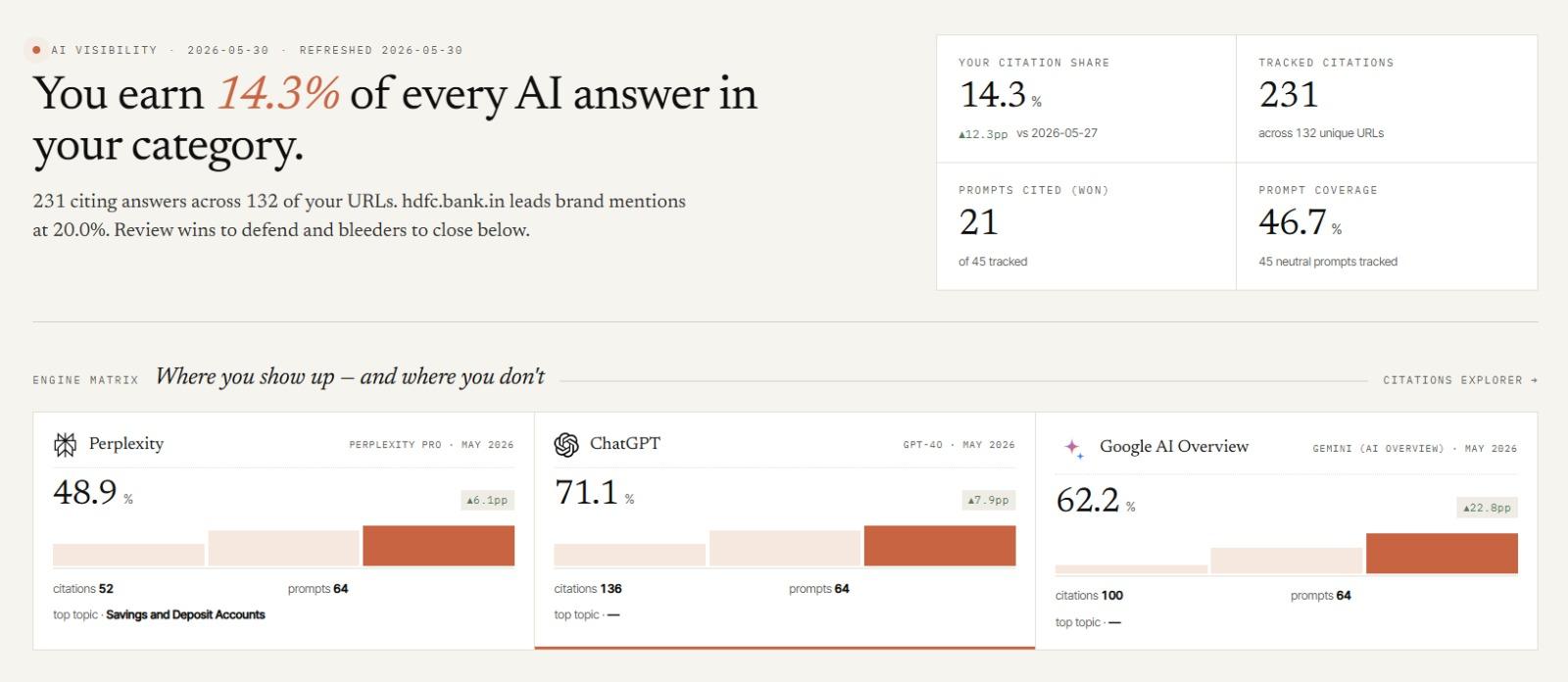
GEO companies use two categories of tools: AI visibility trackers that measure citations, and content tooling that produces liftable, evidence-backed pages. The visibility trackers are the new and essential category, because classic SEO tools cannot see inside AI answers.
An AI visibility tracker samples the engines on a schedule, records which brands and URLs each one cites for your target prompts, and reports your citation share against competitors per engine. This is the GEO equivalent of a rank tracker, and it is what tells you whether your work moved the needle. Tools in this category include Profound, Peec, Otterly, and Visiby; they differ in which engines they sample, how they attribute citations, and whether they stop at a score or hand you the fix. Alongside trackers, teams use standard content, technical-SEO, and schema tooling to build and ship the pages, but without a visibility tracker the GEO loop has no scorecard. For a deeper comparison of the category, see our guide to AI visibility tools.
14 — EducationIs there a generative engine optimization course worth taking?
The most useful GEO learning right now comes from primary sources and hands-on practice, not a single canonical course. Start with the 2023 GEO: Generative Engine Optimization research paper for the evidence behind what actually moves citations. Read the documentation and guidance the engine makers publish on how their systems retrieve and cite sources; Google's own generative AI optimization guide (May 2026) states plainly that creating useful, original content matters more than any markup trick, and that no special llms.txt or chunking is required to appear in AI search. Then practise the loop on your own site: build a prompt library, audit your citation gap with a visibility tracker, restructure a few pages, and watch what changes.
The reason no course has become the standard is that the field is young and the engines change their behaviour faster than curricula update. The durable skills (writing answer-first, sourcing claims, structuring for parsing, and measuring per engine) are learned best by running the cycle on real content and reading the primary research, rather than by memorising tactics that may shift in a quarter.
15 — ComparisonHow does generative engine optimization differ from classic SEO?
GEO differs from classic SEO in what it competes for, how it wins, and how it is measured, even though the two share a foundation. SEO competes for a ranked link and is measured by position and clicks. GEO competes for a citation inside a generated answer and is measured by citation share and brand mentions. The table makes the contrast concrete.
| Dimension | Classic SEO | Generative Engine Optimization (GEO) |
|---|---|---|
| Goal | Rank a page in a results list | Get cited or named in an AI-generated answer |
| Engine | Google, Bing classic search | ChatGPT, Perplexity, Google AI Overviews |
| Unit that wins | The page and its rank | The quotable passage |
| Top lever | Keywords, content depth, backlinks | Direct answers, statistics, named-source quotes, structure |
| Success metric | Rank, organic clicks, CTR | Citation share, brand mention frequency |
| Measurement tool | Rank tracker, Search Console | AI visibility tracker sampling engine answers |
| Click dependency | No click, no value | Value even without a click; the model relays your point |
| Crawler concern | Googlebot | GPTBot, PerplexityBot, Google-Extended |
The foundation they share is real. Crawlable, fast, well-structured, authoritative content helps both, which is why GEO is best run as an added layer on top of SEO rather than a replacement for it. You keep ranking. You also become the answer. (For the answer-engine variant of this, see what AEO is.)
Why we built Visiby
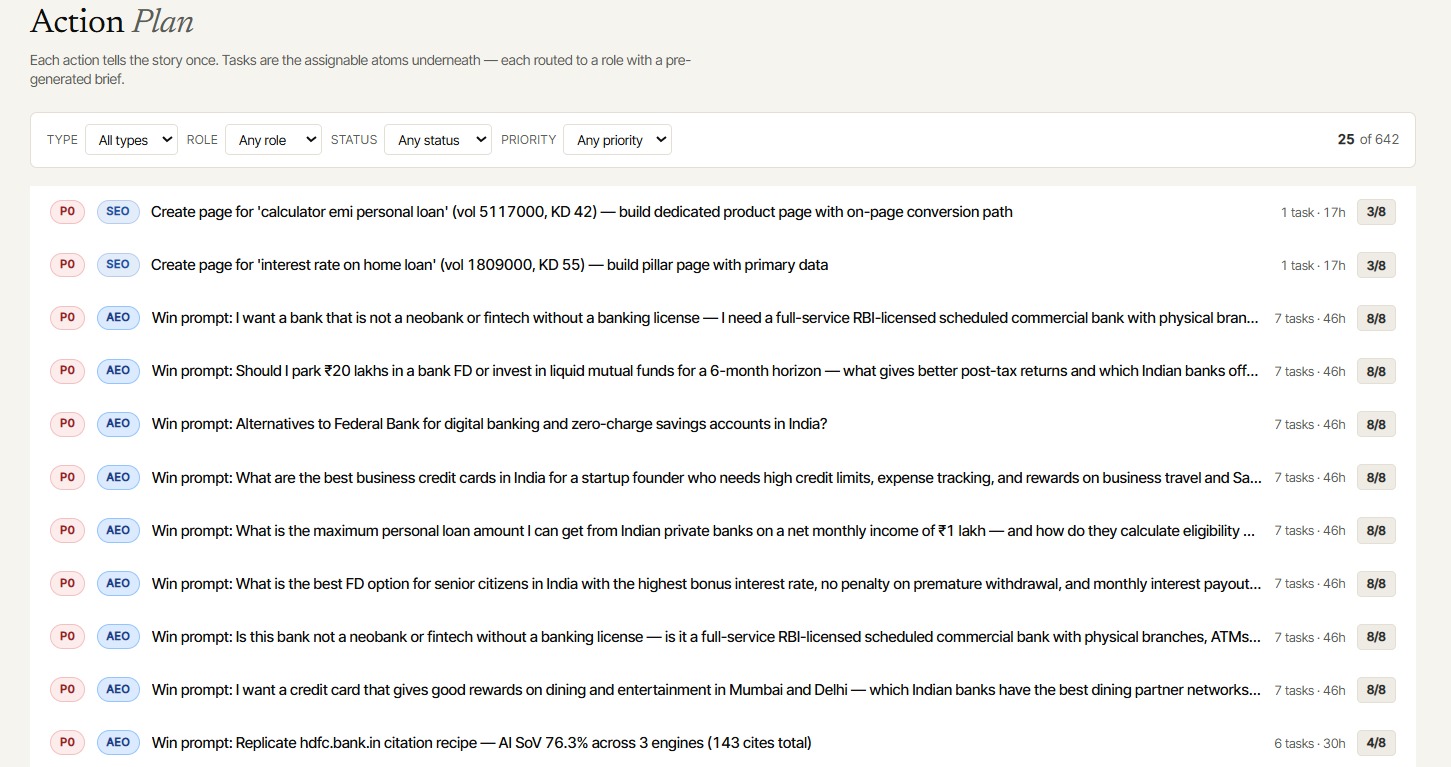
The findings in this guide are not borrowed. For each brand we track, the Visiby pipeline runs a full prompt library through ChatGPT, Perplexity, and Google AI Overviews and records which sources every engine cites. In our June 2026 run we tested 172 prompts across all three engines, 516 AI responses in total, and indexed 3,340 citation events spanning 1,174 domains. That work taught us one thing fast: traditional SEO tools cannot measure AI citations, because they count clicks on links, not synthesized mentions inside paragraphs.
It also taught us humility. On that same run, our own brand was cited 0% of the time, on ChatGPT, on Perplexity, and on Google AI Overviews. That is a first-run baseline in a young, unclaimed category, not a verdict, and it is exactly why we built the scorecard that was missing. Visiby tracks how often your brand is cited across ChatGPT, Perplexity, and Google AI Overviews, shows you which competitor was cited instead of you and why, and turns each gap into a weekly prioritised action plan, naming the exact page and passage to update. Most AI-visibility tools stop at a score. Visiby names the fix. See where you stand: visiby.net.
16 — FAQGenerative engine optimization: frequently asked questions
Related guides
- What Is AEO — Answer engine optimization explained, with an implementation playbook.
- AI Visibility Tools — How to measure citation share across ChatGPT, Perplexity, and Google AI Overviews.
- AI Citation Benchmark — Our multi-brand study of who AI engines actually cite, and why.
Arun Pandit is the founder of Visiby, an AI-visibility tracker by FNA Technology that measures how often ChatGPT, Perplexity, and Google AI Overviews cite a brand. He writes about generative engine optimization from the data Visiby collects across the brands it tracks. View full profile →