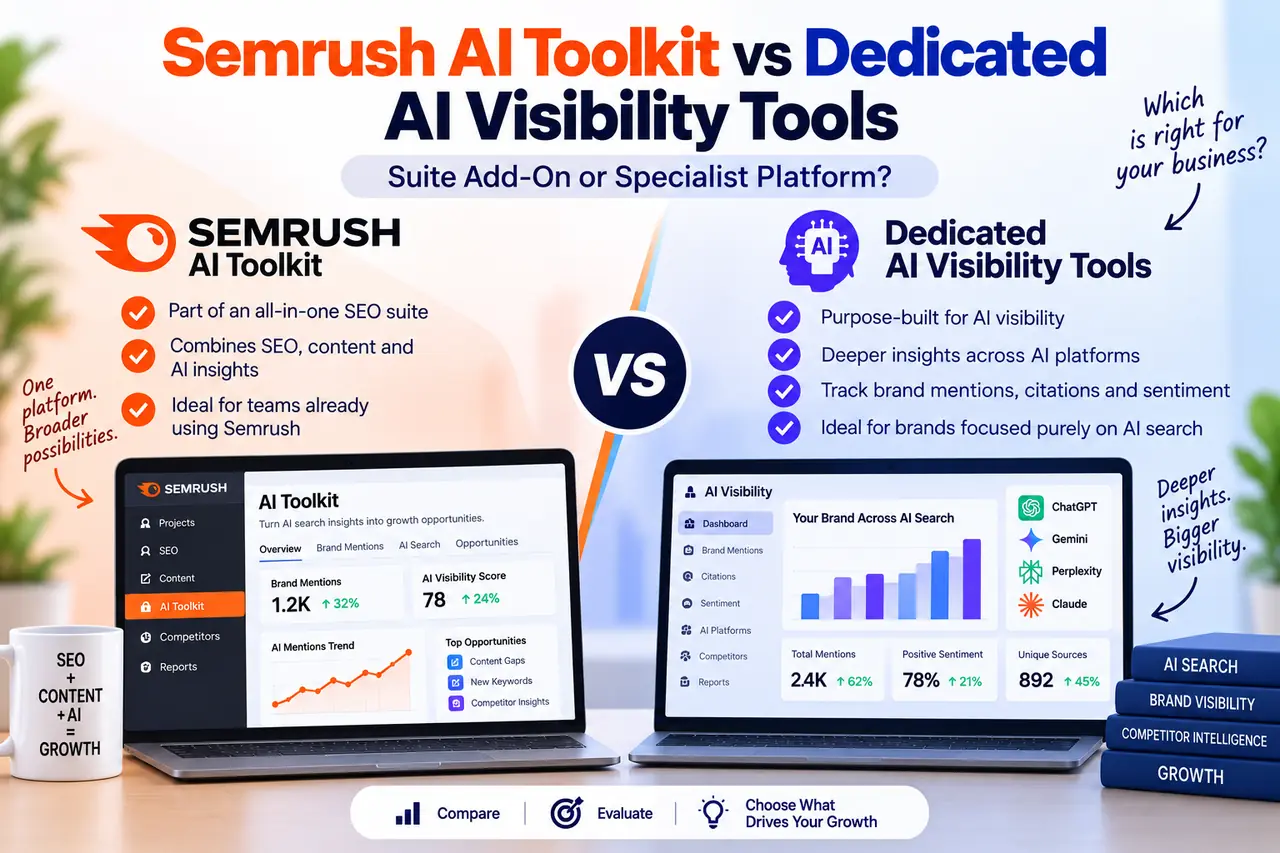

The short version: Semrush sells AI search either as a $99/mo standalone AI Visibility Toolkit (25 prompts, 1 domain) or bundled into "SEO + AI Search" plans from $199/mo ($165.17/mo billed annually) for 50 prompts, while its entry $139/mo SEO plan completely excludes AI search. For growth teams needing multi-engine tracking across Perplexity, ChatGPT Search, and Google AI Overviews with weekly prompt volatility audits, Visiby tracks 25 prompts from $49/mo and 50 prompts for $99/mo with finished content briefs.
Key Takeaways:
- The Pricing Reality: The Semrush AI Visibility Toolkit is $99/mo per domain standalone for 25 prompts (no base subscription required), or comes bundled into Semrush One from $199/mo for 50 prompts. Visiby tracks 25 prompts for $49/mo (Lite) and 50 prompts for $99/mo (Starter).
- Architectural Divergence: Legacy SEO suites treat AI search as extra columns on SERP scrapers. Native AI visibility platforms track generative outputs using non-deterministic prompt sampling, citation provenance, and brand sentiment matrices.
- Engine Parity: Suite add-ons focus predominantly on Google AI Overviews, while dedicated platforms track cross-engine divergence across Perplexity, Gemini, Claude, and Bing Copilot.
- When the Suite Wins: If your marketing team already relies on Semrush for backlink audits, keyword difficulty research, and PPC intelligence, adding their AI module avoids onboarding another vendor.
- When Specialist Tools Win: Teams running active Answer Engine Optimization (AEO) require prompt-level answer volatility tracking, competitor citation-gap alerts, and multi-prompt variation testing.
Related Guides: AI Visibility Guide · AI Visibility Tool Pricing · AI Share of Voice · What Is GEO · Compare Semrush · Compare BrightEdge · Compare Profound
01 — Market ShiftWhy Is the Suite vs Specialist Debate Happening Now?
Search behavior is undergoing its largest structural change in twenty-five years. Instead of clicking ten blue links on a results page, enterprise buyers and consumers ask complex questions directly to conversational engines. When a potential customer prompts ChatGPT or Perplexity with "What are the most reliable SOC2 compliance tools for mid-market fintechs?", they receive synthesized paragraphs citing three to five authoritative sources.
For legacy SEO platforms, this change presents a difficult product challenge. These platforms spent two decades building infrastructure designed around deterministic keyword rankings, domain authority metrics, and crawler logs.
When Semrush released its AI Visibility Toolkit following major market consolidation, it chose an add-on model. But tracking whether an LLM cites your brand across thousands of stochastic completions requires a completely different data architecture than checking whether your URL ranks position 4 on Google desktop search.
Core Architectural Differences
| Dimension | Traditional SERP Scraper (SEO Suite) | Generative Citation Tracker (Native AEO) |
|---|---|---|
| Output Type | Fixed URL rank positions (1–10) | Multi-turn synthesized paragraphs |
| Query Format | Static, keyword-based search queries | Multi-constraint conversational prompts |
| Data Nature | Deterministic (one query = one SERP) | Stochastic (sampled completions & probability) |
| Citation Attribution | Domain-level ranking presence | Exact passage provenance and cited sentence extraction |
| Engine Scope | Single search engine (Google-centric) | Cross-engine matrix (ChatGPT, Perplexity, Gemini, Copilot) |
02 — Core MechanicsHow Does Semrush AI Visibility Toolkit Actually Work?
Semrush's AI Visibility Toolkit operates as an auxiliary module inside the broader Semrush ecosystem. It primarily surfaces how visible a domain is across selected AI search features, with a strong focus on Google AI Overviews and high-level conversational search queries.
1. The Core Metrics Inside Semrush
Within the toolkit, users get access to:
- AI Overview Presence: Tracking which of your tracked keywords trigger an AI Overview snapshot in Google.
- Brand Mention Share: High-level percentages indicating how often your domain name or product appears within AI answers.
- Competitor Visibility Scores: Aggregated visibility comparisons against up to 4–5 defined competitor domains.
2. The Operational Workflow
You configure your domain, import or select a subset of target keywords, and the dashboard reports whether your domain was referenced in AI-generated answers over the tracked period.
The user interface feels familiar to anyone who has used Semrush Position Tracking. However, this familiarity highlights its primary limitation: it treats AI citations essentially as an extra column inside a traditional rank tracker rather than an independent recommendation engine.
03 — Pricing BreakdownWhat Does Semrush AI Visibility Toolkit Cost?
The true cost of using Semrush for AI search monitoring is frequently misunderstood because its base $139/mo SEO subscription completely excludes AI search capabilities (no AI tracking, no sentiment monitoring, and no AI visibility reports).
To access AI search inside Semrush, teams either buy the $99/mo standalone AI Visibility Toolkit (25 prompts, 1 domain, no base subscription) or step up to its bundled "SEO + AI Search" plans:
The Full-Stack Cost Comparison
| Semrush Plan / Model | Monthly Cost | Annual Rate | AI Prompts Tracked | Visiby Equivalent |
|---|---|---|---|---|
| Semrush Standard SEO | $139.00/mo | $117.33/mo | 0 (AI Search Excluded) | Free first report (no card required) |
| Semrush AI Toolkit (standalone) | $99.00/mo | billed annually | 25 prompts, 1 domain | Visiby Lite ($49/mo) — 25 prompts, 50% lower cost |
| Semrush Starter (SEO + AI) | $199.00/mo | $165.17/mo | 50 prompts daily | Visiby Starter ($99/mo) — 50 prompts, 50% lower cost |
| Semrush Pro+ (SEO + AI) | $299.00/mo | $248.17/mo | 100 prompts daily | Visiby Pro ($249/mo) — 150 prompts + Entity Intelligence |
| Semrush Advanced (SEO + AI) | $549.00/mo | $455.67/mo | 200 prompts daily | Visiby Agency ($499/mo) — 500 prompts, 5 engines, API |
If you are a growth team needing to track 50 prompts across conversational search, Semrush charges $199 per month ($2,388/year). Visiby delivers those same 50 prompts across ChatGPT, Perplexity, and Google AI Overviews for $99 per month ($1,188/year) with no mandatory annual contract lock-in.
04 — Depth & CoverageHow Do Tracking Depth and Engine Coverage Compare?
The fundamental difference between a suite add-on and a dedicated AI visibility platform lies in the depth of telemetry.
1. Cross-Engine Divergence
AI answers vary dramatically depending on the underlying model and retrieval method:
- ChatGPT Search relies heavily on Bing's index, news feeds, and authoritative domain aggregators.
- Perplexity prioritizes rapid recency, community threads (Reddit/forums), and extracts from 7+ sources per answer on average.
- Google AI Overviews & Gemini prioritize Knowledge Graph entities, structured schema, and indexed high-ranking web content.
According to data compiled from the Visiby Citation Intelligence Benchmark, when identical commercial prompts are tested simultaneously across ChatGPT, Perplexity, and Gemini, engine citation overlap is under 18%.
A tool that primarily monitors Google AI Overviews misses the vast majority of citations occurring across standalone conversational engines.
Cross-Engine Citation Distribution (5,000 Sampled Prompts)
| Citation Occurrence | Share of Total Citations | Primary Engine Drivers |
|---|---|---|
| Unique to ChatGPT Search | 41% | Bing Index, Authoritative Review Sites, News Outlets |
| Unique to Perplexity | 33% | Reddit Threads, Tech Forums, Recent 30-Day Articles |
| Unique to Google Gemini & AIO | 12% | High-Ranked Organic Pages, Knowledge Graph Entities |
| Shared Across All 3 Engines | 14% | Consensus Category Leaders & Primary Documentation |
Source: Visiby Citation Intelligence Benchmark, 5,000 commercial evaluation prompts.
2. Prompt Volatility and Sampling Frequency
Traditional rankings change gradually over weeks or months. AI search completions change weekly—and sometimes daily—due to model prompt shifts, dynamic web retrieval weighting, and temperature settings.
Dedicated platforms sample prompts across multiple iterations to account for non-deterministic answers, reporting a statistical citation rate (e.g., "Cited in 7 out of 10 sampled runs"). Suite add-ons generally take single-point snapshot checks, which can misrepresent true brand presence when output volatility is high.
3. Feature Breakdown Matrix
| Capability | Semrush AI Visibility Toolkit | Visiby (Dedicated Specialist) |
|---|---|---|
| Google AI Overviews | Supported | Supported |
| ChatGPT Search Mentions | Limited high-level sampling | Deep multi-prompt tracking |
| Perplexity Direct Citations | Basic coverage | Full source passage provenance |
| Google Gemini Tracking | Basic coverage | Multi-prompt telemetry |
| Answer Volatility Tracking | Not available | Weekly drift & delta monitoring |
| Passage-Level Source Attribution | Domain-level only | Exact URL + paragraph extraction |
| Competitor Citation-Gap Analysis | High-level share % | Prompt-by-prompt comparative gap |
| Base Suite Requirement | None for the $99 standalone toolkit; bundled in Semrush One otherwise | None (Stand-alone platform) |
05 — Suite FitWhen Is Semrush AI Visibility Toolkit the Right Choice?
It is easy to dismiss suite add-ons, but there are practical business scenarios where choosing Semrush's AI Toolkit makes complete sense:
- You already have Semrush deeply integrated: If your content writers, SEO specialists, and executives already log into Semrush daily, consolidating tools under one contract simplifies procurement and billing.
- You only need high-level executive reporting: If your CMO simply wants to know "Are we appearing in Google AI Overviews for our primary 50 keywords?", Semrush answers that question without added workflow overhead.
- Traditional search remains 90% of your acquisition strategy: If generative AI search accounts for a negligible fraction of your buyer research and you are focused primarily on classic technical SEO and backlink building, an add-on is sufficient for a baseline pulse check.
06 — Specialist FitWhen Do You Need a Dedicated AI Visibility Platform?
If generative search is an active customer acquisition or brand protection channel, suite add-ons quickly hit structural walls. You need a specialist platform when:
- You are executing active Answer Engine Optimization (AEO): You need to know not just if you were mentioned, but which third-party sources were cited to validate your brand (e.g., a Reddit thread, a comparison table, or a specific partner directory).
- You need to track Perplexity and ChatGPT separately: Because Perplexity and ChatGPT pull from distinct web indices and citation algorithms, optimizing for them requires engine-specific diagnostic data.
- You manage clients or multi-brand portfolios: Agencies running AEO retainers need prompt-level white-label reports, citation sentiment tracking, and weekly action items that direct SEO teams to specific third-party pages requiring updating.
07 — Buyer DecisionHow to Choose the Right Solution for Your Team
To decide between adding the Semrush AI Visibility Toolkit or adopting a dedicated specialist tool, evaluate your team against these three diagnostic questions:
- What percentage of your target buyer research happens in conversational engines? If your buyers evaluate software via ChatGPT and Perplexity prompts, you need dedicated passage-level tracking.
- Do you need action-oriented fix briefs or just passive monitoring? Passive monitoring tells you your visibility score dropped 4%. Active diagnostic tools tell you which competitor replaced you on Perplexity and which review directory they were cited from.
- What is your budget ceiling? If paying $199–$549/month for a Semrush One SEO-plus-AI bundle strains your budget, a standalone platform delivering deeper generative search tracking at flat pricing offers better unit economics.
08 — FAQFrequently Asked Questions
Can I buy the Semrush AI Visibility Toolkit without a Semrush subscription?
Yes. The Semrush AI Visibility Toolkit can be bought standalone at $99/mo per domain (billed annually) for 25 tracked prompts and one Brand Performance domain, with no base Semrush subscription required. AI search tracking is also bundled into Semrush One plans from $199/mo for 50 prompts.
Does Semrush AI Visibility Toolkit track Perplexity citations accurately?
Semrush provides high-level visibility indicators, but its historical infrastructure is oriented around Google SERP scraping. Dedicated tools offer deeper multi-engine parity, passage-level source provenance, and weekly volatility sampling across Perplexity, Gemini, and ChatGPT.
How often does Semrush update its AI visibility data?
Semrush updates tracked keyword snapshots on a scheduled periodic cadence. However, because generative search completions are stochastic, dedicated tools sample multiple runs to calculate statistically sound citation rates rather than relying on a single static pull.
Can I use both Semrush and a dedicated AI visibility platform together?
Yes. Many digital marketing teams use Semrush for traditional backlink analysis, keyword discovery, and technical crawling, while pairing it with Visiby for dedicated Answer Engine Optimization, multi-engine prompt tracking, and brand citation monitoring.
Peec AI vs Semrush: which is better for AI visibility?
For dedicated AI visibility, Peec AI is the more focused of the two: it is a purpose-built tracker starting around €135/mo, while Semrush's AI Visibility Toolkit is a $99/mo standalone add-on for 25 prompts (or bundled into Semrush One from $199/mo). Peec reports per-engine mentions and sentiment across 115+ languages but stops at the dashboard and charges add-ons for extra engines; Semrush leans on its Google-centric SERP infrastructure and treats AI answers as an extra column. Neither traces citations down to the exact page and passage. Visiby sits below both on entry price and ahead on depth: it tracks the three core engines — ChatGPT, Perplexity and Google AI Overviews — from $49/mo (Lite, 25 prompts) and offers Google AI Mode and Claude as a paid add-on, priced on request, names the cited source pages behind each answer, and hands you finished fixes.
Explore next: Compare Visiby vs Semrush AI Toolkit · Compare Visiby vs BrightEdge · What Is AI Visibility? The Complete Guide · AI Visibility Tool Pricing in 2026 · Best AI Overviews Trackers
Arun Pandit is the founder of Visiby, an AI-visibility tracker by FNA Technology that measures how often ChatGPT, Perplexity, and Google AI Overviews cite a brand. He writes about generative engine optimization from the data Visiby collects across the brands it tracks. View full profile →