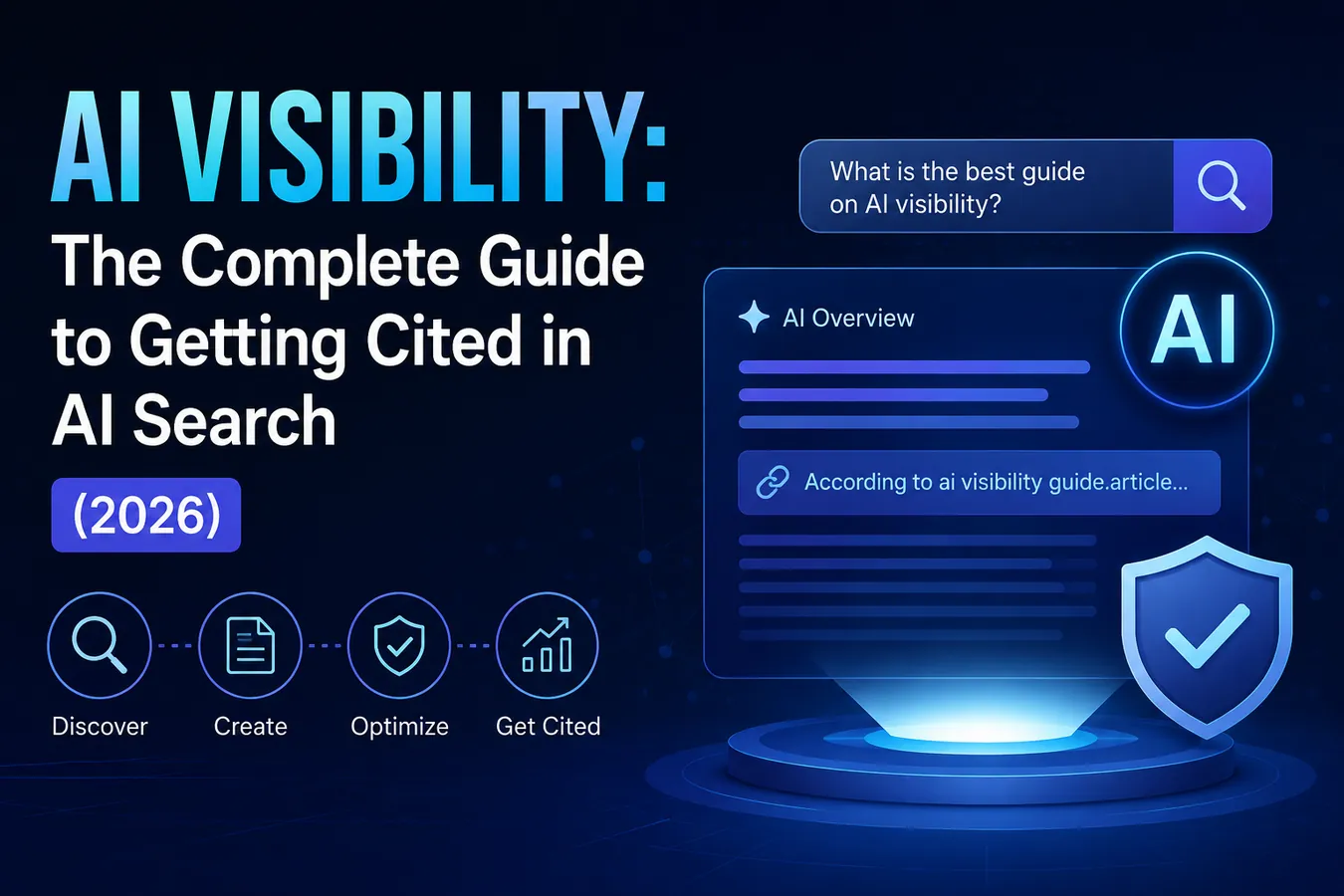

Key Takeaways: Ranking #1 on Google no longer guarantees AI visibility. ChatGPT overlaps with Google's top 10 by just 2.1%. AI search visitors convert 4.4× better than organic. This guide covers what AI visibility is, how to measure it, and how to grow it.
Related Guides: Generative Engine Optimization (GEO) · Answer Engine Optimization (AEO) · robots.txt for AI crawlers · How to write llms.txt
As more people turn to AI platforms like ChatGPT and Google AI Mode to find products, compare options, and make decisions, appearing in traditional Google results is no longer enough.
Your brand can hold position one on Google and still be completely invisible to the buyer who typed their question into ChatGPT. That gap is AI visibility — and in 2026 it is one of the fastest-growing blind spots in digital marketing.
ChatGPT now has 910 million weekly active users, while Google AI Overviews reach 2 billion monthly users across 200+ countries. Buyers on these platforms read a synthesized answer — and the brands cited in that answer win the attention.
01 — DefinitionWhat is AI visibility?
AI visibility is how often your brand is mentioned, cited, or recommended in AI-generated responses across platforms like ChatGPT, Perplexity, and Google AI Overviews. It is not a ranking position. Your brand either appears in the AI's answer or it does not.
Think of it this way: traditional SEO asks where do I rank in Google's results? AI visibility asks a different question entirely: does the AI mention me when someone asks about my topic?
As of early 2026, 48% of tracked Google queries now trigger an AI Overview — a 58% year-over-year increase. For question-based queries the trigger rate climbs to nearly 58%. Standalone AI platforms are growing just as fast.
02 — Why It MattersWhy AI visibility matters in 2026
AI visibility is not a speculative future concern. It is a measurable gap right now — and three numbers prove it.
AI search visitors convert at a dramatically higher rate. Semrush research estimates that AI search visitors convert 4.4 times better than traditional organic search visitors. AI platforms answer broad informational queries directly, so users who click through a cited link arrive as high-intent buyers ready to evaluate or purchase.
Traditional organic click-through rates are falling sharply. The overall zero-click rate across Google searches has reached 58%. When users engage with Google AI Mode, that rate climbs to 93%. AI Overviews reduce organic click-through rates by an average of 61% for the organic results below them.
Ranking on Google does not mean appearing in AI answers. A Semrush study compared exact pages ranking in Google's top 10 against pages cited by four AI platforms across 10 SaaS queries. Only 44.3% of Google top-10 pages appeared in at least one AI-generated answer. ChatGPT overlapped with Google's top 10 by just 2.1%.
We see this pattern constantly in Visiby's data. Brands with strong domain authority and page-one rankings are frequently invisible in AI answers — not because their SEO is wrong, but because their content isn't formatted for passage extraction. That's a fixable problem, and it's the whole point of this guide.
03 — AI vs SEOHow AI visibility differs from traditional SEO
| Factor | Traditional SEO | AI Visibility |
|---|---|---|
| Primary metric | Ranking position (1–10) | Citation presence (yes/no) |
| User action | Click link to visit website | Read synthesized answer in-platform |
| Content unit | Full web pages | Self-contained 40–80 word passages |
| Success signal | Higher rank = more clicks | More citations = more brand exposure |
| Key signals | Backlinks, keyword placement | Passage structure, factual density, entity trust |
Traditional SEO and AI visibility are not competing priorities. In Visiby's August 2026 benchmark of 172 buyer prompts across three engines, pages ranking in Google's top 5 were cited by AI engines at nearly 3× the rate of pages ranking positions 6–10. Strong organic foundations still matter — they just aren't sufficient on their own anymore.
04 — Citation SignalsHow AI search engines decide what to cite
AI search platforms use two retrieval mechanisms when composing an answer.
Parametric memory is static knowledge embedded during model training. Established brands with years of digital PR and documented expertise enjoy a strong baseline here — but this knowledge has a training cutoff and cannot reflect recent pricing or product updates.
Retrieval-Augmented Generation (RAG) is real-time web search invoked when a query requires current facts or comparisons. PerplexityBot, GPTBot, and Google's crawlers fetch live pages, parse text passages, and synthesize answers grounded in cited web sources. In benchmark research on Generative Engine Optimization (GEO), researchers from Princeton, Georgia Tech, and Allen AI demonstrated that adding concrete statistics, authoritative citations, and factual quotes increases a domain's visibility in synthesized generative answers by up to 40%.
Each major platform has a distinct citation style:
- ChatGPT: Numbered inline references. Favors domain authority and factual density.
- Perplexity: Direct source links with snippets. Favors content freshness and community depth.
- Google AI Overviews: Integrated links in synthesized answers. Favors schema markup and E-E-A-T signals.
- Claude: Referenced context from web search. Favors source quality and content clarity.
- Gemini: Blended Google Search citations. Favors traditional SEO signals plus freshness.
The common thread across every platform: authoritative, well-structured, factually dense, and recently updated content earns more citations. Google's own Search documentation describes the same quality signals, making strong technical foundations the bedrock of both traditional and AI search visibility.
05 — Crawler AccessThe AI crawler access problem
With 85% of top 1,000 news sites now blocking at least one major AI bot, brands that allow crawling face significantly less competition for citations. If GPTBot, PerplexityBot, ClaudeBot, or Google-Extended are blocked in your robots.txt, those engines cannot index your content for real-time answers.
Allowing AI crawlers is a prerequisite for AI visibility, and the first step in how to get your business recommended by AI. It is also one of the simplest technical wins available — and most brands have not checked it.
06 — MeasurementHow to measure your AI visibility
You cannot look up an AI citation the way you check a keyword ranking. You have to go ask the engines directly — which means defining a prompt list and tracking it consistently.
Step 1: Define your platforms and prompt list. Start with the platforms your audience actually uses. Review your GA4 referral traffic for sessions from chatgpt.com, perplexity.ai, and claude.ai to see which engines already send you visitors. Then build a prompt list across three stages of the buying journey:
- Research: "What is [category]," "how does [topic] work," "best practices for [use case]"
- Comparison: "[Your brand] vs [competitor]," "best tools for [activity]," "alternatives to [product]"
- Evaluation: "Is [product] worth it," "[product] pricing," "pros and cons of [product]"
The People Also Ask box in Google and top-voted threads in relevant subreddits surface the exact natural-language questions your audience is already asking — and these map closely to how buyers phrase prompts in AI engines.
Step 2: Track four core metrics per prompt. For each prompt across each platform, record whether your brand is mentioned, whether the answer includes a link to your site, where in the response your brand appears relative to competitors, and whether the context is positive, neutral, or negative. Over time, these roll up into your AI Share of Voice — the percentage of relevant AI answers that include your brand.
Step 3: Choose manual tracking or a dedicated tool. Manual tracking works for small prompt lists — run each prompt weekly and log results in a spreadsheet. Dedicated AI visibility tools are necessary for anything beyond 20 to 30 prompts. They track citation frequency, share of voice, sentiment, and competitive gaps across multiple platforms automatically at a cadence manual testing cannot match.
Pairing these insights with Visiby's AI citation tracking lets you measure your share of voice and identify exactly which competitors are being recommended when your brand is absent.
07 — ImprovementHow to improve your brand's AI visibility
08 — Content StrategyContent: Structure every page for passage extraction
AI engines do not read a page from top to bottom. They extract discrete passages to answer specific queries, so each section must stand on its own.
- Answer first: Open every section with a direct 40-to-60-word answer to the heading's question. State the core fact in the first sentence, then follow with supporting data.
- Question-format headings: Frame every H2 and H3 as the exact question your audience types into an AI engine.
- Structured summary at the top: Semrush's internal experiment found that adding a comparison table directly after the introduction increased ChatGPT citations by 21.6% and overall citations by 16.1% within four weeks.
- Increase fact density: Include a specific statistic or quantified claim every 150 to 200 words, each linked to its primary source. AI engines favor content that demonstrates factual rigor through cited research.
- Build FAQ sections: Add 5 to 10 question-and-answer pairs at the bottom of every pillar article, with self-contained 40-to-60-word answers each, and apply
FAQPageJSON-LD schema markup. - Keep content fresh: Seer Interactive research found that nearly 90% of pages crawled by AI bots were published within the last three years. Review high-priority pages monthly to update statistics and expand sections.
09 — TechnicalTechnical: Give AI crawlers full access
Clean technical architecture is essential for AI indexation. Google's Search documentation describes the same crawl-access requirements that apply to AI engines.
- robots.txt: Explicitly allow
GPTBot,PerplexityBot,ClaudeBot, andGoogle-Extended. - Schema markup: Deploy
Article,FAQPage,BreadcrumbList, andProductJSON-LD on all relevant pages. - Server-side rendering: Content hidden behind JavaScript may not be accessible to AI crawlers. Ensure primary content renders server-side.
- Page speed: Target under 3 seconds for full page load to prevent crawler timeouts during real-time retrieval runs.
- llms.txt: Maintain a root
/llms.txtfile summarizing your site's core resources and documentation links for AI ingestion. See our step-by-step llms.txt guide for the exact format. - robots.txt for AI bots: Check which crawlers you're currently allowing or blocking — our robots.txt for AI crawlers guide has the full user-agent list.
10 — Off-PageOff-page: Build entity authority across the web
AI engines do not evaluate web pages in isolation. They cross-reference third-party sources to validate brand claims. A brand that appears consistently across credible independent sources earns stronger entity recognition and more citations.
- Third-party reviews: Maintain active, updated profiles on G2, Capterra, Trustpilot, and Google Business Profile.
- Editorial coverage: Reach out to industry publications and make your product easy for reviewers to evaluate. Independent detailed reviews — particularly those updated regularly — are among the most-cited content types in AI answers.
- Original research: Publish first-party data only your brand can provide. Studies and benchmarks give other publishers something specific to reference, generating natural brand co-occurrences across authoritative domains.
- Listicle inclusion: Earning inclusion in third-party "best of" comparison articles directly feeds LLM recommendation lists.
- Consistent brand messaging: If your homepage, about page, and social profiles use different language to describe what you do, AI engines piece together an inconsistent picture of your brand. Audit all owned properties and directory listings for unified messaging.
11 — MistakesCommon AI visibility mistakes to avoid
Most brands make the same five mistakes. All of them are fixable in an afternoon:
- Blocking AI crawlers: Preventing
GPTBotorPerplexityBotinrobots.txtremoves your content from real-time retrieval entirely. - Vague, unverified content: Generic phrases with no data points are rarely extracted by AI models designed to minimize hallucination risk.
- No schema markup: Missing
FAQPageandArticleJSON-LD means AI engines must guess at your content structure rather than parsing it cleanly. - Tracking only Google rankings: Monitoring traditional search positions without measuring AI citation share leaves the majority of the visibility picture invisible.
- Inconsistent brand naming: Different product names or descriptions across web properties cause AI engines to build a fragmented, inaccurate entity profile.
12 — TimelineHow long does improving AI visibility take?
Expect 30–60 days before the first citation changes appear. Unlike paid advertising, AI citation authority compounds — so the work you do in month one pays off in month three.
Initial citation improvements often appear within 30 to 60 days after updating content structure, allowing AI crawlers, and adding schema markup. Meaningful share-of-voice gains against established competitors typically build over 60 to 90 days as authority signals accumulate.
The leading indicator to watch is branded search volume in Google Search Console. As AI citations increase, more users search for your brand by name after encountering it in an AI answer — creating a measurable downstream signal you can track in parallel with your citation data.
13 — FAQAI visibility: frequently asked questions
Arun Pandit is the founder of Visiby, an AI-visibility tracker by FNA Technology that measures how often ChatGPT, Perplexity, and Google AI Overviews cite a brand. He writes about generative engine optimization from the data Visiby collects across the brands it tracks. View full profile →