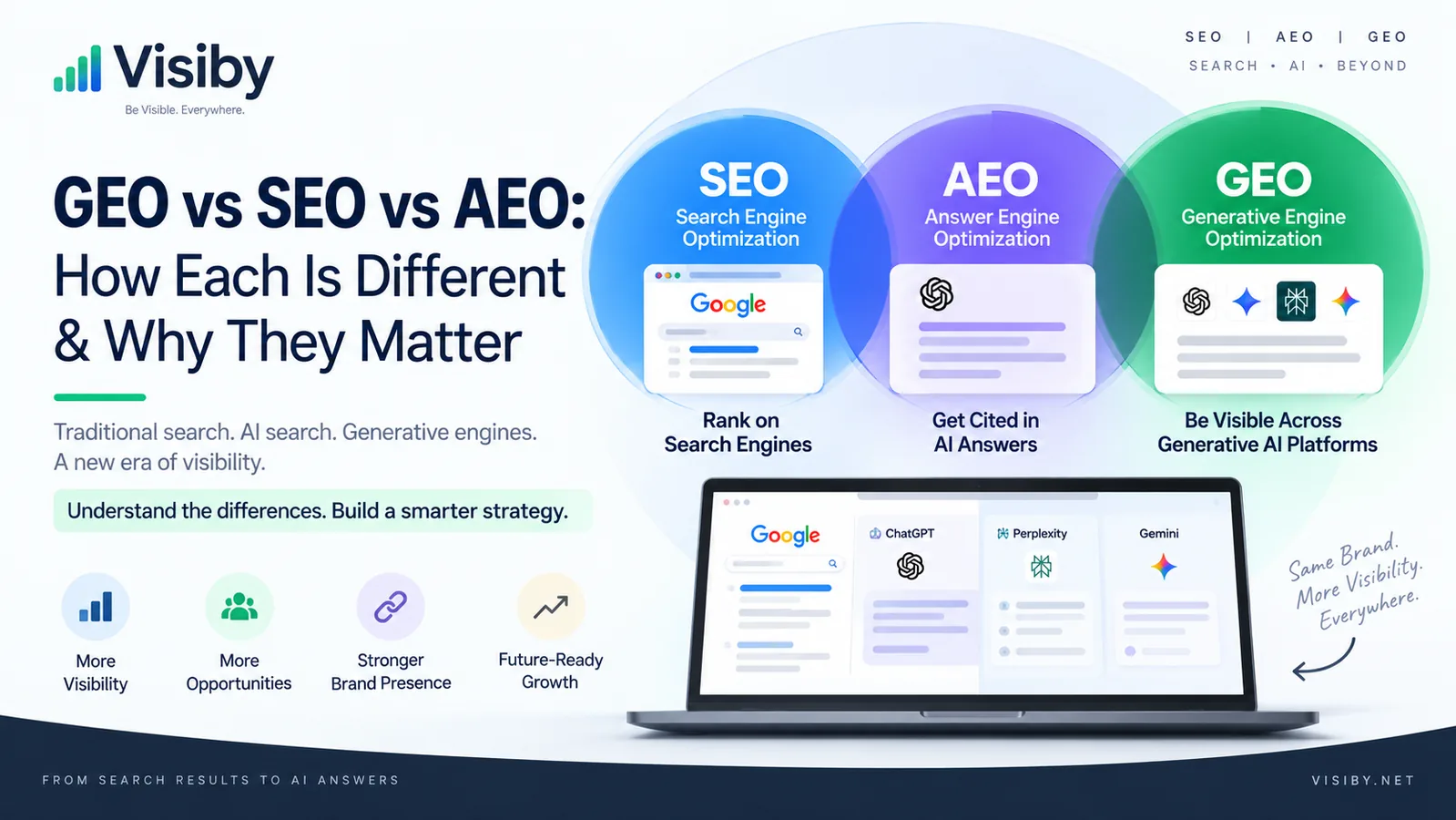

GEO vs SEO vs AEO, in short: SEO gets your page ranked in search results. AEO gets your content picked as the direct answer to a question. GEO gets your brand or page named and cited inside AI answers. All three rest on the same base: pages that search systems can find, read and trust.
If you only have time for one thing, fix the SEO basics first. Then write each page so its answers are easy to quote, and check what AI tools say about your topic.
01 — DefinitionsWhat do SEO, AEO and GEO mean?
SEO (search engine optimization) is the work of getting your pages crawled, indexed and ranked in Google and Bing, so people click through to your site.
AEO (answer engine optimization) is the work of shaping content so a search or answer engine can lift it as the answer to a question. Think of featured snippets, People also ask boxes and voice answers. Our glossary has a longer definition of AEO.
GEO (generative engine optimization) is the work of getting your brand named, and your pages cited, in answers written by AI tools such as ChatGPT, Gemini, Perplexity and Google AI Overviews. The term comes from a 2023 research paper. Here GEO never means geographic or local SEO. For more, read what is GEO.
For the practical steps behind all three, see our guide to improving AI search visibility.
02 — ComparisonHow are SEO, AEO and GEO different?
The three differ in what they target, where you show up and how you measure success.
| Aspect | SEO | AEO | GEO |
|---|---|---|---|
| What it targets | Ranking pages in search results | Being picked as the direct answer to a question | Being named or cited inside AI-written answers |
| Where you show up | Google and Bing organic results | Featured snippets, People also ask boxes, voice answers | ChatGPT, Gemini, Perplexity, Google AI Overviews and AI Mode |
| How you measure it | Rankings, impressions, clicks and conversions | How often your page is shown as the answer for target questions | How often you are named or cited across a fixed set of AI questions |
The lines between them are blurry. HubSpot's Zoe Ashbridge calls the difference between AEO and GEO "mostly terminological", and many marketers use the two terms for the same work.
03 — SEO vs GEOIs GEO just SEO with a new name?
Partly. Google's own guide to AI features says: "The best practices for SEO remain relevant for AI features in Google Search (such as AI Overviews and AI Mode)." It also says: "To be eligible to be shown as a supporting link in AI Overviews or AI Mode, a page must be indexed", and that you "don't need to create new machine readable files, AI text files, or markup to appear in these features."
What changes is the result you are aiming for. Mike King of iPullRank told Digiday that traditional search is mainly a referral traffic channel, while AI search works more like a branding channel. In an AI answer, being named can matter even when nobody clicks.
Google's guidance covers Google only. ChatGPT, Gemini, Perplexity and other tools find and cite pages in their own ways, so check each one rather than assuming.
04 — The ResearchWhat did the original GEO paper test?
The paper that named GEO, "GEO: Generative Engine Optimization" by Pranjal Aggarwal and five co-authors, was first posted on arXiv in November 2023 and last updated in June 2024.
- What they changed: they rewrote source pages in nine ways, such as adding statistics, adding quotations, citing sources, making the text easier to read and stuffing in keywords.
- What they measured: how much of the AI answer was taken from each source, weighted by how early it appeared, plus an AI-scored rating of how prominent the source felt.
- What they found: adding statistics or quotations worked best, with visibility gains of up to about 40% in their test set. Keyword stuffing did not help.
Treat that number with care. The researchers picked a source that had already been retrieved and measured how much of it reached the answer. So the result does not show that a page will be picked as a source in the first place. It also comes mainly from their own test engine (they ran a smaller test on Perplexity), not from live tracking of ChatGPT or Google.
05 — AI CheckWhat did AI tools say when we asked?
We asked ChatGPT and Gemini five beginner questions about GEO, AEO and SEO on 23 October 2026, signed out, from India. Here is what came back.
| Question we asked | Tool | Sources cited |
|---|---|---|
| What is the difference between GEO, AEO and SEO, explained simply? | ChatGPT | HubSpot Blog; INDIRAP |
| What is the difference between GEO, AEO and SEO, explained simply? | Gemini | MakeOlix; Medium |
| Is generative engine optimization really different from SEO, or is it just a new buzzword? | ChatGPT | arXiv (2 papers); Google Search Central (3 pages) |
| Is generative engine optimization really different from SEO, or is it just a new buzzword? | Gemini | SEO.com; Jasper; Reddit |
| How is getting cited in AI chatbot answers different from ranking in normal search results? | ChatGPT | Google Search; Google Search Central (4 pages); OpenAI API docs |
| How is getting cited in AI chatbot answers different from ranking in normal search results? | Gemini | dotCMS; AdLift; Surface Labs |
| What does answer engine optimization mean, and how is it different from GEO? | ChatGPT | HubSpot Blog; TechnologyAdvice |
| What does answer engine optimization mean, and how is it different from GEO? | Gemini | Adobe; Medium; Archetype; Reddit |
| Do I need separate strategies for SEO, AEO and GEO, or does one cover all? | ChatGPT | Google Search Central (2 pages); Google Search Central Blog |
| Do I need separate strategies for SEO, AEO and GEO, or does one cover all? | Gemini | Nexus Media Solution; NON.agency; Terra; Searchable |
- ChatGPT cited Google Search Central in 3 of its 5 answers. It cited a HubSpot article on AEO vs GEO in 2 of 5.
- Gemini cited a Medium post in 2 of its 5 answers and Reddit in 2 of 5. It cited no Google documentation.
- 3 of the 10 answers said outright that you should run the three as one strategy: ChatGPT for questions 4 and 5, and Gemini for question 5.
- Three ChatGPT answers said special AI files or markup are not needed, or do not guarantee a place in AI answers.
AI answers change from day to day, so this is a snapshot of one day: it shows what appeared, not why.
06 — Old and NewWhat carries over from SEO, and what is new
What carries over:
- Pages must be crawlable and indexed.
- Clear headings and plain answers help both rankings and AI answers.
- Authority still counts: named sources, real expertise and mentions on other sites.
What is new:
- The goal is to be named or cited inside the answer, not only to rank.
- AI answers pull short passages from several pages, so each section should answer its question on its own.
- Results change between runs and tools, so you track a fixed set of questions over time instead of one ranking.
Is SEO dead?
No. AI tools build their answers from web pages, and the pages they draw on are indexed, readable, well structured and trusted. Those are SEO outcomes. What changed is that ranking is no longer the whole job, because a buyer can get an answer without seeing a list of links.
For some questions, the answer now sits on the results page, so the searcher may not need to click. For questions that end in hiring someone, the buyer still has to reach a real business. The bigger risk is measuring only clicks: you see them dip on informational pages and miss that you are left out of the answers that matter.
If you are deciding where to start, see Do you need three strategies? below: it is one plan with three checks, and SEO is still the first.
Does Google penalize AI content?
Not for being written with AI. Google's guidance on AI-generated content says it rewards helpful, reliable content however it is produced, and that using automation mainly to manipulate rankings breaks its spam policies. So the test is the page, not the tool: does it answer the question better than the page that wins it now, and does it contain something a summary could not replace? Mass-produced pages usually fail that test, whoever writes them.
07 — One StrategyDo you need three strategies?
No. You need one strategy with three checks:
- Can Google find and index the page?
- Does the page answer the question in its first two sentences?
- Do AI tools name you and cite your page?
To put that into practice:
- Check that your key pages are indexed and can show a snippet in Google.
- Put a one- or two-sentence answer at the top of each section, then the detail.
- Back each claim with a named source, a date or your own data.
- Ask the AI tools your customers use the questions they ask, signed out, and write down who is named and which sites are cited.
- Repeat the same questions each month, so you compare like with like.
08 — MeasurementHow do you measure GEO without rankings?
Use a fixed list of questions and count what comes back:
- Mention rate: the share of answers that name your brand.
- Citation rate: the share of answers that link to one of your pages.
- Position in the answer: whether you are named first, in the middle or last.
- Share of voice: your mentions as a share of all brand mentions in those answers.
For Google, Search Console counts AI Overviews and AI Mode traffic inside the normal "Web" search type. Since June 2026, Google has also offered a separate Search Generative AI performance report that shows impressions in AI Overviews and AI Mode. It has been available to all sites since 31 August 2026.
09 — MistakesCommon mistakes
Treating GEO as a trick. Google says you do not need AI text files or special markup for its AI features, so adding them will not get you into AI Overviews.
Keyword stuffing. In the GEO paper's tests, stuffing keywords into a page gave little or no gain in AI answers.
Judging from one answer. AI answers change between runs. In our own checks, ChatGPT showed the same HubSpot article with two different dates 7 minutes apart.
Dropping SEO for GEO. If Google cannot index a page, it cannot be a supporting link in AI Overviews either.
10 — FAQFrequently asked questions
11 — Free CheckSee where your brand shows up in AI answers
Want to know whether ChatGPT names your brand for the questions your buyers ask? Run the free check.
12 — SourcesSources
- Google Search Central, AI features and your website, checked 23 October 2026.
- Google Search Central, Google's guide to optimizing for generative AI features on Google Search, checked 23 October 2026.
- Google Search Central Blog, Introducing Search Generative AI performance reports in Search Console, June 2026.
- Aggarwal et al., arXiv, GEO: Generative Engine Optimization, November 2023, updated June 2024.
- HubSpot, Zoe Ashbridge, AEO vs. GEO explained: What marketers need to know now, updated 4 September 2026.
- Google Search Central Blog, Google Search's guidance about AI-generated content, February 2023.
- Digiday, GEO hype busted: How it differs (and how it doesn't) from SEO, 10 March 2026.
Arun Pandit is the founder of Visiby, an AI-visibility tracker by FNA Technology that measures how often ChatGPT, Perplexity, and Google AI Overviews cite a brand. He writes about generative engine optimization from the data Visiby collects across the brands it tracks. View full profile →