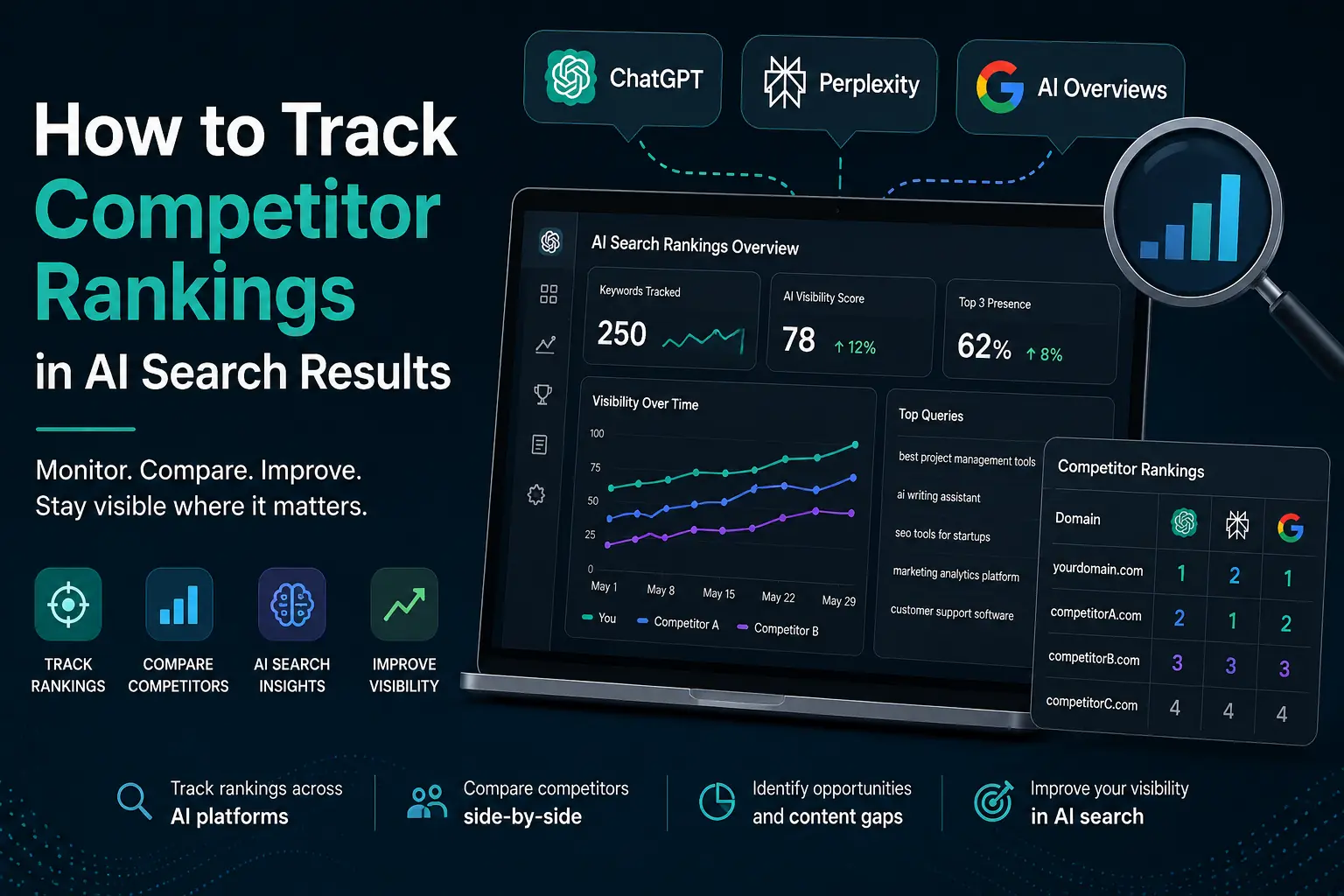

Key Takeaways: Tracking competitor rankings in AI search requires measuring prompt-level share of voice across ChatGPT, Perplexity, and Google AI Overviews rather than static SERP positions. Using a structured competitor audit matrix, teams can identify displacement patterns, reverse-engineer cited competitor URLs, and automate tracking to counter rapid AI answer volatility.
Related Guides: Learn why continuous tracking is essential in our AI Answer Volatility Study and explore dedicated tracking platforms in our AI Visibility Tools Benchmark.
To track competitor rankings in AI search results effectively, marketing teams must monitor conversational recommendation share and cited footnote URLs across ChatGPT, Perplexity, and Google AI Overviews. Traditional rank trackers only check static 10-blue-link SERPs, leaving brands blind to which competitors are recommended inside generative answers.
When a prospective customer asks an AI engine for "the top 5 alternatives to [Competitor]" or "best enterprise billing software," the engine delivers a synthesized recommendation list. Being omitted from that answer while your competitor is highlighted directly costs you pipeline before the buyer ever visits a traditional search results page.
This step-by-step playbook provides a structured framework to audit competitor mentions, calculate your comparative AI Share of Voice, and reverse-engineer the exact pages competitors use to win citations. Pair it with how to read an AI visibility report.
01 — Why SEO Tools FailWhy traditional competitor rank tracking fails in AI search
Traditional SEO competitor tools (like Ahrefs or Semrush) track static domain rankings: Domain A ranks #2 on Google for a keyword, while Domain B ranks #5.
Generative AI search operates on a fundamentally different paradigm:
- Unstructured text recommendations: AI models summarize product categories in conversational prose. Competitor A might be named as the "market leader for enterprises," while Competitor B is described as "budget-friendly."
- Footnote citation links: Engines link to supporting URLs in numbered footnotes rather than ranking URLs sequentially on a page.
- Engine divergence: In Visiby's multi-engine benchmarks, a competitor that captures a 24% citation rate on Perplexity may drop to 5% on ChatGPT.
- Rapid answer volatility: As shown in our AI Answer Volatility benchmark, ChatGPT exhibits a 34% weekly citation churn. A competitor ranking first on Monday might be displaced by Wednesday.
To capture these dynamics, you need a tracking methodology tailored to generative engine outputs.
02 — 5-Step PlaybookThe 5-step playbook: How to track competitor rankings in AI search results
Follow this 5-step process to systematically audit and benchmark your competitors across conversational search platforms:
Step 1: Build a high-intent competitor prompt library
Do not test simple brand queries like "What is [Brand Name]". Instead, compile 30 to 50 real buyer prompts across three high-intent categories:
1. Category recommendation queries:
- "What are the best tools for [Category Name]?"
- "Top enterprise solutions for [Use Case]"
2. Direct comparative prompts:
- "[Your Brand] vs [Competitor A] comparison"
- "Best alternatives to [Competitor B] in 2026"
3. Problem-solving buying queries:
- "How to automate [Workflow] for SaaS teams"
- "Which software supports [Specific Feature] natively?"
Step 2: Set up a structured competitor audit matrix
Build a tracking spreadsheet to log query outputs systematically. Organize your matrix with the following columns:
| Prompt | Target Category | Engine | Your Brand Mentioned? (Y/N) | Top Competitor Recommended | Secondary Competitors | Cited Source URLs | Sentiment |
|---|---|---|---|---|---|---|---|
| Best AI visibility tracking tools | AI Search | ChatGPT | Yes | Profound | Otterly, Peec AI | g2.com, vendor docs | Positive |
| Best AI visibility tracking tools | AI Search | Perplexity | Yes | Profound | Visiby, Searchable | youtube.com, reddit.com | Neutral |
| Profound vs Visiby comparison | AI Search | AI Overviews | Yes | Visiby | Profound | visiby.net/compare | Factual |
Step 3: Execute clean multi-engine query sweeps
Query each prompt across the three dominant generative search engines:
- ChatGPT (Search enabled): The primary conversational discovery platform for general consumers and professionals.
- Perplexity AI: The most citation-dense engine, providing 7+ footnote links per query.
- Google AI Overviews: Captures mainstream search intent directly at the top of Google SERPs.
Testing hygiene: Always run queries in private browsing sessions (incognito) with clean cache and location settings to avoid personalization bias.
Step 4: Calculate Competitor AI Share of Voice (SOV)
Convert raw textual mentions into actionable comparative metrics using the AI Share of Voice formula:
Competitor AI Share of Voice (%) = (Prompts Citing Competitor / Total Prompts Tested) × 100
For example, across a 50-prompt category audit:
- Competitor A: Mentioned in 26 prompts = 52% AI Share of Voice
- Your Brand: Mentioned in 18 prompts = 36% AI Share of Voice
- Competitor B: Mentioned in 8 prompts = 16% AI Share of Voice
Comparing SOV across ChatGPT, Perplexity, and Google AI Overviews highlights which engines your competitors dominate and where your biggest market share opportunities lie.
Step 5: Reverse-engineer competitor citation sources
When a competitor is recommended above your brand, do not simply record the loss. Click the footnote citations to inspect why the AI model selected their page:
- Did the competitor provide an HTML comparison table? LLMs extract structured tables far more reliably than narrative paragraphs.
- Did the model cite a third-party review directory or Reddit thread? As detailed in our study on Which Domains ChatGPT Actually Cites, over 38% of ChatGPT citations originate from community forums and review platforms.
- Did the competitor publish proprietary benchmark data? Adding attributed statistics increases citation likelihood by up to 40%.
03 — Tooling MatrixFree spreadsheet template vs. Automated AI visibility tracking
Marketing teams can choose between manual spreadsheet auditing and dedicated automated tracking software:
| Capability | Free Manual Spreadsheet Audit | Custom Python API Scripts | Dedicated Platform (Visiby) |
|---|---|---|---|
| Setup Cost | $0 (Free) | $40–$150/mo in API tokens | Starts at $99/mo flat |
| Time Investment | 4–8 staff hours per week | 2–4 weeks dev maintenance | 5 minutes automated setup |
| Multi-Engine Sweeps | Manual testing required | Limited (No official AI Overviews API) | Automated daily/weekly sweeps |
| Citation Shift Detection | Misses 61% of intra-week shifts | Requires custom parsing | Real-time displacement alerts |
| Actionable Fix Briefs | Manual analysis needed | None | Automated on-page rewrite briefs |
While manual audits work well for early-stage discovery across 10 prompts, scaling to 50+ queries requires automated tracking to counter continuous citation churn.
04 — Counter-StrategiesWhat to do when a competitor outranks you in AI search results
When your audit reveals that a competitor is winning high-value recommendation prompts, execute these three counter-measures:
1. Match and upgrade their content formatting
Inspect the competitor's cited page. If they use a 3-column comparison table, build a detailed 5-column matrix that includes pricing, API support, and feature limits. Add structured FAQPage and Article Schema.org markup.
2. Build presence on third-party consensus hubs
If ChatGPT cites G2 or Reddit threads when recommending your competitor, focus digital PR efforts on those exact hubs. Encourage customer reviews and participate in relevant category discussions.
3. Publish primary research data
Generative engines prioritize sources that publish original numbers. Create industry benchmark reports and survey data that competitors and AI models must cite as the original authority.
05 — FAQFrequently asked questions
Arun Pandit is the founder of Visiby, an AI-visibility tracker by FNA Technology that measures how often ChatGPT, Perplexity, and Google AI Overviews cite a brand. He writes about generative engine optimization from the data Visiby collects across the brands it tracks. View full profile →