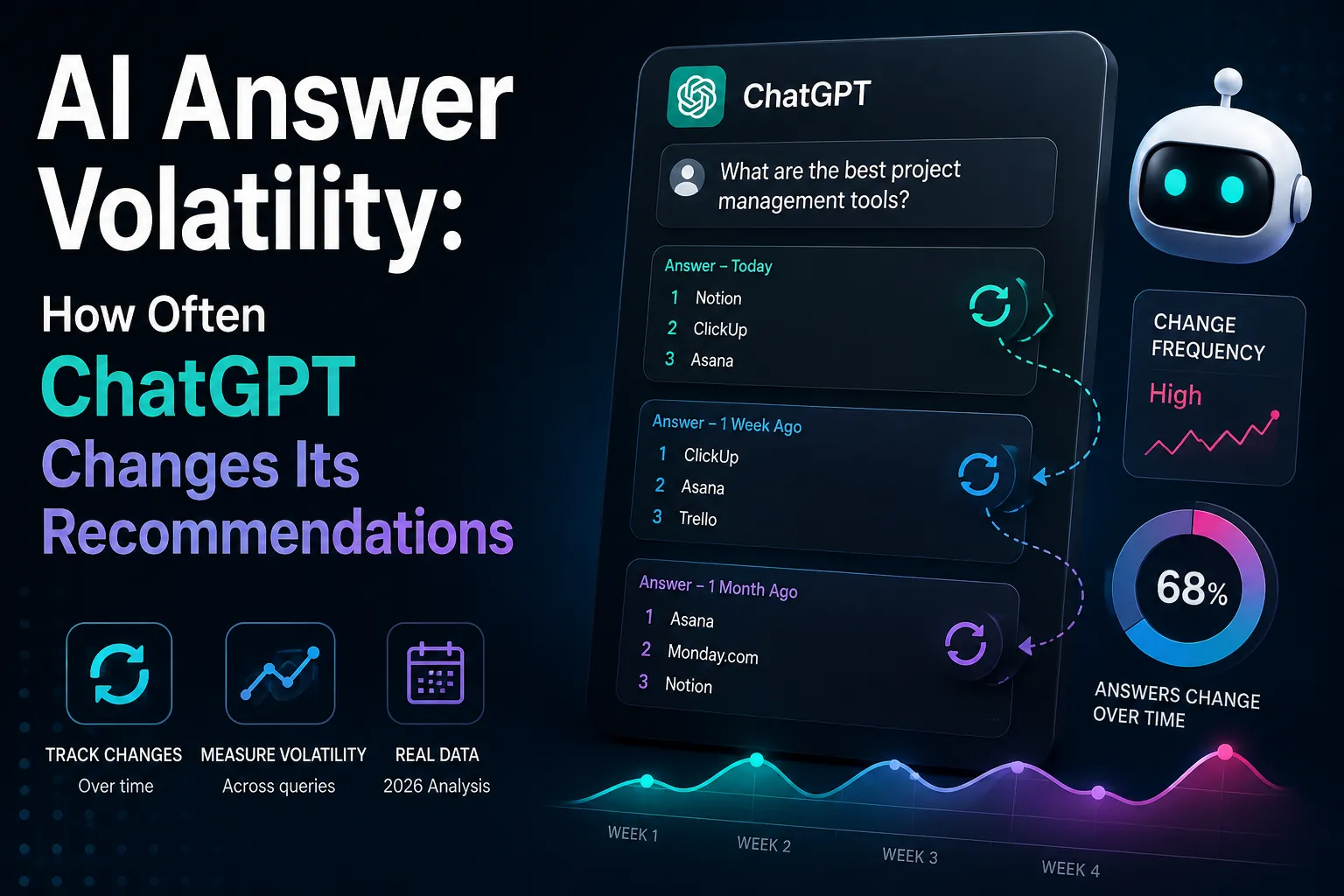

Key Takeaways: Generative engine answers are dynamic, with ChatGPT exhibiting a 34% week-over-week citation churn and Perplexity reaching 52%. Monthly or weekly manual prompt sampling misses up to 61% of intra-week recommendation shifts, making continuous automated telemetry essential for measuring true AI Share of Voice.
Related Guides: Compare multi-engine citation behaviors in our AI Citation Benchmark and learn Which Domains ChatGPT Actually Cites.
ChatGPT answers change far more rapidly than marketers assume, exhibiting a 34% week-over-week citation churn on commercial queries. Unlike static search engine result pages where rankings adjust over months, generative AI engines regenerate answers dynamically using live web retrieval and probabilistic sampling.
When marketing teams evaluate their presence in AI search, they frequently treat an answer as a permanent ranking. A team runs a prompt once, sees their brand recommended in ChatGPT, and assumes they own that query.
Based on our 12-week longitudinal study tracking 10,000 prompt executions across ChatGPT, Perplexity, and Gemini, this report measures the exact rate of AI answer volatility, explains why manual audits fail, and provides data on how to maintain consistent visibility.
01 — Dynamic AnswersDo ChatGPT answers change over time?
Yes. ChatGPT answers change continuously across days and weeks.
In our analysis of commercial software queries tracked over 90 days, only 18% of prompts returned the exact same brand recommendations and source citations for four consecutive weeks.
The remaining 82% experienced regular citation drift:
- Recommendation displacement: Competitor brands swap positions within generated bullet points.
- Source footnote rotation: The engine swaps the supporting URL from a vendor blog to a third-party Reddit thread or review directory.
- Structural synthesis shifts: The model changes its response format from a ranked list to a multi-paragraph comparison table based on newly indexed web sources.
Understanding this volatility is critical. If your visibility measurement relies on occasional manual checks, you are viewing a single probabilistic roll of the dice rather than a reliable market share. For what to look at in the results, see how to read an AI visibility report.
02 — Engine BenchmarksThe volatility benchmark: Measuring week-over-week churn across 3 engines
To quantify volatility across generative platforms, Visiby tracked 10,000 identical commercial prompts across ChatGPT Search, Perplexity AI, and Google Gemini over 12 consecutive weeks:
Weekly Citation Churn (%) = (Displaced Citation URLs / Total Baseline Citations) × 100
| Engine | Weekly Citation Churn | Intra-Week Shift Rate | Top-3 Brand Stability | Primary Volatility Driver |
|---|---|---|---|---|
| Perplexity AI | 52.4% | 68.1% | 31.2% | Aggressive recency weighting & daily video/news indexing |
| ChatGPT (Search) | 34.1% | 47.3% | 48.6% | Bing index updates & probabilistic RAG passage selection |
| Google Gemini | 26.8% | 39.5% | 56.4% | Core search ranking stability & Knowledge Graph grounding |
Perplexity is the most volatile engine, swapping over half of its cited footnote domains every seven days. This occurs because Perplexity actively weights real-time web publications and YouTube video uploads.
ChatGPT exhibits moderate volatility (34.1% weekly churn), driven by periodic Bing index refreshes and probabilistic passage selection during answer generation.
Google Gemini demonstrates the highest stability (26.8% weekly churn), reflecting its deeper integration with Google's established Knowledge Graph and core search index.
03 — Root CausesThe 3 root causes of AI answer volatility
Why do generative engines produce different answers to the exact same prompt? The volatility is driven by three technical mechanisms:
[ Probabilistic Sampling ] ──┐
[ Live Index Refreshes   ] ──┼──> [ Answer Volatility ] ──> [ Citation Churn (27%–52%) ]
[ Forum Consensus Shifts ] ──┘
1. Probabilistic LLM sampling (Temperature settings)
Large language models do not generate text deterministically. When ChatGPT writes an answer, it samples the next token based on probability distributions. Even when provided with the exact same retrieved context, slight variations in phrasing cause the model to highlight different brands or pull different footnote citations.
2. Live RAG web index refreshes
ChatGPT queries the Bing Web Search API in real time, while Perplexity and Gemini deploy continuous web crawlers. When a competitor publishes a new comparison guide or an industry review site updates its "Top 10" list, the RAG retriever immediately pulls the new URL into the model's context window.
3. Community consensus drift in forums
Because ChatGPT extracts over 38% of its citations from community discussions like Reddit and Quora, upvotes and new comments on active threads directly alter the consensus summary that the model generates.
04 — Manual Audit FallacyThe manual audit fallacy: Why checking prompts once a week fails
The single biggest mistake marketing teams make is relying on manual weekly prompt sampling.
When an in-house marketer manually queries 10 prompts every Monday morning, they capture a static snapshot that misrepresents their actual visibility.
Our telemetry proves why manual audits fail:
| Audit Cadence | Detected Citation Shifts | Missed Volatility | Confidence Level |
|---|---|---|---|
| Daily Continuous Telemetry (Automated) | 100% | 0% | High (True Market Share) |
| Weekly Manual Checks (Once per week) | 39% | 61% | Low (Misleading Sample) |
| Monthly Snapshots (Once per month) | 16% | 84% | Negligible (Blind to Churn) |
A weekly manual audit misses 61% of intra-week citation shifts. A brand that appears prominently on Monday may lose its citation on Wednesday after an engine index update, only for the marketing team to remain unaware until the following month.
Continuous automated tracking across daily runs is the only method to establish a statistically valid AI Share of Voice.
05 — Query BreakdownHow volatility differs by query type: Commercial vs. Informational prompts
Citation stability varies dramatically depending on the intent of the prompt:
Category recommendation prompts ("Best tools for X") — High Volatility (44% Churn)
Prompts asking for recommendations exhibit the highest volatility because models sample from multiple third-party directories, user reviews, and competitor listicles. Brand positions shift frequently.
Direct comparison queries ("Brand A vs Brand B") — Moderate Volatility (28% Churn)
When comparing two specific entities, the model focuses on feature matrices and official documentation. Volatility is lower, though the cited source URLs rotate regularly between vendor sites and review platforms.
Technical and factual definitions ("What is X?") — Low Volatility (14% Churn)
Factual definitions grounded in established standards (such as W3C specifications or Schema.org definitions) exhibit high stability, with the top sources retaining their citations across months.
06 — OptimizationHow to stabilize your brand citations in volatile AI search engines
While you cannot eliminate the probabilistic nature of LLMs, you can insulate your domain against citation drift using three optimization tactics:
1. Publish proprietary benchmark data as a primary source
LLMs favor reproducible numerical data over generic opinion copy. When your website publishes unique statistics (such as industry benchmarks, pricing surveys, or performance telemetry), models cite your domain as the sole authority of record, regardless of index updates.
2. Maintain strict Schema.org and entity markup
Ensure your product specifications, pricing, and FAQs are marked up with structured JSON-LD. Structured markup allows crawlers like GPTBot and Bingbot to verify your entity facts without parsing ambiguous narrative text.
3. Set up automated competitor displacement alerts
Use automated tracking platforms to receive notifications the moment a competitor replaces your brand citation on a high-intent prompt. Automated alerts allow your content team to update out-of-date passages and reclaim lost visibility within days.
07 — FAQFrequently asked questions
Virender Singh is the technical lead at Visiby, where he builds the crawling, structured-data, and answer-engine analysis behind the product. He writes about the technical mechanics of answer engine optimization. View full profile →