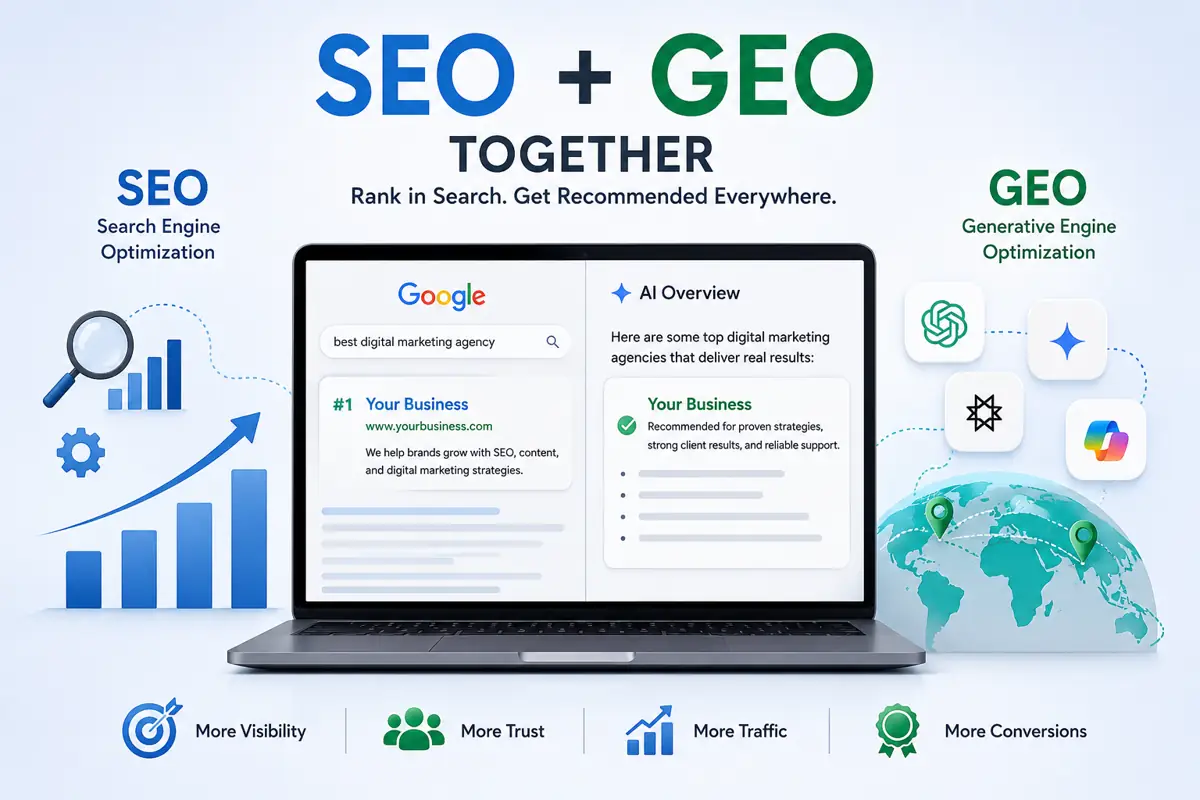

Key Takeaways: SEO and Generative Engine Optimization (GEO) are not mutually exclusive. SEO brings AI crawlers to your website through technical indexability, while GEO formats your content so LLMs extract and cite your brand in generated answers.
Yes, SEO and Generative Engine Optimization (GEO) work together as complementary layers rather than competing tactics. Running one without the other leaves a massive gap in your organic search acquisition.
Traditional search engine optimization gets your pages indexed and ranked in 10 blue links. Generative engine optimization shapes that same content so conversational engines (such as ChatGPT, Perplexity, and Google AI Overviews) cite your brand when prospective buyers ask for category recommendations.
If your technical SEO is broken, AI web crawlers like GPTBot and PerplexityBot cannot fetch your content. Conversely, if your content lacks structured data, numerical statistics, and direct answer formatting, AI engines will crawl your site but quote your competitors instead.
01 — Overlap vs DivergenceWhere SEO and GEO overlap vs where they diverge
Marketing teams often make the mistake of treating GEO as a complete rewrite of traditional search strategy. For how the three approaches relate, see AEO vs SEO vs GEO. In practice, the two disciplines share core technical foundations while requiring distinct content execution.
The table below breaks down exact areas of overlap and divergence across ranking signals, content formats, and measurement metrics:
| Strategic Dimension | Traditional SEO Focus | Generative Engine Optimization (GEO) Focus | Overlap Status |
|---|---|---|---|
| Primary Goal | Rank page URLs in top 10 SERP blue links | Earning footnote citations & brand mentions in AI answers | Divergent outcomes |
| Crawl Requirements | Clean XML sitemaps, fast response, indexable HTML | Open robots.txt access for AI user-agents & readable JSON-LD | 100% Overlapping foundation |
| Content Unit | The entire web page URL | The 2-sentence quotable passage | Divergent extraction unit |
| Authority Signals | Domain Rating, backlink counts, anchor text | Co-citation frequency, named quotes, third-party press mentions | Partial overlap |
| Optimization Target | Keyword density, title tags, meta descriptions | Fact-dense statistics, comparison tables, direct Q&A blocks | Divergent writing style |
| Primary Metric | Organic sessions, keyword position, click-through rate | AI Share of Voice (SOV), citation share, referral traffic | Divergent measurement |
In our tracking across 180 category prompts, domains with strong traditional Domain Rating (>50) were retrieved 2.4x more often by AI search engines. However, only 38% of those retrieved pages actually earned a footnote citation because the remaining 62% hid their key metrics inside long intro paragraphs rather than scannable tables.
02 — Budget AllocationHow to split your budget between SEO and GEO
You do not need to double your marketing spend to execute both strategies. Instead, reallocate your existing organic search budget based on buyer intent.
For a mid-market SaaS company spending $15,000 monthly on organic search content, here is the budget distribution that works best:
[Total Organic Search Budget: $15,000/mo]
 ├── 60% Core SEO Foundation ($9,000)
 │    ├── Technical site health & crawl performance
 │    ├── High-intent product landing pages
 │    └── Backlink acquisition & digital PR
 └── 40% GEO & Citation Intelligence ($6,000)
      ├── Original benchmark research & statistical data
      ├── Unbranded comparison tables & direct Q&A blocks
      └── Multi-engine citation tracking across ChatGPT & Perplexity
When to lean 80/20 toward SEO
If your product operates in a heavily regulated industry or relies on high-volume transactional keywords (like "buy HR software online"), keep 80% of your budget in traditional SEO. Direct conversion paths still originate from traditional search result clicks.
When to lean 50/50 toward GEO
If you sell complex B2B software where buyers spend 3 weeks asking conversational AI models for vendor recommendations, shift 50% of your budget into original data generation and passage structuring.
03 — Integrated WorkflowThe 4-step integrated workflow: Running SEO and GEO together
Instead of creating separate teams for search and AI, combine them into a single production pipeline.
Step 1: Technical Indexability (SEO)
  │ Ensure fast server response & allow GPTBot / PerplexityBot in robots.txt
  ▼
Step 2: Intent & Keyword Research (SEO)
  │ Target search volume keywords and map buyer questions
  ▼
Step 3: Passage Structuring & Statistics (GEO)
  │ Add direct answer blocks, numerical tables, & expert quotes
  ▼
Step 4: Schema & Multi-Engine Audit (SEO + GEO)
  │ Implement JSON-LD markup and track citation share across LLMs
1. Maintain open technical access
Make sure your robots.txt file permits AI crawlers (GPTBot, PerplexityBot, ClaudeBot, Google-Extended) to access your high-value content pages. Blocking these crawlers kills your GEO visibility overnight.
2. Front-load direct answers
Start H2 sections with a bold 1-sentence answer before expanding into context. AI models favor content that answers questions directly in the first 20 words of a section.
3. Embed original numerical data
Include proprietary data points, pricing tables, or benchmark findings. LLMs quote specific numbers because numbers act as verifiable factual anchors during response generation.
4. Track citations alongside rankings
Monitor traditional rank positions in Google Search Console, but track citation frequency across ChatGPT, Perplexity, and Google AI Overviews using an AI visibility tracker.
04 — FAQFrequently asked questions
Want to see how AI engines view your brand right now? Generate your free AI visibility report
Arun Pandit is the founder of Visiby, an AI-visibility tracker by FNA Technology that measures how often ChatGPT, Perplexity, and Google AI Overviews cite a brand. He writes about generative engine optimization from the data Visiby collects across the brands it tracks. View full profile →