
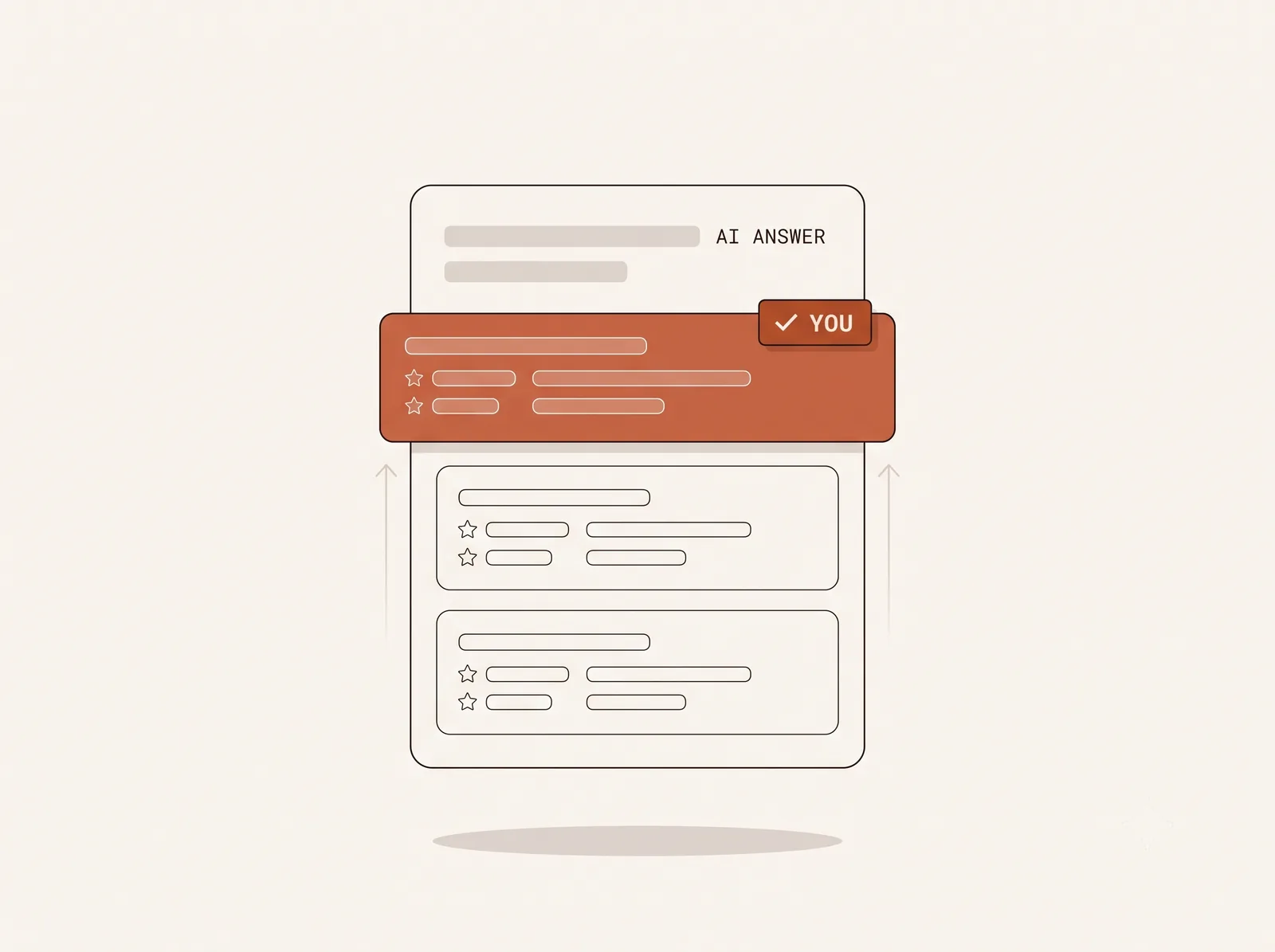
TL;DR: AI assistants name businesses they can read and trust. Let the AI crawlers in, publish one clear page per buyer question, add structured data, keep your details consistent everywhere, and earn mentions on the sites AI already cites. Then re-ask the same questions monthly.
Buyers who used to type three words into Google now ask a full question and read one answer. That answer usually names two or three businesses. If yours is one of them, you get the enquiry. If it is not, the question was asked and you never heard about it.
Most of the work needed to get named is work you can do yourself. This guide explains how AI assistants build an answer, why a business gets left out, and the steps to fix it. At the end, a short note on where the Visiby Growth Engine does the same work for you.
Last updated: 18 September 2026.
Key takeaways
- AI assistants answer from two things: what they were trained on, and, for many questions, pages they pull from the live web at the moment you ask.
- Most businesses are missing because AI cannot read their site, or because no page on it answers the question a buyer actually asked.
- The fix is ordinary: let the crawlers in, publish a clear page per buyer question, add structured data, keep your business details consistent, and get mentioned on the third-party sites AI tends to cite.
- Google AI Overviews and AI Mode sit on top of Google's index, so the SEO foundations you already know still matter for both.
- You cannot see this working unless you measure it. Ask the same buyer questions across the engines on a schedule and record who gets named and which sources get cited.
How does ChatGPT recommend businesses?
It does not pick a winner the way a directory ranks listings. When you ask for a recommendation, the assistant produces the most likely helpful answer from what it knows, and for many questions it searches the web first and summarises the sources it finds. A business gets named when it appears clearly and consistently in material the assistant can read and has reason to trust.
There is no ranking position to buy. What you influence is the evidence: how clearly your site states what you do, who you do it for and where, and how often credible third-party sources say the same thing.
Where does ChatGPT get its information?
From two sources. The first is the material the model was trained on, which is a large snapshot of public text with a cut-off date. The second, for many questions, is a live web search run at the moment of the question, whose results the assistant reads and cites. Perplexity and Claude work in a comparable way and can show the sources they used.
That split explains a common frustration. A brand new page will not be in any model's training data, but it can be retrieved and cited soon after it is published and indexed. Publishing genuinely useful pages is the fastest lever available to you.
An assistant reads your pages much as a search crawler does. Text that only appears after a script runs, content behind a form, a PDF with no matching web page, or a page your robots rules exclude are all at risk of being invisible. Anything you want quoted should be plain, readable text on a normal page.
Why does AI leave your business out of the answer?
Usually for one of a small number of practical reasons, and almost all of them are fixable without any special access to an AI company. Work through these in order before trying anything more creative.
Your site blocks AI crawlers
The assistants and search engines use named crawlers, and many sites block some of them. Sometimes by accident, sometimes through a security or bot-protection setting nobody has revisited. If the crawler is blocked, none of your other work counts. My opinion, having seen this go wrong more often than anything else on the list: check this first, before you write a single page.
No page answers the buyer's actual question
Most business sites have a services page, an about page and a contact page. Buyers ask things like "who does X for Y businesses in Z" or "what does X cost for a small firm". If you have no page that answers that specific question, there is nothing for an assistant to lift.
The pages you do have are thin or vague
A page of adjectives with no specifics gives an assistant nothing to quote. Prices or price ranges, timelines, who the service is for, what is included, what is not included, and where you operate are the parts that end up in answers.
Missing or wrong structured data
Structured data is a small block of machine-readable code stating the facts of a page: that you are an organisation, your address and hours, what a service costs, a page's questions and answers. It does not force anyone to recommend you. It removes ambiguity about the basics.
Little presence on the sites AI tends to cite
When an assistant searches the web, it often lands on pages that list or compare providers: directories, local business listings, review sites, industry publications, trade bodies, forums. A business with no footprint on any of those has only its own site speaking for it, and a single self-interested source is weak evidence.
Your business details are inconsistent
If your name, address, phone number and service description differ across your site, your listings and your profiles, you make it harder for any system to treat them as one business. Pick one version of every detail and make everything match.
How do I get my business ranked on ChatGPT?
There is no ranking to buy, so treat it as making yourself the easiest business to cite. This eight step process is the same work whether you are aiming at ChatGPT, Google AI Overviews, Google AI Mode, Perplexity or Claude, because all of them depend on pages they can fetch, read and trust.
- Write down the questions your buyers actually ask. Use the words they use on calls and in emails, not your internal service names. Twenty to thirty questions is plenty to start.
- Ask those questions in each engine and record the answers. Note who gets named, in what order, and which sources are cited underneath. That list of cited sources becomes your target list for step 7.
- Check that AI crawlers can reach your site. Review your robots rules and any bot-protection or firewall settings, and make sure the crawlers used by the search and assistant providers are allowed. Confirm your important pages are indexed in Google Search Console.
- Publish one clear page per question. Put the direct answer in the first paragraph, in about 40 to 60 words, then the detail below it. One question per page beats one page trying to cover eight.
- Put the specifics in writing. Prices or ranges, timelines, service areas, who it suits, who it does not, what happens next. Specifics get quoted. Generalities get skipped.
- Add structured data to the pages that matter. Organisation and local business details on your main pages, service details where they apply, and question and answer markup on pages with a real FAQ.
- Earn mentions on the sources AI already cites. Claim and complete your listings, get into the directories and review sites relevant to your sector and area, and offer a genuinely useful contribution to the industry publications that came up in step 2.
- Re-ask the same questions on a schedule. Monthly is a reasonable minimum. You are looking for changes in who gets named and which sources get cited, not for a single score.
One honest limitation. Steps 1 to 6 are within reach of a business owner and a competent web person. Step 7 is slow, and it depends on other people, so treat it as a quarter of work rather than a weekend.
How do the five AI engines differ?
At a broad level they split into two groups. Google AI Overviews and AI Mode are built on Google's search index, so anything that helps Google find, crawl, index and understand your pages helps there too. ChatGPT, Perplexity and Claude are assistants that can search the web during a conversation and cite the pages they used.
| Engine | Where it appears | What it draws on | What helps you get named |
|---|---|---|---|
| ChatGPT | Inside the ChatGPT app and its search mode | Training data, plus live web results for many questions | Clear pages that answer one question, plus mentions on third-party sites it can retrieve |
| Google AI Overviews | At the top of ordinary Google results | Google's index and its reading of the query | Standard SEO foundations: crawlable, indexed, specific pages that match the question |
| Google AI Mode | A separate conversational tab in Google Search | Google's index, over a longer back and forth with follow-up questions | Depth across a topic rather than one page in isolation, so related pages that link to each other |
| Perplexity | Its own search and answer app | Live web results, shown with visible citations | Pages worth citing on a question, and presence on the sources it cites repeatedly |
| Claude | Inside the Claude app, with web search available | Training data, plus live web results when it searches | Plainly written, factual pages that are easy to read and quote |
Keep the differences in proportion. The same page, made clearer and easier to reach, helps in all five. There is no separate site to build for each one.
How to rank a website in AI Overview?
Treat it as normal Google work with a sharper focus on questions. See how to rank in AI search for the step-by-step version. AI Overviews are generated from Google's index, so the page has to be crawlable, indexed and a good match for the query first. After that, pages that state a direct answer near the top, in clear language and with specifics, are the easiest for a generated summary to draw on.
Two habits help more than anything clever. Cover the question fully on one page instead of scattering it across a services page and a blog post. Keep the page current, because stale prices are a reason to prefer someone else's page.
Which is better, AI Overview or AI Mode?
Neither is better. They do different jobs. An AI Overview is a short summary that appears above the normal results when someone runs an ordinary Google search. AI Mode is a separate conversational experience where the person keeps asking follow-up questions and gets a longer, more exploratory answer. Overviews reach far more people. AI Mode reaches people who are deep in a decision.
How to rank in Google's AI Mode
The foundations are the same, with one addition. Because AI Mode is a conversation, it tends to pull from several pages across a topic rather than one. A single strong page is less useful there than a small cluster of related pages that each answer one question and link sensibly to each other. If you sell a service, that means a main service page plus pages on cost, process, who it suits and comparisons.
How do you check whether it is working?
Ask the same buyer questions across the same engines on the same schedule, and write down three things each time: whether you were named, who else was named, and which sources were cited. Progress usually shows as being mentioned in more questions, moving earlier in the answer, and seeing your own pages appear in the citation list.
What to record, at a minimum
A simple sheet is enough to start. Date, engine, question, businesses named and in what order, sources cited, and whether one of them was yours. Run it monthly and the pattern becomes clear within a couple of rounds.
What your existing tools still tell you
Google Search Console shows whether your new pages are indexed and which queries they appear for. Google Analytics shows what those pages do once people land. Neither reports AI answers directly, but indexing and page performance are the foundation the rest sits on. Our guide to reading an AI visibility report covers what to look at first.
Do not chase a single number
Answers vary between runs and between people. One question where you disappear is noise. The same question, in the same engine, where a competitor is named three months running, is a gap worth a page.
When you would rather not do this yourself
The steps above are not difficult, but they do not finish. The questions change, competitors publish, pages slip, and the check has to be repeated. Most owners get through the crawler fixes and the first few pages, then the work quietly stops.
What the Growth Engine does instead
The Visiby Growth Engine is an AI visibility team assigned to your site. It tracks how the five engines answer your buyers and logs every question where a competitor is recommended instead of you, works from your own Search Console and Analytics numbers, fixes technical and AI-crawler problems, and publishes 20 to 25 buyer-focused pages a month to your own site, plus refreshes of pages that start slipping. You approve the content. That is the whole job on your side.
It starts at $1,000 per month. No contract, cancel anytime, and everything created stays yours. If you are weighing that against other routes, the comparison of an AI visibility team, an SEO agency and an AI content tool sets out what each covers, and what an AI visibility team does each week shows the rhythm.
Frequently asked questions
How can I get AI to recommend my business?
Make yourself the easiest business to cite. Let the AI crawlers reach your site, publish a clear page for each question your buyers ask, put real specifics on those pages, add structured data, keep your business details identical everywhere, and get mentioned on the directories, review sites and industry publications that AI answers already cite for your topic.
How do you get your business to show up on ChatGPT?
The same way. There is no submission form and no paid placement for recommendations. ChatGPT names businesses that appear clearly in its training data or in the live web results it retrieves, so the practical route is readable, specific pages of your own plus credible third-party mentions.
How long does it take to see a change?
Longer than most people hope. New pages can be indexed within days, and technical fixes take effect as soon as the crawlers return. Meaningful movement generally compounds over 2 to 3 months, because it depends on pages being indexed, cited and repeated across sources. Nobody can honestly promise a date.
Does AI-written content hurt my chances?
Google's published guidance is about quality, not about how a page was produced. Thin, generic pages do badly whoever writes them. A page that answers a real buyer question better than the page currently winning it does well, and a human review step before publishing is what keeps the difference.
Do I still need SEO if AI is answering the questions?
Yes. Google AI Overviews and AI Mode are built on Google's index, and the assistants that search the web are fetching ordinary web pages. Crawlability, indexing, clear structure and genuinely useful content serve both. Our explainer on AEO, SEO and GEO covers how the terms relate.
Can I do this myself?
Yes, and you should start. The crawler check, the question list and the first handful of pages are all within reach of a business owner and a competent web person. The part that defeats most people is repetition: re-asking the questions, refreshing pages, and keeping up as competitors publish.
How do I find out where I stand right now?
Run the free AI visibility check on your domain. It shows which of your buyers' questions the AI engines are answering today, and who gets recommended when it is not you.
Start with the gap
If you want a second pair of eyes on what your check found, book 15 minutes. We will go through the questions where AI is naming someone else, and what closing the first of those gaps would involve for your site.
Or run the free AI visibility check first and bring the results to the call.
Raunaq Arora
Raunaq Arora is a senior software and AI engineer at Visiby, where he builds the AI-visibility measurement pipeline and dashboard. He writes about how AI-visibility tracking is measured and tooled. Run the free AI visibility check →