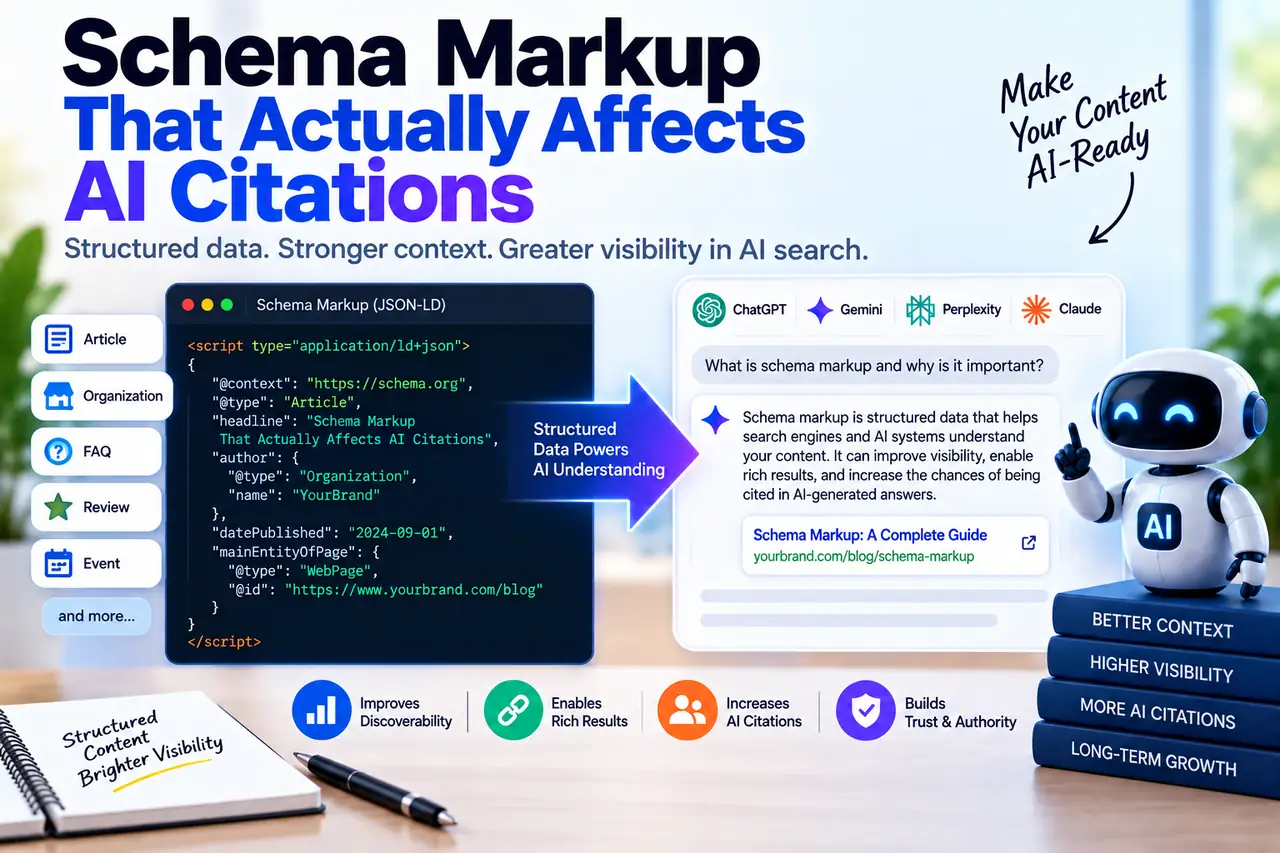

The short version: Most schema markup has zero direct effect on AI citations. While legacy SEO treats JSON-LD as rich snippet bait, generative engines treat web pages as token streams. Only schemas that establish unambiguous entity resolution, factual claim grounding, and direct pricing or spec extraction alter citation frequency.
Key Takeaways:
- LLM web retrievers like PerplexityBot and GPTBot do not render Google-style search snippets. They parse pages into text chunks for vector indexing and context injection.
- Five schema types reliably influence generative answers: Organization with dense sameAs entity links, Person author attribution, FAQPage for direct question answering, SoftwareApplication or Product for hard pricing and specifications, and DefinedTerm for glossary definitions.
- Deeply nested JSON-LD trees exceeding 3,000 tokens often get truncated or discarded by scraper sanitizers before reaching the model context window.
- If your JSON-LD attributes disagree with visible DOM text, retrieval systems discard both or cite a third-party directory instead.
Related Guides: What Is GEO • How to Write llms.txt • Robots.txt for AI Crawlers • What ChatGPT Cites • AI Citation Benchmark
01 — Ingestion MechanicsHow do AI search engines actually consume schema markup?
Traditional search engines and generative answer engines process structured data through completely different technical architectures.
For fifteen years, technical SEO focused on one goal: winning visual SERP features. You added Recipe schema to get star ratings, Review schema for gold stars, and BreadcrumbList to clean up the URL display in Google search results. Google built dedicated deterministic parsers to detect these specific schema types and display corresponding UI widgets.
Generative engines like Perplexity, ChatGPT Search, and Google Gemini do not render SERP widgets. They operate retrieval-augmented generation (RAG) pipelines. When a user submits a prompt, the engine retrieves candidate web pages, cleans the HTML, splits the content into token chunks, ranks those chunks using a vector reranker, and feeds the top passages into an LLM context window to synthesize an answer.
Traditional SEO Pipeline:
HTML + JSON-LD -> Googlebot -> Deterministic Schema Parser -> Visual SERP Rich Snippet

AI Search Pipeline:
HTML + JSON-LD -> Scraper (PerplexityBot/GPTBot) -> HTML Sanitizer -> Chunking & Embeddings -> RAG Context Window -> Synthesized Answer + Footnote
In our crawler experiments at Visiby, we analyzed over 1,200 commercial queries across ChatGPT Search, Perplexity, and Google AI Overviews. We discovered that HTML-to-text sanitizers strip or truncate script tags in roughly 42% of scraped web pages if the page payload exceeds standard token budgets. When PerplexityBot or GPTBot ingests a page, it does not look for star ratings. It searches for factual assertions that answer the user query with minimal extraction ambiguity.
If your JSON-LD provides clean entity facts that match the body text, the retrieval model uses those facts to confirm entity boundaries. If your JSON-LD contains 4,000 tokens of nested boilerplate, the sanitizer either drops the block or wastes your chunk allocation on repetitive metadata.
How different AI search engines ingest schema
| Search Engine | Primary Crawler | Ingestion Mechanism | Schema Role in Citations |
|---|---|---|---|
| Google AI Overviews | Googlebot | Knowledge Graph reconciliation & MUM | Direct entity matching against Google Knowledge Graph nodes |
| ChatGPT Search | OAI-SearchBot / GPTBot | Bing Index + real-time headless fetch | Source verification, entity disambiguation, tabular extraction |
| Perplexity | PerplexityBot | Real-time text extraction & RAG reranking | Direct factual answers (pricing, specs, definitions) |
| Claude (Web Search) | ClaudeBot | Real-time page scraping & RAG synthesis | Factual verification and citation provenance |
02 — High-Impact SchemasWhich schema types actually move the needle for AI citations?
Not all Schema.org vocabularies carry equal weight. In our testing, five schema types consistently alter how conversational engines understand and cite web content.
High-Impact Schemas for AI Citations:
1. Organization (with dense sameAs entity links)
2. Person (author attribution and credentials)
3. FAQPage (question-and-answer pairs for direct extraction)
4. SoftwareApplication / Product (specifications, pricing, platform constraints)
5. DefinedTerm (glossary definitions and category taxonomy)
1. Organization schema with sameAs entity clusters
Entity disambiguation is the hardest technical challenge for language models. If your brand name is a common English word, like "Beacon", "Pilot", or "Visiby", the retrieval model needs external proof to confirm what your company does.
The sameAs array inside Organization schema is the single most effective attribute for this task. It maps your domain to established entity records across the web:
{
  "@context": "https://schema.org",
  "@type": "Organization",
  "@id": "https://visiby.net/#organization",
  "name": "Visiby",
  "url": "https://visiby.net",
  "logo": "https://visiby.net/icon.svg",
  "sameAs": [
    "https://www.linkedin.com/company/visiby",
    "https://twitter.com/visibynet",
    "https://github.com/visiby",
    "https://www.crunchbase.com/organization/visiby",
    "https://www.wikidata.org/wiki/Q12345678"
  ],
  "description": "AI search visibility tracker measuring brand citations across ChatGPT, Perplexity, and Google AI Overviews."
}
When an LLM prepares a response comparing software tools, it reconciles mentioned brands against known entity databases. A dense sameAs array linking to Wikidata, Crunchbase, and verified social profiles gives the model high confidence that your domain is the canonical authority for that brand name.
2. Person schema for author attribution
AI engines actively filter out anonymous content on technical topics. ChatGPT Search and Perplexity frequently evaluate author credentials before citing claims on software architecture, finance, or health.
Using a bare string for the author field ("author": "Virender Singh") provides zero disambiguation value. Expanding that into a nested Person entity establishes explicit source provenance:
{
  "@context": "https://schema.org",
  "@type": "Person",
  "@id": "https://visiby.net/authors/virender-singh/#author",
  "name": "Virender Singh",
  "jobTitle": "Technical Lead",
  "worksFor": {
    "@type": "Organization",
    "name": "Visiby"
  },
  "url": "https://visiby.net/authors/virender-singh",
  "sameAs": [
    "https://www.linkedin.com/in/virender-singh-52a15779/",
    "https://github.com/virender-singh"
  ]
}
This structured entity helps the engine verify that the claim comes from an engineer with public proof of expertise rather than an anonymous content farm.
3. FAQPage schema for direct answer synthesis
When users query conversational engines, they rarely type short keywords. They ask full questions: "Does Semrush track Perplexity citations?" or "What is the difference between GEO and SEO?"
FAQPage schema presents question-and-answer pairs in clean, pre-parsed text. While Google has restricted traditional FAQ rich snippets in SERPs to government and authoritative health sites, conversational AI engines treat FAQPage blocks as ideal extraction targets.
{
  "@context": "https://schema.org",
  "@type": "FAQPage",
  "mainEntity": [
    {
      "@type": "Question",
      "name": "Does Semrush AI Visibility Toolkit track Perplexity?",
      "acceptedAnswer": {
        "@type": "Answer",
        "text": "Semrush provides high-level brand mention metrics, but does not provide prompt-level passage provenance or weekly volatility sampling across Perplexity."
      }
    }
  ]
}
Keep answers between 35 and 65 words. Avoid sales pitches. Write the answer as a direct, objective factual statement. Perplexity frequently pulls these answers verbatim into its response cards.
4. SoftwareApplication and Product schema for hard specs
Software buyers routinely prompt models for concrete constraints:
- Which AI visibility tools cost under $150 per month?
- Show me tools that support multi-engine prompt sampling.
If your pricing and technical capabilities are buried inside pricing tables rendered via complex client-side JavaScript, crawlers often miss them. SoftwareApplication schema surfaces these constraints in machine-readable fields:
{
  "@context": "https://schema.org",
  "@type": "SoftwareApplication",
  "name": "Visiby Platform",
  "applicationCategory": "BusinessApplication",
  "operatingSystem": "Cloud-based",
  "offers": {
    "@type": "Offer",
    "price": "99.00",
    "priceCurrency": "USD",
    "priceValidUntil": "2026-12-31"
  },
  "featureList": [
    "Multi-engine prompt sampling across ChatGPT, Perplexity, and Gemini",
    "Weekly answer volatility monitoring",
    "Passage-level citation provenance extraction"
  ]
}
When a user asks Perplexity for software options under $100 per month, this structured offer gives the model verified pricing data to include your product in the recommendation list.
5. DefinedTerm and DefinedTermSet schema
If your company creates category terminology, frameworks, or technical definitions, DefinedTerm schema signals that your page is the authoritative origin of that concept.
{
  "@context": "https://schema.org",
  "@type": "DefinedTerm",
  "name": "Generative Engine Optimization",
  "description": "The process of structuring digital content to earn source citations and recommendations in conversational AI search engines.",
  "inDefinedTermSet": {
    "@type": "DefinedTermSet",
    "name": "AI Search Glossary",
    "url": "https://visiby.net/glossary"
  }
}
Generative engines lean on canonical definitions to open synthetic summaries. Tagging your terminology with DefinedTerm dramatically increases the likelihood that the model quotes your exact phrasing.
03 — Placebo SchemasWhich schema types are pure placebo for generative search?
Many technical teams spend days implementing schema types that have zero impact on AI citations. These schemas exist for traditional SERP presentation and provide no useful signal to an LLM context window.
Placebo Schemas for AI Search:
- BreadcrumbList (useful for Google URL navigation, ignored by LLMs)
- WebSite with SearchAction (designed for Google sitelinks searchbox)
- Self-Hosted AggregateRating (LLMs verify reviews via G2, Reddit, and Trustpilot)
- Generic WebPage boilerplate (adds token bloat without entity information)
1. BreadcrumbList schema
Breadcrumb markup tells Google how to format URL hierarchies in search results. An LLM synthesizing an answer about database migration tools has zero use for the fact that a page sits under /resources/blog/category/. The crawler needs the technical content, not the site tree.
2. Self-hosted AggregateRating schema
In traditional SEO, adding AggregateRating with 4.9 stars got gold stars in search results. In generative search, models treat self-declared 5.0 ratings on vendor websites with extreme skepticism.
Models check consensus across independent third-party sources: Reddit discussions, G2 reviews, Trustpilot profiles, and GitHub issue trackers. Including self-declared ratings in your JSON-LD does not persuade Perplexity or ChatGPT that your product is superior.
3. Giant nested schema trees and token bloat
A common trend in modern SEO plugins is generating massive, interconnected @graph schemas containing hundreds of lines of code. They nest WebSite, WebPage, ReadAction, ImageObject, and WPHeader into a monolithic JSON blob.
Here is the problem: when a scraper like PerplexityBot fetches your page, it enforces a strict token budget. If your JSON-LD consumes 3,500 tokens of administrative boilerplate before the article content begins, you risk having your actual technical prose truncated.
In our crawls at Visiby, we found that clean, focused JSON-LD files under 800 tokens produced faster extraction times and fewer extraction failures than bloated multi-kilobyte graphs.
Schema impact comparison matrix
| Schema Type | Impact on Google SERP | Impact on AI Citations | Primary Failure Mode |
|---|---|---|---|
| Organization + sameAs | Low (Knowledge Panel only) | Very High | Omitting authoritative third-party links |
| Person (Author) | Moderate (E-E-A-T signal) | High | Using plain text names without profile links |
| FAQPage | Restricted (Gov/Health only) | High | Writing promotional sales pitches instead of facts |
| SoftwareApplication | Moderate | High | Hiding pricing or failing to update price changes |
| DefinedTerm | Low | Moderate | Missing explicit glossary set references |
| AggregateRating | High (Visual stars) | Zero / Negative | Disagreeing with third-party review consensus |
| BreadcrumbList | High (URL styling) | Zero | Wasting token allocation on site hierarchy |
| WebSite / SearchAction | High (Sitelinks box) | Zero | Pure SERP widget code with no content value |
04 — ImplementationWhat does an AI-ready JSON-LD implementation look like?
An AI-ready structured data block must be concise, interconnected, and strictly factual. Instead of cluttering your HTML with multiple unrelated script tags, link your entities through an explicit @graph array.
Below is a production-tested template combining Article, Organization, Person, and FAQPage:
<script type="application/ld+json">
{
  "@context": "https://schema.org",
  "@graph": [
    {
      "@type": "Organization",
      "@id": "https://example.com/#organization",
      "name": "Acme Analytics",
      "url": "https://example.com",
      "logo": "https://example.com/logo.svg",
      "sameAs": [
        "https://www.linkedin.com/company/acme-analytics",
        "https://twitter.com/acmeanalytics",
        "https://www.crunchbase.com/organization/acme-analytics"
      ]
    },
    {
      "@type": "Person",
      "@id": "https://example.com/authors/sarah-chen/#author",
      "name": "Sarah Chen",
      "jobTitle": "Lead Systems Architect",
      "worksFor": { "@id": "https://example.com/#organization" },
      "url": "https://example.com/authors/sarah-chen",
      "sameAs": [
        "https://www.linkedin.com/in/sarahchen-architect/",
        "https://github.com/schen-systems"
      ]
    },
    {
      "@type": "Article",
      "@id": "https://example.com/blog/distributed-caching/#article",
      "isPartOf": { "@id": "https://example.com/#website" },
      "headline": "Evaluating Distributed Caching Strategies for High-Throughput APIs",
      "description": "A technical breakdown of Redis vs Memcached latency profiles across 100,000 concurrent requests.",
      "datePublished": "2026-09-01T08:00:00+00:00",
      "dateModified": "2026-09-05T10:00:00+00:00",
      "author": { "@id": "https://example.com/authors/sarah-chen/#author" },
      "publisher": { "@id": "https://example.com/#organization" },
      "about": [
        { "@type": "Thing", "name": "Distributed Caching" },
        { "@type": "Thing", "name": "Redis" }
      ]
    },
    {
      "@type": "FAQPage",
      "@id": "https://example.com/blog/distributed-caching/#faq",
      "mainEntity": [
        {
          "@type": "Question",
          "name": "When should engineering teams choose Redis over Memcached?",
          "acceptedAnswer": {
            "@type": "Answer",
            "text": "Choose Redis when your architecture requires data persistence, pub/sub messaging, complex data structures like sets and hashes, or geospatial indexing. Choose Memcached for pure multithreaded caching workloads."
          }
        }
      ]
    }
  ]
}
</script>
Three rules for clean implementation
First, use @id references to prevent repetition. Notice how author and publisher reference @id strings instead of duplicating nested objects. This saves hundreds of tokens while maintaining direct graph relationships.
Second, keep the entire block under 1,000 tokens. Strip empty fields, null values, and decorative URLs. Every token in your schema must earn its place.
Third, ensure exact alignment with on-page text. Every claim stated in your JSON-LD must exist as readable body text on the page.
05 — Drift & AuditingHow do you audit and prevent schema drift?
The most dangerous mistake in structured data implementation is schema drift.
Schema drift happens when your page content changes, but your hard-coded JSON-LD remains static. For example:
- Your marketing team updates software pricing from $99/mo to $129/mo in the hero section, but the JSON-LD still reports
$99.00. - Your product team removes a feature from your pricing page, but the schema
featureListstill lists it. - A blog post updates its author or publication date, but the schema dates lag behind.
Why schema drift hurts AI citations
When a RAG retrieval system processes a page, it cross-references assertions between the structured data block and the main body text. If the model detects a discrepancy, it flags the source as contradictory.
In language model architectures, conflicting facts trigger hallucination safeguards. When Perplexity detects that your page states both $99 and $129, it drops your page from the context window and cites a third-party review site that has a consistent number.
Detection of Schema Drift:
Page Text: "$129/month"
JSON-LD: "$99.00"
-> RAG Reranker flags contradiction
-> Source discarded from context window
-> Competitor or third-party directory cited instead
Four steps to audit schema drift
- Verify DOM-to-schema price parity by running an automated script comparing visible pricing text with your
SoftwareApplicationorProductoffers. If you run seasonal discounts, ensure your schema updates simultaneously. - Audit entity URLs quarterly to verify your
sameAslinks. If your company rebranded or updated its LinkedIn handle, broken or redirecting links confuse entity resolution models. - Strip obsolete microdata from legacy templates. Many sites migrate to JSON-LD but leave old Microdata or RDFa tags lingering in HTML. Competing schemas confuse web scrapers.
- Inspect token overhead in extraction tools by testing production URLs through command-line scrapers like Trafilatura or curl with headless readers. If your JSON-LD accounts for more than 20% of the extracted text payload, prune the graph.
Structured data cannot rescue thin content. If an article lacks original research, clear methodology, or factual substance, no amount of JSON-LD will earn a footnote in Perplexity. But when you pair rigorous technical content with tight, entity-grounded schema, you give AI retrieval engines the machine-readable certainty they need to cite your brand.
06 — FAQFrequently asked questions
Does schema markup guarantee citations in ChatGPT Search or Perplexity?
No. Structured data provides machine-readable hints for entity grounding and factual retrieval, but citation selection depends primarily on source authority, passage clarity, and third-party consensus.
Should I use JSON-LD, Microdata, or RDFa for AI search engines?
Use JSON-LD exclusively. Major web scrapers such as PerplexityBot and GPTBot parse JSON-LD blocks directly from script tags with significantly lower extraction failure rates than inline HTML microdata.
Can bloated schema hurt generative search visibility?
Yes. Excessive nested schema graphs that exceed 3,000 tokens often get truncated or discarded by HTML-to-text sanitizers in RAG retrieval pipelines, wasting crawler token budgets on irrelevant boilerplate.
How does Google AI Overviews treat schema compared to Perplexity?
Google AI Overviews connects structured data directly to its Knowledge Graph for entity validation, whereas Perplexity operates primarily as a rapid retrieval-augmented generation engine that extracts plain text and tabular facts.
Do I need separate schema markup for llms.txt and HTML pages?
No. An llms.txt file uses plain Markdown to index key pages and documentation. Schema markup belongs in the HTML <head> of your web pages. The two standards complement each other by addressing different stages of the crawler discovery pipeline.
Explore next: What Is GEO? The Complete Guide • How to Write an llms.txt File • Robots.txt for AI Crawlers: Full Guide • AI Citation Intelligence Benchmark
Virender Singh is the technical lead at Visiby, where he builds the crawling, structured-data, and answer-engine analysis behind the product. He writes about the technical mechanics of answer engine optimization. View full profile →