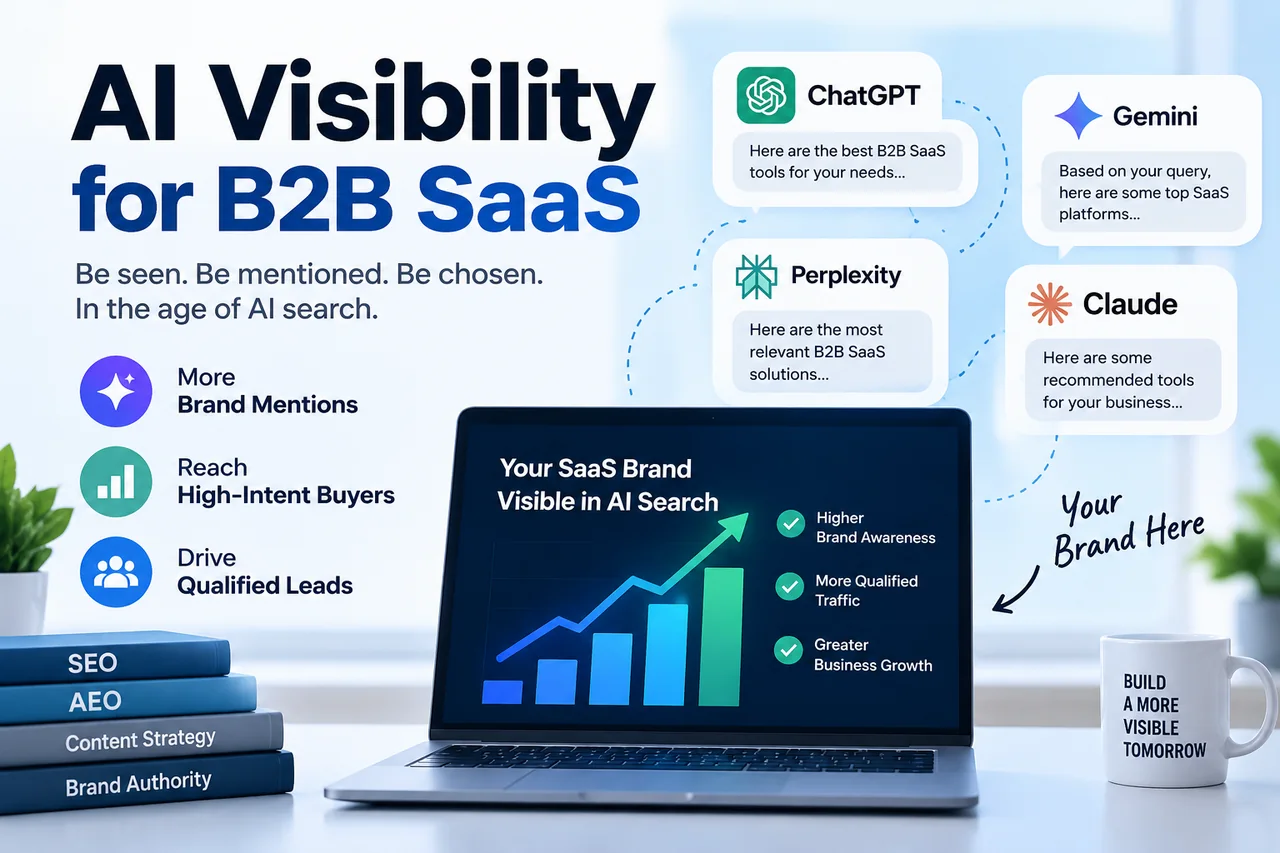

The short version: B2B SaaS buyers increasingly make software shortlists inside ChatGPT, Perplexity, and Google AI Overviews before visiting vendor sites. This 90-day execution framework sequences technical setup, entity building, third-party citation seeding, and volatility defense into actionable weekly sprints to earn consistent AI recommendations. For the recurring cadence, see the weekly work an AI visibility team does.
Key Takeaways:
- The Conversion Asymmetry: Industry research shows AI-referred search visitors convert at 4–5x the rate of standard organic search traffic because prospects ask conversational engines for specific tooling recommendations late in the buying cycle.
- The Core Risk: If your B2B SaaS is omitted from foundational prompt clusters ("best [category] software for [industry]"), you are excluded from buyer consideration sets before a sales rep ever receives an inbound inquiry.
- Three-Phase Sequence: Successful Generative Engine Optimization (GEO) requires a structured 90-day progression: Days 1–30 (Foundation & Baseline Audit), Days 31–60 (Entity Cementing & Source Seeding), and Days 61–90 (Volatility Defense & Authority Moats).
- The Third-Party Factor: Over 68% of citations in B2B conversational search originate from independent reviews, comparison tables, and developer discussions—not vendor homepages.
Related Guides: AI Share of Voice Guide · How to Write llms.txt · Robots.txt for AI Crawlers · What Is GEO · AI Visibility Platform
01 — EconomicsWhy Is AI Search the Highest-Converting Channel in B2B SaaS?
The traditional B2B software buyer journey is broken. Buyers no longer want to click through ten sponsored search ads, read gated whitepapers, or book discovery calls just to learn if a product supports their tech stack.
Instead, software evaluation happens in conversational prompts:
- "Compare the top three data observability platforms for Snowflake teams."
- "Which billing engines handle usage-based pricing with multi-currency tax compliance?"
- "What are the trade-offs between [Competitor A] and [Competitor B]?"
When an AI engine answers these prompts, it synthesizes three to five vendor recommendations accompanied by direct rationale and cited sources.
Comparison: Traditional Funnel vs Generative AI Search Funnel
| Step | Traditional Search Funnel | Generative AI Search Funnel |
|---|---|---|
| Initial Query | Broad, generic keywords (e.g. "cloud observability tool") | Multi-constraint conversational prompts with specific stack filters |
| Search Experience | 10 blue links, sponsored PPC ads, SEO content hubs | Single synthesized response naming 3–5 evaluated solutions |
| Friction Level | High: gated whitepapers, ungated lead forms, SDR discovery calls | Low: immediate comparison matrix with cited reference points |
| Buyer Intent | Top-of-funnel exploration | Late-stage evaluation and final vendor shortlisting |
| Conversion Impact | Industry baseline organic conversion (~1.2–2.0%) | 4–5x higher conversion velocity (assisted pipeline up to 9.7%) |
According to cross-category digital marketing analyses by NP Digital, while AI-referred visits represent a modest single-digit percentage of overall site sessions today, they generate up to 9.7% of total assisted B2B pipeline. Visitors arriving from citation links convert higher because their evaluation criteria were already answered before clicking through.
02 — Phase 1Phase 1 (Days 1–30): Foundation, Technical Hygiene & Baseline Audit
Before creating new content or reaching out to external publishers, you must establish clean data ingestion channels and audit your current AI footprint.
Phase 1 Milestone Summary
| Sprint | Focus Area | Core Objective | Primary Deliverable |
|---|---|---|---|
| Week 1 | Prompt Universe Mapping | Identify target commercial buyer queries | 50-Prompt Commercial Evaluation Matrix |
| Week 2 | Baseline Telemetry Audit | Score initial brand citation share | Multi-Engine Baseline Citation Scorecard |
| Week 3 | Bot Accessibility | Audit crawler logs & permissions | Verified robots.txt & Server Bot Access Logs |
| Week 4 | Structured Data & Schema | Establish unambiguous entity clarity | Production llms.txt & Connected JSON-LD Schema |
Week 1: Mapping the B2B Prompt Universe
Identify the exact 40–50 prompts your prospective buyers ask. Categorize them into four commercial intent buckets:
- Category Definition Queries: "What software categories manage cloud cost anomaly detection?"
- Shortlist & Alternatives Queries: "Best alternative to [Incumbent Enterprise Tool] for mid-market teams."
- Feature & Integration Queries: "Does [Your Product] integrate natively with HubSpot CRM?"
- Pricing & ROI Comparison Queries: "What is the real cost breakdown of [Your Product] vs [Competitor]?"
Week 2: Running the Baseline Telemetry Audit
Run these prompts across ChatGPT Search, Perplexity, Google Gemini, and Google AI Overviews. Record:
- Citation Rate: What percentage of target prompts mention your brand?
- Position in Synthesized Text: Are you listed as the primary recommendation or a secondary alternative?
- Cited Domain Types: Which external sites does the LLM cite when it mentions you or your competitors?
Week 3: Ensuring Crawler Accessibility
Check your server logs and robots.txt configuration to confirm that AI search bots are not blocked from indexing your product documentation and public resource hubs:
GPTBot(OpenAI retrieval and web search)PerplexityBot(Perplexity indexing)ClaudeBot(Anthropic citation indexing)Google-Extended(Google Gemini training and retrieval controls)
Week 4: Deploying Structured Entity Markup and llms.txt
Generative engines build entity confidence when data is unambiguous.
- Deploy connected
Organization,SoftwareApplication, andFAQPageJSON-LD schema on your core marketing pages. - Publish an
/llms.txtfile at your domain root containing a clean Markdown index of your core product documentation, feature summaries, and architecture specs.
03 — Phase 2Phase 2 (Days 31–60): Entity Cementing & Third-Party Citation Seeding
The most common misconception among B2B marketing teams is believing that updating their own website is sufficient to win AI citations. In reality, conversational engines rely heavily on corroborating third-party sources to prevent hallucination.
Phase 2 Milestone Summary
| Sprint | Focus Area | Core Objective | Primary Deliverable |
|---|---|---|---|
| Week 5 | Competitor Citation-Gap Audit | Inspect URLs cited for competing solutions | Target Third-Party URL Priority Backlog |
| Week 6 | Review Profiles & Directories | Refresh profiles on G2, Capterra, Peer | Updated Feature Matrices & Fresh Reviews |
| Week 7 | Publisher Outreach | Update category listicles with fresh data | 10 Publisher Pitches with Structured Facts |
| Week 8 | Passage Fact Density | Refactor owned docs for passage extraction | 5 High-Intent Pages Optimized for LLMs |
Week 5: Conducting Competitor Citation-Gap Audits
Look at the third-party URLs that Perplexity and ChatGPT cite when recommending your competitors. In 50,000 prompts analyzed across the Visiby Citation Intelligence Benchmark, over 70% of citations for commercial B2B queries come from three distinct source buckets:
- Category comparison listicles published by trusted industry blogs.
- Verified B2B software review directories (G2, Capterra, Gartner Peer Insights).
- Community practitioner forums (Reddit r/devops, r/sysadmin, Hacker News).
Week 6: Updating Third-Party Profile Data
Verify that your company profile across G2, TrustRadius, and Capterra is accurate, categorizes your features correctly, and has received fresh reviews within the last 60 days. LLMs extract pricing models, integration lists, and user sentiment directly from these review platforms.
Week 7: Outreach and Listicle Updating
Reach out to the publishers of the top-ranking listicles identified in Week 5. Supply updated feature matrices, verified pricing details, and concise bullet points that editors can easily copy into existing articles.
Week 8: Formatting Owned Content for Passage Extraction
Re-structure your product pages, documentation, and blog guides using direct answer patterns:
- Place clear 40–50 word declarative answers immediately beneath question headings (
<h2>). - Convert long paragraphs into structured Markdown tables.
- Use explicit entity names rather than ambiguous pronouns like "our tool" or "it".
04 — Phase 3Phase 3 (Days 61–90): Volatility Defense & Authority Moats
AI search results are not static. Prompt completions drift as models update, citation weights shift, and competitors adjust their strategies.
Phase 3 Milestone Summary
| Sprint | Focus Area | Core Objective | Primary Deliverable |
|---|---|---|---|
| Week 9 | Automated Drift Tracking | Detect week-over-week prompt fluctuations | Automated Delta Dashboard in Visiby |
| Week 10 | Primary Benchmark Assets | Publish original data anchors | Industry Research & Proprietary Dataset |
| Week 11 | Displacement Sprints | Rapidly fix competitor citation takeovers | 72-Hour Content Remediation Plan |
| Week 12 | Executive Attribution | Measure assisted pipeline and closed revenue | Q1 Executive AI Pipeline & ROI Deck |
Week 9: Establishing Automated Volatility Monitoring
Configure weekly automated tracking across your 50 core prompts using Visiby. Track whether your citation share changes week-over-week and receive alerts when a competitor displaces your brand in a key prompt category.
Week 10: Publishing Original Research and Datasets
Generative models favor primary sources. When you publish original benchmark data (e.g., "We analyzed 10,000 API payloads..." or "The 2026 State of Cloud Cost Management"), conversational engines cite your data points as factual anchors when answering industry questions.
Week 11: Executing Competitor Displacement Sprints
When an automated alert shows that a competitor has won citations for a high-value prompt (such as "best SOC2 tool for startups"), inspect the source URL the engine cited. Update your corresponding content or third-party presence within 48–72 hours to recapture the citation.
Week 12: Connecting AI Visibility to B2B Pipeline
Calculate your assisted revenue from AI search:
- Monitor direct URL referrers from
chatgpt.com,perplexity.ai, andgemini.google.com. - Add a mandatory "How did you hear about us?" open-text field to your demo and signup forms (look for responses like "Asked Claude for recommendations").
- Calculate your AI Share of Voice across your product tier.
05 — 12-Week MatrixThe 12-Week B2B SaaS Execution Matrix
| Sprint | Phase | Focus Area | Effort (Hours/Wk) | Concrete Deliverable |
|---|---|---|---|---|
| Week 1 | Foundation | Prompt Mapping | 8 hrs | 50-Prompt Commercial Evaluation Matrix |
| Week 2 | Foundation | Telemetry Audit | 10 hrs | Multi-Engine Baseline Citation Scorecard |
| Week 3 | Foundation | Bot Access | 4 hrs | Audited robots.txt & Server Bot Access Logs |
| Week 4 | Foundation | Structured Data | 6 hrs | Production llms.txt & Connected JSON-LD Schema |
| Week 5 | Seeding | Citation-Gap Audit | 8 hrs | Target Third-Party URL Priority Backlog |
| Week 6 | Seeding | Review Profiles | 6 hrs | Updated G2 / Capterra / TrustRadius Profiles |
| Week 7 | Seeding | Publisher Outreach | 12 hrs | 10 Outreach Pitches Sent to Category Listicles |
| Week 8 | Seeding | Passage Density | 10 hrs | 5 Core Documentation Pages Refactored for Extraction |
| Week 9 | Defense | Automated Tracking | 4 hrs | Weekly Automated Delta Dashboard in Visiby |
| Week 10 | Defense | Primary Research | 14 hrs | Published Proprietary Benchmark Asset |
| Week 11 | Defense | Displacement Fixes | 8 hrs | Rapid-Response Content Updates to Recapture Citations |
| Week 12 | Defense | Executive Reporting | 5 hrs | Q1 AI Citation Impact & Assisted Pipeline Deck |
AI Visibility for Agencies
If you run this program for a roster of clients, you need one workspace that keeps each client's prompts separate and exports white-label reports the client can read without seeing your tooling. Visiby's Agency tier ($499/mo) is built for exactly that: 500+ tracked prompts to distribute across accounts, plus white-label reporting, SSO, and API access so citation data ships under your own brand.
The 90-day sequence above scales to an agency model with three adjustments:
- Run one prompt universe per client, not one for the whole book. Each client gets its own 40–50 prompt commercial matrix (Week 1) so citation share is measured against that client's real competitors, not a shared list.
- Standardize the Week 2 baseline scorecard as your reporting template. A consistent multi-engine scorecard across ChatGPT, Perplexity, Google AI Overviews, Google AI Mode, and Claude lets you show every client the same before-and-after, and white-label it per account.
- Centralize volatility defense (Phase 3). One team watching week-over-week drift across all client prompts catches competitor displacement faster than siloed per-client checks, and the 500+ prompt ceiling on the Agency tier leaves headroom to add clients without re-buying.
For agencies that would rather not build and staff this in-house, the Visiby Growth Engine runs the full cadence as a done-for-you service from $1,000/mo per client, with no contract.
06 — PitfallsCommon Mistakes That Derail B2B SaaS AI Visibility
- Treating AI Search as Identical to Traditional SEO: Optimizing for high search volume keywords without verifying whether those queries actually trigger conversational AI summaries wastes time on obsolete targets.
- Ignoring Perplexity's Recency Bias: Perplexity updates its index rapidly (often in 2–7 days) and leans heavily on recent news and community sentiment. Stale content older than six months rarely earns citations on active SaaS comparison prompts.
- Failing to Publish Transparent Pricing: B2B buyers frequently ask LLMs for software pricing. If your pricing is completely gated behind a sales call, conversational engines will cite competitors who publish transparent pricing tiers.
- Expecting Linear Week-Over-Week Growth: AI models are stochastic. Fluctuations of 5–10% week-over-week are normal; focus on 30-day directional trends rather than individual single-prompt checks.
07 — FAQFrequently Asked Questions
How long does it take for a B2B SaaS company to see results in AI search?
With focused execution, third-party citation updates and technical schema fixes often reflect in Perplexity within 1 to 2 weeks. Broader recommendations in ChatGPT Search and Google AI Overviews typically compound over 45 to 90 days as model indices refresh.
Can we track AI search traffic in Google Analytics 4?
Yes, but standard analytics only capture users who click through citation links from domains like perplexity.ai or chatgpt.com. Many buyers research inside conversational engines and subsequently visit your brand via direct navigation or branded search, making open-text attribution fields on demo forms essential.
Do we need an enterprise budget to execute this 90-day plan?
No. The majority of the 90-day program relies on content clarity, accurate third-party directory listings, structured schema markup, and systematic weekly monitoring rather than paid ad budgets or expensive enterprise agency retainers.
Why does our B2B SaaS appear in ChatGPT but not in Perplexity?
ChatGPT Search and Perplexity use separate indexing engines and weighting algorithms. ChatGPT relies heavily on the Bing index and authoritative domain clusters, whereas Perplexity prioritizes recent forum discussions, Reddit threads, and specific factual data tables.
What's the best AI visibility tool for agencies?
The best AI visibility tool for an agency is one that isolates each client in its own workspace and exports white-label reports, so results ship under your brand rather than the vendor's. Visiby's Agency tier ($499/mo) covers this with 500+ tracked prompts to spread across accounts, white-label reporting, SSO, and API access, and it tracks ChatGPT, Perplexity, and Google AI Overviews, with Google AI Mode and Claude as a paid add-on, priced on request, so every client sees the same multi-engine scorecard. Agencies that prefer a done-for-you option can run the whole program through the Visiby Growth Engine from $1,000/mo per client with no contract.
Related Reading: What Is AI Share of Voice and How Is It Measured? · How to Write llms.txt for AI Search · Visiby AI Visibility Platform
Arun Pandit is the founder of Visiby, an AI-visibility tracker by FNA Technology that measures how often ChatGPT, Perplexity, and Google AI Overviews cite a brand. He writes about generative engine optimization from the data Visiby collects across the brands it tracks. View full profile →