

- AEO is being the answer, not just a link: the featured snippet, voice reply, or cited source inside ChatGPT, Perplexity, and Google AI Overviews.
- It works in three layers: eligibility (you rank or get retrieved), extractability (a clean self-contained answer), and trust (specific, sourced, authoritative).
- An answer gets cited across four stages: retrieve, read, synthesise, cite. A failure at any stage drops you from the answer.
- AEO depends on SEO: answers are drawn mostly from page-one results, so strong SEO is the entry ticket.
- You measure it by answer ownership and citation share per engine, not rankings alone. A rank tracker cannot see who owns the answer.
By Virender Singh, Technical Lead at Visiby · Last updated: 24 June 2026
AEO (Answer Engine Optimization) is the practice of structuring content so engines select it as the direct answer to a question: the featured snippet, the voice reply, and the cited source inside AI answers. Where SEO competes for a ranked link, AEO competes to be the answer itself.
Related Guides: Learn how to optimize other layers of the search funnel in our guides on Generative Engine Optimization (GEO) and foundational Search Engine Optimization (SEO).
Answer Engine Optimization (AEO) is the practice of structuring content so that search and AI engines select it as the direct answer to a question: the featured snippet, the voice reply, the People Also Ask box, and the cited source inside answers from ChatGPT, Perplexity, and Google AI Overviews. Where classic SEO competes to rank a page in a list of links, AEO competes to be the answer itself, shown above the list or read aloud with no link at all. This guide explains what AEO is, how it works, how to do it step by step, what an AEO service includes and costs, how long it takes, and how it differs from SEO and GEO.
The one-sentence version most teams need: SEO gets you on the page; AEO gets you in the answer. You keep doing SEO to earn the ranking and the click. You add AEO to win the answer slot, the snippet, the voice reply, and the AI-generated response that now sits where "position one" used to be.
01 — DefinitionWhat is answer engine optimization (AEO)?
Answer engine optimization is the practice of structuring content so engines select it as the direct answer to a question rather than just one of many ranked links. Instead of competing only for a position in a list, you format your content (clear question-style headings, concise direct answers, and structured data) so the engine extracts your answer and surfaces it on its own: as a featured snippet, a voice-assistant reply, a People Also Ask entry, or a cited source inside an AI-generated answer.
The "answer engine" is any system that returns an answer instead of a list of links. That includes Google's featured snippets and People Also Ask, voice assistants, and the direct-answer portions of AI tools such as ChatGPT, Perplexity, and Google AI Overviews. AEO is the work of being the source those answers come from, and increasingly the brand those answers name.
This is a different finish line from ranking. A traditional search result asks the user to click and read. An answer engine reads for them, composes a response, and surfaces or cites a few sources. AEO is about being one of those sources. When someone asks ChatGPT "what's the best project management tool for a small team," the brands that get named and described are doing AEO well. The ones that get omitted are invisible, even if they rank on page one of Google for the same query.
A working definition: AEO is the discipline of writing, structuring, and earning trust for content so that answer engines select or cite your brand as the answer.
What does AEO mean in simple words?
In simple words, AEO means getting your content into the answer instead of just into the list. Imagine someone asks a question out loud to a voice assistant, or types it into ChatGPT. They do not get ten links to choose from; they get one answer. AEO is everything you do to make sure that answer comes from your content, and that your brand is the one named.
Three things decide whether you win the answer: whether your page ranks well enough to be considered (engines usually pull answers from pages already ranking on page one), whether your content states the answer clearly enough to be extracted in a clean chunk, and whether the engine trusts your brand as a credible source on the topic. AEO is the practice of getting all three right on purpose, then measuring whether it worked.
02 — MechanismHow does answer engine optimization work?
AEO works by matching the exact question a user asks to a clear, extractable answer on your page, then proving that answer is trustworthy with structure and evidence. The mechanism runs in three layers.
The first layer is eligibility. For featured snippets and People Also Ask, engines almost always draw the answer from pages already ranking on page one. For AI answers, the engine retrieves a set of candidate sources from a live index, from its training, or both. If your page is not in the candidate set (because it does not rank, is not indexed, or blocks AI crawlers), no formatting will save it. Eligibility is the gate.
The second layer is extractability. Among the eligible pages, the engine looks for a self-contained passage that answers the question without needing surrounding context. A page that ranks but states its answer across several meandering sentences offers nothing clean to lift. A page that opens a section with a tight, direct answer hands the engine exactly what it needs.
The third layer is trust and clarity. The engine weighs which extractable answer to use based on how specific, well-sourced, and authoritative it is. Concise answers backed by evidence from credible sources win over vague or hedged ones. For AI answers, the engine may blend several sources, so being the clearest, best-sourced passage raises your odds of inclusion even when you are not the only source named.
Put together: rank to be eligible, format to be extractable, and prove trust to be chosen. AEO is the discipline of winning all three.
04 — FrameworkHow AEO works: the Answer-Intent-Fit framework
A simple way to plan AEO work is the Answer-Intent-Fit (AIF) framework: win the answer when your content fits the intent so tightly that the engine has no better passage to choose. The three parts decompose the job into things you can actually act on.
Answer. Every target question needs a clean, self-contained answer on your page, stated first, in plain language, short enough to lift whole. This is the raw material the engine quotes. If there is no extractable answer, there is nothing to win, no matter how good the rest of the page is.
Intent. The answer has to match what the user actually meant, not just the words they used. "Best CRM for a small team" implies budget sensitivity, ease of setup, and a short user list. An answer that ignores those signals fits the keywords but not the intent, and the engine prefers the source that reads the intent correctly. Intent-fit is why generic answers lose to specific ones.
Fit. The third part is structural and trust fit: schema that labels the answer, evidence that backs it, entity signals that tell the engine which brand to credit, and rankings that make the page eligible. Fit is what makes the engine confident enough to choose your answer over a competitor's.
The AIF framework maps onto the three layers above. Answer is extractability, Intent is relevance, and Fit is eligibility plus trust. You can audit any page against it: is there a clean answer, does it match the real intent, and does it fit the engine's structural and trust requirements? A "no" on any of the three is your next task.
05 — Engine choicesHow do answer engines choose what to say?
Answer engines choose their answer by finding the clearest, most extractable, most trustworthy passage among the pages they already consider relevant. For classic features like featured snippets, that means scanning page-one results for a passage that directly answers the query in a clean, liftable form, then favouring the most concise and authoritative one. For voice, the engine usually returns a single spoken answer, so there is no list to fall back on. You either own it or you are silent.
For AI answers (ChatGPT, Perplexity, Google AI Overviews), the engine retrieves candidates, reads their passages, and synthesises a response, selecting and paraphrasing the chunks it judges most relevant and trustworthy. It favours direct claims it can verify, content from sources it associates with authority on the topic, and passages structured cleanly enough to extract without dragging in context. It can also name several brands in one answer, so partial credit exists, and being one of the cleanest sources gets you included alongside others.
The practical takeaway is consistent across every surface: a real question phrased the way users ask it, a concise self-contained answer placed first, and evidence the engine can trust. Build for that and you become eligible everywhere answers appear.
06 — The frameworkThe Visiby AEO Framework: the four stages of how an answer gets cited
An AI answer engine cites a source by running four stages in order: it retrieves candidate pages, reads them for quotable passages, synthesises an answer from the strongest material, and attaches citations to the sources that backed it. We call this the Visiby AEO Framework, and we run every page audit against it in order, because every tactic in this guide maps to one of the four stages, and a failure at any stage drops you out of the answer no matter how well you did at the others.
| AEO Stage | The Goal | What wins it |
|---|---|---|
| 1. Retrieve | Be a candidate | Crawlable, indexed, relevant pages; AI crawlers unblocked |
| 2. Read | Be extractable | Answer-first passages under question-shaped headings |
| 3. Synthesise | Be trusted | Specific, sourced claims and a consistent brand entity |
| 4. Cite | Get named | A clean, load-bearing passage the engine leaned on |
Stage one, retrieval. The engine assembles a candidate set of sources for the question. For some engines this is a live search against a web index; for others it blends indexed knowledge with fresh retrieval. The bar here is binary and unforgiving: a page that cannot be crawled and indexed is never retrieved, and a page that is not relevant to the question is never assembled. Retrieval rewards crawlability, indexability, freshness, and topical relevance. Fail here and nothing downstream matters, because you were never a candidate.
Stage two, reading and passage extraction. The engine reads each candidate page and looks for passages it can use: a clean claim, a direct answer, a comparison row, a figure with attribution. This is where page structure earns its keep. A page that states the answer in its first sentence under a question-shaped heading hands the model an extractable passage on a plate. A page that buries the answer in the fourth paragraph of a long block forces the model to summarise, and a summary loses your exact wording, often your citation with it. Reading rewards short, self-contained, question-aligned passages.
Stage three, synthesis. The engine composes the answer, choosing which passages to trust and weave together. Trust signals dominate here: the clarity of your evidence, the authority of your brand on the topic, the consistency of how your entity is described across the web, and whether your claim agrees with the consensus the model already holds. A bold claim with no evidence gets read and discarded. A plainly stated claim with a number, a date, or a named method gets trusted and used. Synthesis rewards evidence, authority, and an unambiguous brand entity.
Stage four, citation. The engine attaches sources to the answer it wrote, and it tends to cite the pages whose passages it actually leaned on. That closes the loop back to stage two: the cleaner and more load-bearing your passage was, the more likely your URL is the one named. There is no separate "ranking" step you can buy your way into. The citation falls out of which passages did the work.
The strategic point is that AEO works on three fronts at once: winning retrieval (be crawlable and relevant), winning the read (be extractable), and winning synthesis (be trusted and unambiguous). Most teams obsess over stage-two formatting and quietly fail stage one because a robots.txt line blocks an AI crawler, or fail stage three because their brand entity is described inconsistently across the web. Audit all three.
The four stages also explain why AEO results are partial rather than all-or-nothing. An engine can synthesise one answer from several sources, so being a clean stage-two passage often earns you a citation alongside competitors rather than instead of them. That is good news: you do not have to be the single best page in your category to get named. You have to be one of the clearest, most trustworthy, most extractable sources in the candidate set. The work is to be reliably in that set on every question that matters.
07 — Engine differencesHow AEO differs across ChatGPT, Perplexity, and Google AI Overviews
AEO differs by engine because ChatGPT, Perplexity, and Google AI Overviews retrieve, weight, and cite sources differently, which means they routinely cite different pages for the identical question. You cannot tune for one and assume the rest follow, and a single blended "AI visibility" number hides the engine where you are losing.
We see this divergence directly in our own data. When we ran 33 AEO-category buyer prompts through all three engines in June 2026, the most-cited domains barely overlapped between them. ChatGPT leaned on community and education sources (reddit.com cited 15 times, aeoengine.ai 9 times, conductor.com 8 times). Perplexity leaned on video and courses (youtube.com 29 times, Webflow's university site 11 times, coursera.org 10 times). Google AI Overviews leaned on video and social (youtube.com 37 times, reddit.com 13 times, linkedin.com 11 times). No dedicated AEO tool vendor appeared in any engine's top five. The same question, three different source worlds.
The lesson is concrete: run the same buyer question across all three engines and compare the cited sources yourself. The overlap is usually partial at best. That is not randomness; it reflects genuine differences in how each system is built. Here is how the three core engines differ in ways that change what you do on the page.
| Engine | How it tends to source answers | What this means for your AEO |
|---|---|---|
| ChatGPT | Blends trained knowledge with live retrieval when browsing; leans on well-established, authoritative sources and cleanly written explanations. | A strong, consistent brand entity and plainly written, authoritative pages matter most. Being a recognised name in your category compounds in your favour. |
| Perplexity | Built around live search with citations as the core interface; surfaces and names a broader, fresher set of sources per answer. | Fresh, crawlable, directly relevant pages with clean liftable passages get pulled in. Recency and extractability are rewarded heavily. |
| Google AI Overviews | Generated above Google's own results and grounded substantially in pages that already rank in Google search. | Traditional ranking strength feeds directly into citations here. Pages that rank well and answer cleanly are favoured; your SEO foundation pays off most directly. |
Two rules follow. First, track each engine separately, because the fix for one is not always the fix for another: ChatGPT rewards entity authority, Perplexity rewards freshness and extractability, and AI Overviews rewards ranking strength. A page that wins one can lose the others, and you only see that if you measure per engine. Second, do not over-fit to a single engine's quirks. The fundamentals that win across all three are identical: crawlable, relevant, extractable, trusted, unambiguous. The per-engine differences tell you where to push harder, not which fundamentals to skip.
A note on engine coverage: ChatGPT, Perplexity, and Google AI Overviews carry the weight of AI search today, and they are the three a visibility program should track as standard. Other engines such as Claude and Gemini surface answers too, but tracking them is best treated as a custom add-on rather than a default, because the three above are where brand-visibility measurement is most established and most decisive.
08 — EvolutionThe evolution of AEO: how we got here
AEO did not appear overnight; it grew out of a decade of search shifting from "ten blue links" toward direct answers. Three waves shaped it.
The first wave was featured snippets and the Knowledge Graph. Around the mid-2010s, Google began answering many queries directly at the top of the results: the boxed snippet, the definition, the quick fact. Suddenly the goal extended past ranking to owning that boxed answer, and the earliest AEO tactics (concise answers, question headings, structured data) were born.
The second wave was voice search. As voice assistants spread, queries became more conversational and the result collapsed to a single spoken answer. There was no list to scan, which made owning the answer existential for question-shaped queries. Schema and FAQ formatting became standard practice.
The third wave, the one defining 2026, is generative AI answers. ChatGPT, Perplexity, and Google AI Overviews now compose answers from multiple sources and often cite some of them, and the reach is now enormous: Google reported that AI Overviews had 2 billion monthly users as of July 2025, up from 1.5 billion two months earlier. This raised the stakes again: the "answer" is no longer a single snippet but a synthesised response that names brands. AEO expanded to include earning citations inside those generated answers, which is where it overlaps with GEO. The 2023 research paper GEO: Generative Engine Optimization, by researchers from Princeton, the Allen Institute for AI, Georgia Tech, and IIT Delhi, ran controlled tests on this wave and found that adding cited statistics and quoting credible sources lifted a page's presence in generated answers by up to 40%, while keyword stuffing did little. Each wave kept the same core idea, being the answer rather than a link, and broadened the surfaces where that idea applies.
09 — Why it mattersWhy AEO matters in 2026
AEO matters in 2026 because a growing share of searches now end in an answer rather than a click, and the brands that own those answers shape decisions before any visit happens. When an engine reads the answer aloud or displays it in a snippet or an AI Overview, it delivers your information, or a competitor's, without the user ever scanning a list of links. If you are not the answer, you are invisible for that query, regardless of where you rank.
The shift is most pronounced on informational, question-shaped, and voice queries, exactly the awareness and research stages where buyers form their shortlist. A brand that owns the answers at those stages enters the consideration set; a brand that does not never gets named. And because AI answers can cite brands, AEO now shapes how you are described and which competitor you are compared against, well beyond the question of whether you are seen.
The risk is asymmetric. Ignoring AEO does more than cost you a little traffic. It can quietly hand the answer, and the brand mention, to a competitor on queries you assumed you owned because you rank for them. The teams treating 2026 seriously are measuring answer ownership, not just rankings, and closing the gaps where competitors are being cited instead of them.
The wider picture is the same. Across a separate seven-brand sample, even the median brand was cited in only a small share of answers per engine, with citation rates that swung sharply between engines. We break those numbers down in our AI citation benchmark. The takeaway for AEO is that being cited is still the exception, not the default, which is precisely why the opportunity is open.
10 — ComparisonAEO vs SEO vs GEO: how the three relate
AEO, SEO, and GEO are three layers of one program: SEO earns the rank, AEO wins the direct answer, and GEO earns the citation inside a generated multi-source answer. They share a content foundation and diverge only at the finish line. Confusing them leads teams to do one well and assume the others follow, which they do not.
- SEO (Search Engine Optimization) targets a ranked position in the results list, measured by rank, clicks, and click-through rate. It remains the foundation and the largest traffic source for most sites.
- AEO (Answer Engine Optimization) targets the direct answer (featured snippets, voice replies, People Also Ask, and the concise factual response), measured by how often you own the answer slot.
- GEO (Generative Engine Optimization) targets the longer synthesised answer a generative model composes from multiple sources, where your passage is blended with others and ideally cited, measured by citation share per engine.
The table makes the relationship concrete.
| Dimension | SEO | AEO | GEO |
|---|---|---|---|
| Finish line | Ranked link in the list | The direct answer surfaced | A citation inside a generated answer |
| Surface | Organic results | Snippets, voice, PAA | ChatGPT, Perplexity, AI Overviews |
| Unit that wins | The ranked page | The extracted answer | The quotable passage among many |
| Top signal | Relevance, authority, backlinks | Clear Q&A structure, concise answers, schema | Direct answers, statistics, named sources, entity clarity |
| Success metric | Rank, clicks, CTR | Answer-slot ownership | Citation share, brand mentions |
| Click dependency | No click, no value | Often zero-click | Value without a click, model relays your point |
| Schema that helps | Article, Organization | FAQPage, HowTo, QAPage | FAQPage, Article, Service |
In practice the tactics overlap so heavily that one well-built page can win all three: a real question as the heading, a concise answer first, a supporting statistic, a comparison table, FAQ schema, and verifiable evidence. That page ranks (SEO), owns the snippet and voice answer (AEO), and gets lifted into AI answers (GEO). One content standard, three kinds of visibility, which is why most teams run them together as the "AI visibility" layer rather than as competing projects. For the generated-answer layer specifically, our guide to GEO goes deeper on earning citations inside AI responses. If you need a comprehensive tool to measure these metrics across ChatGPT and Perplexity, you can read more about how our AI Visibility Platform tracks citations. For a full breakdown of key concepts, explore our complete AI Search Glossary.
The clearest way to understand AEO is this: it is SEO applied to AI-generated answers instead of to ranked links. The intent is the same, being the source a search system trusts, but the reader changed from a human scanning a list to a model composing a reply, and that one change reshapes the tactics.
SEO and AEO share most of their DNA. Both need crawlable, fast, well-structured pages. Both reward genuine expertise and topical authority. Both punish thin, unhelpful content. A page that is strong for SEO has a real head start at AEO, because it is more likely to rank, more likely to be retrieved into an AI engine's candidate set, and more likely to carry the authority signals engines trust. This is why "do AEO instead of SEO" is bad advice: AEO is built on the foundation SEO provides.
Where they part is the output and the reader. SEO tunes a page to be ranked and clicked by a human; AEO tunes a passage to be extracted and quoted by a model. The model does not scroll, does not forgive a slow build-up, and does not pick from ten options. It commits to an answer and prefers the source that states things plainly and backs them with evidence. So AEO adds the moves SEO never required: answer-first passages, question-style headings matched to real phrasing, answer schema, and per-engine measurement of which answers you own.
Hold both ideas at once. AEO is a layer on SEO, neither a replacement nor a rebrand. It is SEO's discipline (clarity, authority, structure, measurement) pointed at a new surface, the AI-generated answer, with a few new tactics for a reader that reads differently.
12 — What gets citedWhat gets cited in AI answers, and what gets skipped?
Engines cite content that is structurally clean, directly relevant, and verifiably trustworthy; they skip content that is buried, vague, or unverifiable. The pattern holds across snippets, voice, and AI answers.
What gets cited:
- Direct answers placed first under a heading that matches the question.
- Self-contained passages that make sense without the surrounding text, ideally under 120 words.
- Specific, sourced claims: figures and facts an engine can verify, attributed to named sources.
- Structured formats: comparison tables, FAQ blocks, and numbered steps the engine can parse and extract cleanly.
- Clear entity signals so the engine knows which brand to credit.
- Pages that already rank, because they are the candidate pool for most answer features.
What gets skipped:
- Answers buried after paragraphs of setup.
- Vague, hedged, or unsourced claims.
- Marketing-language headings that do not match how users ask.
- Content with no schema, forcing the engine to guess the structure.
- Pages blocked to AI crawlers, which are never retrieved at all.
The dividing line is whether a single section, lifted out of your page, still reads as a complete, trustworthy answer. Everything in AEO bends toward making that true. An independent analysis backs the format point: a 2025 AI visibility report from The Digital Bloom found comparative listicles accounted for 32.5% of all AI citations, and that adding statistics raised AI visibility by 22% while adding quotations raised it by 37%.
13 — Ranking factorsThe AEO ranking factors that get content cited
The factors that decide whether an answer engine cites your content group into three tiers, and you fix them in order, because a higher tier cannot rescue a broken lower one. This list is the operational form of the four-stage framework above: get the foundation right, then widen your share, then compound.
Format matters as much as topic. Plain definition pages are among the least-cited formats, because a model can already define a term from its training data without quoting anyone. Original research, comparisons, and direct Q&A get cited far more often, because that content cannot be reproduced without a source. That is exactly why this guide, itself a definition page, leads with original data, a comparison table, and an FAQ rather than plain prose. The factors below are how a weaker format earns citations anyway.
Tier 1, the factors that get you cited at all. These are non-negotiable, and they map to retrieval and the read.
- AI-crawler access. GPTBot, PerplexityBot, and Google-Extended must be unblocked in robots.txt. A blocked crawler makes every other factor moot.
- Indexability and rankings. Snippets and Google AI Overviews are drawn from pages already ranking, so the page has to be indexed and, for those surfaces, ranking on page one.
- Answer-first passages. Each section opens with a direct, self-contained answer the engine can lift whole, ideally under 120 words.
- Question-shaped headings. Headings phrased as the buyer's real question, so the engine maps the query straight to your answer.
Tier 2, the factors you build in next. Once you are reliably retrieved and extractable, these widen the set of answers you own. They map to the read and to synthesis.
- Structured data. FAQPage, HowTo, and QAPage schema that labels your answers, with the markup text matching the visible prose exactly.
- Tables and FAQ blocks. Comparison tables and genuine FAQ sections give engines clean, pre-packaged passages to extract.
- Verifiable evidence. Specific figures and named, dated sources, which Google's own AI-optimization guidance and its helpful-content guidance both single out as a strong lever.
- Entity clarity. A consistent, explicit description of what your brand is and is known for, so the engine credits the right brand.
Tier 3, the compounding factors. These move slowly and depend partly on others, but they accumulate. They map to synthesis and trust.
- Earned authority. Third-party mentions and references across credible sites that teach engines your brand belongs in the category's answer set.
- Consistency across the web. The same entity description on your site, your profiles, and external sources, so the model resolves who you are without ambiguity.
- Reputation and sentiment. Review and community presence on credible platforms that shapes how an engine describes you.
Audit top-down. Most teams pour effort into Tier 3 brand-building while a Tier 1 crawler block keeps them out of every answer.
14 — In practiceWhat is an example of AEO?
Here is a concrete AEO example. A B2B software company wants to own the answer when buyers ask, "How long does it take to implement marketing attribution software?" In an SEO-only approach, they publish a long guide and try to rank it. In an AEO approach, they restructure the page so an engine can lift the answer: a question-style heading using the buyer's exact phrasing, a tight two-sentence answer right underneath ("Most teams implement attribution software in four to eight weeks, depending on data-source complexity. A single-source setup can go live in under two weeks."), supporting detail below, and FAQPage schema marking the question and answer.
The payoff across surfaces: Google shows that answer as a featured snippet; a voice assistant reads it aloud; and when a buyer asks ChatGPT or Perplexity, the engine pulls the clean answer and names the company. Because the page also ranks, it stays eligible for Google AI Overviews. One restructured page, multiple owned answers, measured by answer ownership and citation share rather than a single rank. That is AEO in practice: content rebuilt to be the answer.
To make the resolution concrete, trace one prompt through the four stages. A buyer types "how long does it take to implement marketing attribution software?" into Perplexity. Retrieve: Perplexity runs a live search and assembles a candidate set of pages on attribution implementation, which your page joins because it is crawlable, indexed, and relevant. Read: it scans those candidates and finds your two-sentence answer sitting first under a heading that matches the question word for word, so it lifts that passage cleanly instead of summarising a competitor's buried one. Synthesise: it weighs the candidates and prefers your passage because it states a specific range and reads as a confident, sourced claim. Cite: it writes the four-to-eight-weeks answer and attaches your URL as the source. Nothing here required a new ranking trick; the citation fell out of being the clearest passage in the set.
A second example shows the comparison case. Suppose buyers ask, "What are the best AI visibility tracking tools?" An AEO-tuned page opens with a question heading, a one-paragraph direct answer naming the category and the main options honestly, then a comparison table with clear criteria (engines tracked, refresh cadence, what each measures). The table gives the engine clean, extractable rows; the honest framing earns trust; and the FAQ underneath answers the adjacent questions ("how is an AI visibility score calculated," "which tool tracks Perplexity"). When a buyer asks Perplexity, it cites the comparison; when they ask ChatGPT, it names the tools from the table. The same page that would once have been a thin "top 10" listicle becomes a cited reference because it is structured to be lifted and honest enough to be trusted. The difference between winning and losing that answer is almost entirely structure and trust, not word count.
15 — StrategyHow do you do AEO? A step-by-step strategy
You do AEO by mining the real questions your audience asks, answering each one concisely under a matching heading, marking it up with schema, and measuring which answers you own. The full strategy:
- Mine real questions and prompts. Pull question-shaped queries from People Also Ask, search data, support tickets, sales calls, and the natural-language prompts buyers type into AI tools. These are your AEO targets, the way keywords are your SEO targets.
- Match headings to the questions. Use the user's exact phrasing as a question-style H2 or H3, so the engine maps the question directly to your answer.
- Answer first, in 40 to 60 words. Put a tight, self-contained answer in the first one or two sentences under each question. The engine lifts what it can extract cleanly.
- Add answer schema. Mark up FAQs with FAQPage, step-by-steps with HowTo, and Q&A content with QAPage so engines understand the structure and label your answer.
- Keep passages liftable. Aim for self-contained chunks under roughly 120 words with one clear claim each, so they stand alone when extracted.
- Add evidence. Support answers with specific figures and named sources where honest. Verifiable claims earn citations, especially in AI answers.
- Earn the rank first. Make sure the page ranks on page one, because snippets and answers are drawn from top results. AEO without ranking has nothing to extract from.
- Clear the AI crawlers. Confirm GPTBot, PerplexityBot, and Google-Extended are allowed in robots.txt; if blocked, AI engines never see the page.
- Build entity clarity. Make it unmistakable what your brand is and is known for, across your site and the wider web, so engines credit the right brand.
- Measure answer ownership per engine. Track which questions you own as snippets, voice answers, and AI citations, against competitors, over time. This is a different scorecard from rank tracking.
The loop repeats: measure, find the answers competitors own that you do not, fix the gap, measure again. AEO is iterative, like SEO, but the metric is answer ownership rather than rank.
16 — StructureHow to structure a page so engines quote it
You structure a page for AEO by making every section a self-contained question-and-answer unit an engine can lift without context. The blueprint:
- Lead with the answer. The first sentence under each heading is the answer, stated plainly. Save the elaboration for after.
- Use question headings. Phrase H2s and H3s as the questions users actually ask, in their words.
- Keep answer passages short. One clear claim per passage, ideally under 120 words, so the engine can extract it whole.
- Add a comparison table where you are contrasting options. Engines extract rows cleanly, and tables earn outsized citations.
- Add an FAQ block with genuine, specific questions answered tightly, marked up with FAQPage schema.
- Mark up structure with schema. FAQPage for Q&A, HowTo for processes, Article for the page, Organization for entity signals.
- Cite evidence inline. Name sources and include specific figures; verifiable claims are quotable claims.
- Keep formatting clean. Clear headings, short paragraphs, and labelled lists help both the engine and the human.
The principle behind every item is the same: write so that any single section, lifted out of the page, still reads as a complete, trustworthy answer. That is what an engine quotes.
What is AEO for B2B and SaaS companies?
For B2B and SaaS companies, AEO is the practice of owning the answers buyers ask AI engines during long, research-heavy purchase journeys. B2B buying involves many question-shaped queries ("best X for enterprise," "X vs Y," "how to evaluate X," "what does X cost") asked across weeks and multiple stakeholders. AEO gets your brand named in those answers, entering the consideration set before a sales conversation ever starts.
Is it worth it for SaaS specifically? In our own AI-visibility-tools category, the answer slots are largely empty: across 172 buyer prompts, the most-cited competitor appeared in only about 12% of ChatGPT answers, and most of the category sat in single digits. When the leader is at 12% and many rivals are near zero, a SaaS brand that structures its answers well can move from invisible to cited on high-value prompts without out-spending anyone. The math favours the early mover.
B2B and SaaS AEO differs from consumer AEO in a few ways. The questions are more specialised and lower-volume but far higher-value, so even a handful of owned answers can influence a six-figure deal. The content has to demonstrate genuine expertise, because B2B buyers (and the engines serving them) weight authority heavily. And the buying committee asks different questions at different stages, from awareness ("what is X") to consideration ("X vs Y") to evaluation ("does X integrate with Z," "what does X cost"), so a B2B AEO program maps content to the full prompt journey rather than top-of-funnel definitions alone.
The measurement matters most in B2B because volume is low: you cannot judge AEO by traffic when the winning queries get a few hundred searches a month but decide major deals. You judge it by whether you own the answer and get cited when those specific high-stakes questions are asked, which requires tracking citations per engine, not just rankings or clicks.
18 — Buyer journeyAEO across the buyer journey: awareness, consideration, evaluation
AEO pays off most when you map content to the questions buyers ask at each stage of their journey, because engines serve different answer types at different stages. A single "what is X" page does not cover a buyer who has moved from learning to comparing to choosing. The stages, and the AEO move for each:
Awareness, "what is" and "how does" questions. Early buyers ask definitional and explanatory questions: "what is answer engine optimization," "how does attribution work." Engines answer these with concise definitions and explainers, often as snippets or short AI answers. The AEO move is to own the clean definition: a question heading, a tight answer first, and enough authority that the engine trusts your version. Winning awareness answers gets your brand named before the buyer even has a shortlist.
Consideration, "best," "vs," and "alternatives" questions. Mid-journey buyers compare: "best X for small teams," "X vs Y," "alternatives to Z." Engines answer these by naming and comparing options, frequently citing comparison content and listicles. The AEO move is structured comparison: tables the engine can extract row by row, clear criteria, and honest positioning. This is the stage where being cited puts you directly into the consideration set, while losing it hands the slot to a competitor.
Evaluation, "how much," "does it integrate," "how long" questions. Late-journey buyers ask specifics: pricing, integrations, implementation time, support. Engines answer with concrete facts, so the AEO move is to publish those facts clearly and in extractable form: a pricing answer, an integration list, an implementation-timeline answer, each under a matching question heading with schema. Specific, verifiable answers win here; vague ones lose to competitors who simply stated the number.
The reason to map content to the full journey is that owning one stage is not enough. A brand that wins awareness answers but loses every comparison query gets known and then passed over. A complete AEO program covers the prompt journey end to end and measures answer ownership at each stage, per engine, so it can see exactly where buyers are being handed to a competitor.
19 — ChecklistAn AEO checklist you can run on any page
Use this checklist to audit any page for AEO readiness; a "no" on any line is your next task. It operationalises the Answer-Intent-Fit framework into concrete checks.
- Does each section lead with a direct answer? The first sentence under each heading should answer the question plainly.
- Do the headings match how users ask? Phrase H2s and H3s as the real questions, in the user's words, not in marketing language.
- Are passages self-contained and short? Each should make sense lifted out of the page, ideally under 120 words.
- Is there a comparison table where you contrast options? Engines extract rows cleanly and cite tables often.
- Is there a genuine FAQ block with FAQPage schema? Real questions, tight answers, correct markup.
- Is the page marked up with the right schema? FAQPage for Q&A, HowTo for processes, Article for the page, Organization for entity signals.
- Are claims specific and sourced? Replace vague statements with figures and named sources where honest.
- Does the page rank on page one for its target query? If not, the SEO work comes first; answers are drawn from top results.
- Are AI crawlers allowed? Confirm GPTBot, PerplexityBot, and Google-Extended are not blocked in robots.txt.
- Are your entity signals clear and consistent? The engine should know exactly what your brand is and is known for.
- Are you measuring answer ownership per engine? If you cannot see which answers you own across ChatGPT, Perplexity, and Google AI Overviews, you cannot improve them.
Run the checklist top to bottom. The early items (answer-first, matching headings, schema) are quick editorial fixes; the later ones (rankings, crawlers, entity signals, measurement) are the structural foundation. Most pages fail on the same two lines: the answer is buried, and nobody is measuring ownership.
20 — ToolingWhat tools are used for answer engine optimization?
AEO uses two tool categories: AI visibility trackers that measure which answers and citations you own, and content and schema tooling that produces and marks up liftable answers. The visibility tracker is the newer and more essential category, because classic SEO tools cannot see inside AI answers or tell you who owns a featured snippet across engines. Tools in the visibility category include Profound, Peec, Otterly, and Visiby.
An AI visibility tracker samples the engines on a schedule, records which brands and URLs each one cites or names for your target questions, and reports your answer and citation share against competitors per engine. This is the AEO equivalent of a rank tracker, and it is what tells you whether your work moved the needle. The strongest tools in the category go past a single score to show which competitor was cited instead of you and why, and to turn each gap into a prioritised action plan that names the page and the answer to fix.
Alongside trackers, teams use schema-generation tools (for FAQPage, HowTo, QAPage markup), content tooling to draft and restructure answers, and technical-SEO checks to confirm pages rank and AI crawlers are unblocked. But without a visibility tracker, the AEO loop has no scorecard: you ship answers and never learn whether you own them. Our guide to AI visibility tools compares what the trackers in the category actually measure.
What does an AEO service include, and how much does it cost?
A genuine AEO service includes question and prompt research, content restructuring, schema implementation, answer-ownership measurement, technical checks, and a prioritised action plan, not keyword work relabelled. The components to expect:
- Question and prompt research: mining the real questions and AI prompts your audience uses, beyond a keyword list.
- Content restructuring: reformatting pages to lead with concise, self-contained answers under question-style headings.
- Structured-data implementation: FAQPage, HowTo, and QAPage schema so engines can extract and label answers.
- Answer and citation measurement: tracking which answers you own across snippets, voice, and AI engines, against competitors, per engine.
- AI-crawler and technical checks: confirming engines can reach the content (GPTBot, PerplexityBot, Google-Extended unblocked) and the page is indexable and ranking.
- Entity and authority work: strengthening the signals that tell engines what your brand is known for.
- A prioritised action plan: what to fix first, based on where the answer gaps are and which carry the most value.
On cost, AEO is priced along the same axis as the work it replaces, and the spread is wide. At the light end, you buy an AI visibility tracker as a monthly subscription and do the restructuring in-house, which is the lowest-cost way to start because the tool is the part you cannot improvise. At the heavier end, a done-for-you engagement adds prompt research, page restructuring, schema, and authority work as a monthly retainer, priced by how many pages and prompts are in scope. The three things that move the number are the size of your prompt library, the number of pages being restructured, and whether the engagement includes off-page authority work or stops at on-page. A useful rule: pay for measurement first, because without a scorecard you cannot tell whether any of the rest is working.
The measurement piece is what separates a real AEO service from rebranded SEO. Without a way to see which answers you own across engines, the work has no scorecard. A credible service shows you, week over week, which answers you gained, which competitors took, and what to do next.
23 — TimelineHow long does AEO take to show results?
AEO can show results in weeks for pages that already rank and just need answer formatting and schema, and months for pages that must first earn rankings, because snippets and answers are usually drawn from page-one results. The timeline depends almost entirely on whether the page is already eligible. A page sitting in the top few organic results can win a featured snippet within a couple of refresh cycles once you reformat it to answer the question concisely and add schema. A page not yet ranking needs the slower SEO work to reach page one before any answer slot is reachable.
For AI answers specifically, timing is less predictable because engines refresh their grounding on their own schedules, and a page that earns citations one week may be blended differently the next. The reliable pattern matches SEO: AEO compounds. Early wins come from already-ranking pages that just needed answer formatting; harder questions follow as authority and structure build. Treat AEO as an ongoing loop measured per engine, not a one-time project with a fixed finish date, and expect the first measurable wins within a month on your strongest pages.
25 — MeasurementHow to measure AEO performance
You measure AEO by tracking answer ownership and citation share per surface and per engine, not by rankings alone. Because there is no single "rank" for an answer, you ask the engines a set of real buyer questions on a schedule and record which brands and URLs each one surfaces or cites. From that you build a view of which answers you own (snippets, voice, AI citations), your citation share against competitors, and how those move over time.
This differs sharply from rank tracking. A rank tracker tells you where a page sits in a list; it cannot tell you whether you own the snippet, whether a voice assistant reads your answer, or whether ChatGPT named your brand instead of a rival. The AEO metric set is answer ownership, citation share, brand mention frequency, and, increasingly, sentiment (how the engine describes you). Tracking these per engine matters because the same brand can own answers in one engine and lose them in another; a single blended number hides the gaps you need to fix.
Closing that gap takes a tool that samples ChatGPT, Perplexity, and Google AI Overviews on a schedule, reports your citation share against competitors per engine, surfaces which competitor was cited instead of you and why, and turns the gaps into a prioritised action plan you can act on. The AEO loop only works when you can see the scoreboard, and the scoreboard lives inside the engines' answers, not in a rank tracker.
26 — How Visiby measuresHow Visiby measures AEO
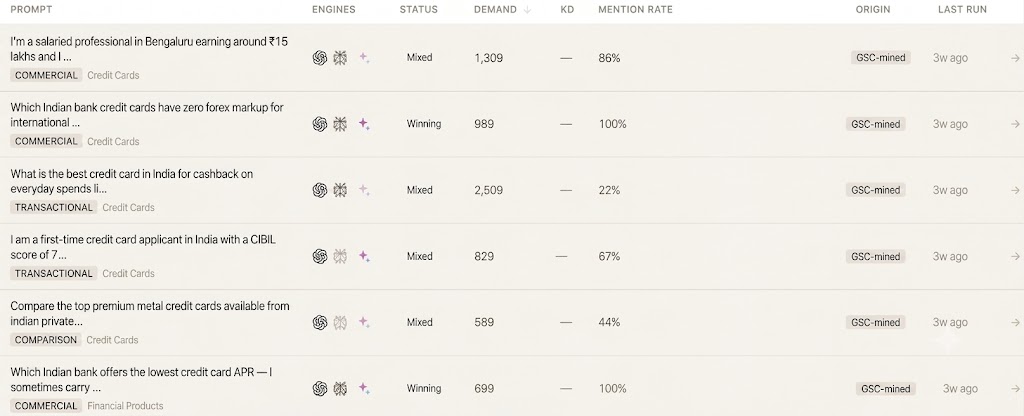
The data in this guide comes from running that loop ourselves. For each brand we track, Visiby builds a library of the real questions buyers ask in that category, then samples ChatGPT, Perplexity, and Google AI Overviews against those questions on a schedule. For every answer an engine returns, we record which brands it names and which URLs it cites, then roll the results up into a citation share per engine, measured against the brand's named competitors.
Our own June 2026 run is a worked example of how unclaimed the answer slots are. We ran 172 prompts in the AI-visibility-tools category across all three engines, which produced 516 answers and 3,502 individual URL citations drawn from 1,185 distinct domains. Across every one of those answers, our own brand was cited 0 times on all three engines, while the most-cited competitor reached about 12% of ChatGPT answers, 11% of Perplexity answers, and 9% of Google AI Overviews answers. A separate brand-entity score put us at 8 out of 100 against that competitor's 52, a gap that reflects an early-stage brand, not a structural one. We report our own zero because the methodology only earns trust if we apply it to ourselves first.
The output is a per-engine scoreboard rather than one blended figure, because the same brand routinely owns answers in one engine and loses them in another. Where a competitor is cited and the tracked brand is not, that gap becomes a line in a prioritised action plan that names the page and the answer to fix. This methodology is also why the patterns in this guide are first-hand. They are what the engines actually did when we asked them the questions buyers ask.
27 — MistakesCommon AEO mistakes
The most common AEO mistakes come from porting SEO habits straight across without adjusting for how engines select answers. The costly ones:
- Burying the answer. SEO copy often delays the payoff to hold attention; AEO needs the answer in the first sentence under the heading, because the engine extracts what it can lift cleanly.
- Mismatched questions. Writing headings in marketing language ("Our approach to onboarding") when users ask plain questions ("How long does onboarding take?"). The engine maps the user's words to your heading; mismatch loses the answer to a competitor.
- Skipping schema. Without FAQPage, HowTo, or QAPage markup, you rely on the engine to infer structure from prose, an avoidable coin flip.
- Chasing AEO on pages that do not rank. Snippets and answers come from the relevant set, which for classic features means page-one results. Fix the rank first.
- Blocking AI crawlers. A restrictive robots.txt that blocks GPTBot, PerplexityBot, or Google-Extended makes every other effort moot for AI answers.
- Measuring AEO with rank trackers. A rank tracker cannot see answer ownership across engines. Without an AI visibility tracker, teams ship AEO content and never learn whether it worked.
- Treating AI visibility as one number. Answer ownership differs by engine, topic, and buyer stage. Rolling it into a single score hides the specific gaps that cost deals.
The fix for all of them is the discipline SEO learned years ago, applied to a new surface: write the answer first, structure it explicitly, earn the rank that makes you eligible, and measure ownership per engine.
28 — FAQAnswer engine optimization: frequently asked questions
Why we built Visiby
Classic SEO tools cannot see inside AI answers. They count clicks on links, not the brand mentions an engine writes into a paragraph or the snippet it reads aloud. So a team can rank well and still have no idea whether ChatGPT, Perplexity, and Google AI Overviews are naming them or a competitor.
Visiby is the scorecard for that gap. It samples ChatGPT, Perplexity, and Google AI Overviews on a weekly cadence, reports how often your brand is cited against competitors per engine, shows which competitor was cited instead of you and why, and turns each gap into a prioritised action plan that names the exact page and answer to fix. Most AI-visibility tools stop at a score. Visiby names the fix. See where you stand: visiby.net.
Related guides
- What Is GEO — Generative engine optimization defined, plus how to implement it.
- AI Visibility Tools — How to measure citation share across ChatGPT, Perplexity, and Google AI Overviews.
- AI Citation Benchmark — Original Visiby research on how often engines actually cite a brand.
Virender Singh is the technical lead at Visiby, where he builds the crawling, structured-data, and answer-engine analysis behind the product. He writes about the technical mechanics of answer engine optimization. View full profile →