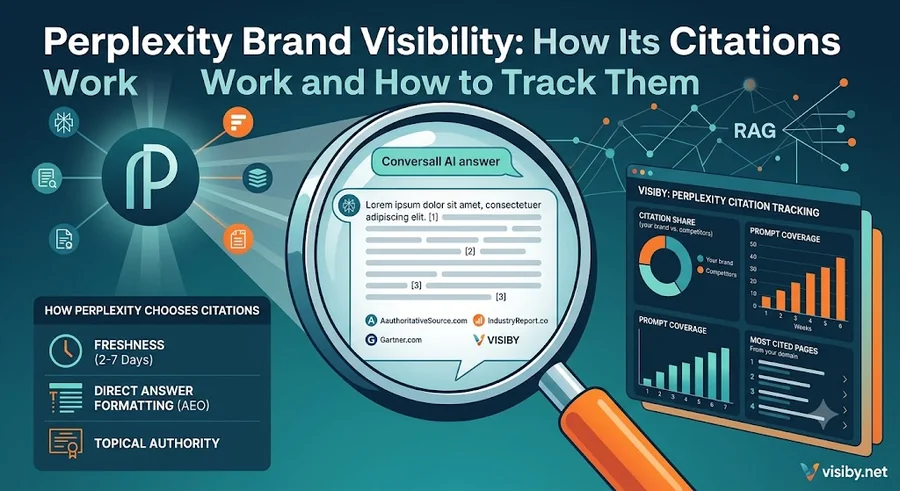

Key Takeaways: Perplexity is a citation-first AI search engine that heavily weights fresh, authoritative content. Because its retrieval system typically reflects content updates within 2–7 days, search marketers often use it as an early indicator of Generative Engine Optimization (GEO) trends before changes propagate to slower AI platforms.
Traditional SEO measures rankings. AI search measures whether your content becomes part of the generated answer.
Perplexity shifts away from the traditional "ten blue links" model. It generates conversational responses backed by inline citations, delivering both an immediate answer and the evidentiary sources used to construct it. For digital brands, visibility increasingly depends on being cited, rather than merely indexed.
A page holding the number one organic position in Google may not always appear inside Perplexity if a competing source provides a more direct, structurally extractable answer to the user's prompt. This reality makes Perplexity brand monitoring an increasingly important layer of search measurement.
A major differentiator for Perplexity is its retrieval speed. Unlike other AI search platforms with delayed index refreshes, Perplexity frequently surfaces new content within two to seven days. That rapid refresh cycle makes it a useful testing environment for evaluating whether new product pages, research reports, or technical documentation successfully trigger AI citations.
01 — DefinitionWhat Is Perplexity Brand Visibility?
Perplexity brand visibility is a metric that measures how frequently a company's domain, products, or brand name appear as cited sources within Perplexity's AI-generated responses.
Unlike traditional search engines that list pages hierarchically, Perplexity uses Retrieval-Augmented Generation (RAG) to synthesize answers from multiple trusted sources. Those cited sources become the user's verified evidence. If your content is excluded from that synthesis, your brand effectively does not exist in the conversation.
In the AI search ecosystem, visibility is measured through five core pillars:
- Citation Frequency: Raw count of prompts citing your domain.
- Prompt Coverage: The breadth of relevant questions your brand appears in.
- Brand Mentions: Unlinked text mentions within the generated answer.
- Citation Share: Your visibility relative to direct competitors.
- Source Authority: The perceived topical trust of your domain.
These metrics do not replace traditional SEO; they are the next evolutionary layer built on top of it.
Why Citation Visibility Dictates Market Share
Users are shifting from browsing search results to consuming immediate, synthesized answers. The domains that secure citations inside those answers gain compounding advantages:
- Direct referral traffic from highly qualified, high-intent users.
- Strong brand authority by serving as the AI's "evidence."
- Outsized influence over B2B and B2C buying decisions.
02 — GenerationHow Perplexity Generates Answers
Perplexity executes a specific RAG workflow to build its responses. Instead of relying solely on its static training weights, it queries the live web, scores retrieved sources for relevance, and generates an answer supported by inline footnotes.
The retrieval pipeline follows a strict sequence:
User Prompt
      ↓
Live Search Retrieval
      ↓
Semantic Source Evaluation
      ↓
Information Extraction
      ↓
AI Generated Answer
      ↓
Visible Inline Citations
Because citations are prominently displayed, users can instantly verify the AI's claims. For SEO professionals, this means content should be optimized for machine extraction, not just human readability.
03 — Core SignalsHow Perplexity Chooses Citations: The Core Signals
While Perplexity guards its exact retrieval algorithm, consistent testing across commercial prompts reveals four primary ranking signals.
1. Content Freshness
Perplexity heavily biases recent information. When multiple authoritative domains answer the same prompt, the newer or more recently updated content is often preferred for time-sensitive queries. This is particularly true in rapidly evolving sectors like software, finance, and marketing.
2. Direct Answer Formatting (AEO)
Content that immediately and concisely answers a user's prompt generally outperforms pages requiring semantic interpretation. Strong AI-friendly pages utilize Answer Engine Optimization (AEO) principles:
- Question-based H2/H3 headings.
- One-sentence definitive answers immediately following headings.
- Structured tables for data comparisons.
- Clear, step-by-step ordered lists.
3. Topical Authority
Authoritative domains earn citations because they provide reliable baseline data. Authority in the context of Perplexity stems from subject-matter focus, original research, and consistent publishing history. However, authority is a multiplier, not a guarantee; a highly authoritative domain will still lose a citation to a lesser-known site if the latter provides a more recent, structurally precise answer.
4. Semantic Relevance
Perplexity targets the exact semantic intent of the prompt. Highly focused, niche content frequently outranks broad, generalized articles.
04 — Source CountHow Many Sources Does Perplexity Cite?
A critical difference between Perplexity and platforms like ChatGPT is citation volume. Based on Visiby's internal tracking data across live commercial queries, Perplexity typically synthesizes information from 7 to 10 distinct sources per response.
Methodology Note: This observation is based on a sample of 5,000 commercial B2B search prompts (defined as queries with high enterprise software or service purchasing intent) tracked by Visiby between January and June 2026. Prompts were selected across 10 major B2B SaaS verticals. These results are observational; citation source counts can vary significantly based on query intent, complexity, and available retrieval data.
This creates a highly fragmented but transparent search experience. For marketers, it means there are multiple opportunities to earn a citation within a single response. You are no longer fighting solely for Position #1; you are competing to become a part of the AI's trusted consensus.
05 — Vs. ChatGPTPerplexity vs. ChatGPT Search Behavior
While both platforms utilize RAG, their citation behaviors diverge significantly.
| Feature | Perplexity | ChatGPT Search |
|---|---|---|
| Primary Utility | Live search and discovery | Conversational assistance |
| Typical Citations | 7–10 sources | 3–5 sources |
| Freshness Bias | Very High | Moderate |
| Citation Visibility | Prominent in every response | Varies by UI and mode |
Because Perplexity reflects new content faster, many enterprise SEO teams use it as an early testing environment. However, it is important to note that each AI platform uses its own proprietary retrieval algorithms; success in Perplexity does not guarantee visibility in Google AI Overviews or ChatGPT, though strong structural optimization generally benefits performance across all RAG-based systems.
06 — GEO MetricsMetrics That Actually Matter for GEO
Relying solely on total citation counts is a vanity metric. A mature Generative Engine Optimization strategy tracks deeper, contextual data.
Citation Share (AI Share of Voice)
Tracking raw citations is useless without competitive context. If your brand earns 50 citations, but a competitor earns 150 across the same prompt cluster, your actual market influence is shrinking. Citation Share measures your percentage of total available visibility.
Source Diversity
Analyze which specific page formats Perplexity prefers from your domain. If Perplexity exclusively cites your API documentation but ignores your marketing blog, your content strategy requires immediate realignment to capture top-of-funnel prompts.
07 — Weekly AuditA Practical Weekly Citation Audit
Because Perplexity updates rapidly, monthly reporting obscures critical volatility. High-performing AI marketing teams often execute weekly citation audits.
The Perplexity Audit Workflow:
- Define a static cohort of 50–100 commercial prompts.
- Run automated retrieval across the prompt set weekly.
- Log domains cited in the top 3 positions.
- Calculate weekly changes in Citation Share.
- Identify lost citations and analyze the winning competitor's content structure.
- Deploy immediate on-page updates to attempt to reclaim lost ground.
Instead of asking, "Are we ranking?", the objective becomes, "Is our percentage of the AI consensus growing?"
08 — Citation LossWhy Brands Lose Perplexity Citations
Citation loss is rarely a manual penalty; it is usually an algorithmic displacement by a more efficient source.
- Data Decay: Your statistics or product features are outdated compared to a newly published competitor guide.
- Structural Friction: Your answers are buried deep in paragraphs, while a competitor used a clean markdown table.
- Topical Dilution: Your article covers too many broad concepts, losing to a hyper-focused page that perfectly matches the user's specific prompt.
09 — OptimizationHow to Optimize Content for Perplexity Citations
Earning citations requires structuring factual data so an AI retrieval system can extract it efficiently.
1. Publish Primary Research
Original data is the ultimate citation magnet. Large Language Models (LLMs) crave unique statistics, benchmark reports, and proprietary survey data. If you provide the original data point, the AI is much more likely to cite you to validate its answer.
2. Implement Answer-First Writing
Invert the traditional SEO content pyramid. Do not use long, narrative introductions. State the definitive answer in the first sentence of a section, then use subsequent paragraphs to provide context and evidence.
3. Deploy Semantic HTML and Markdown
Machines parse structured data faster than raw text.
- Use explicit H2/H3 tags for questions.
- Use
<ul>and<ol>for lists. - Use
<table>for comparative data.
10 — VisibyHow Visiby Simplifies Perplexity Brand Monitoring
Manually executing identical prompts every week is impossible at scale. To manage GEO effectively, marketing teams require automated, continuous telemetry.
Visiby automates AI search visibility tracking by monitoring:
- Prompt-level brand citations across Perplexity, ChatGPT, and Google AIO.
- Competitive Citation Share and historical volatility.
- Exact brand mentions and sentiment within AI-generated text.
By replacing manual screenshots with structured, API-driven data, SEO teams can better measure the impact of their Generative Engine Optimization campaigns.
11 — ConclusionFinal Thoughts
The era of ten blue links is evolving. As high-intent buyers increasingly rely on synthesized AI answers, understanding who the AI cites is the new frontier of search marketing.
Brands that adapt their content architecture to prioritize machine extractability, extreme freshness, and original data will likely dominate citations. Those that rely solely on legacy keyword density tactics may struggle to maintain visibility in conversational search formats.
Start monitoring your AI citation share today, because your competitors already are.
12 — FAQFrequently Asked Questions
Arun Pandit is the founder of Visiby, an AI-visibility tracker by FNA Technology that measures how often ChatGPT, Perplexity, and Google AI Overviews cite a brand. He writes about generative engine optimization from the data Visiby collects across the brands it tracks. View full profile →