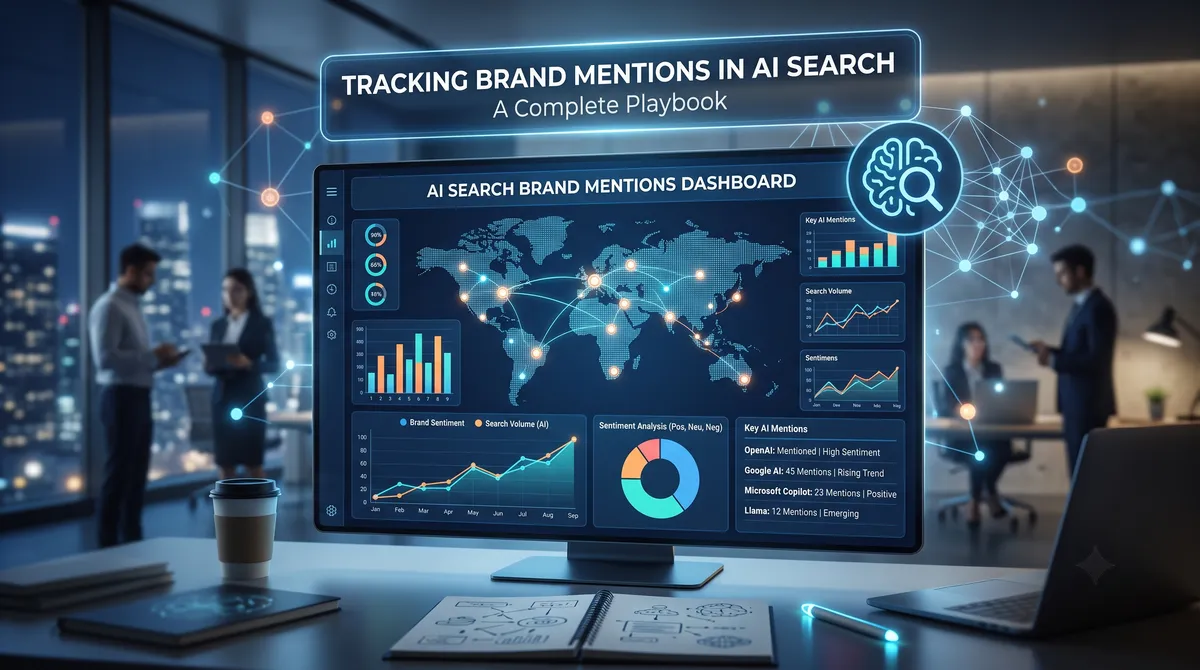

Key Takeaways: Tracking brand mentions in AI search requires monitoring synthesized conversational answers rather than counting ranked blue links. The best methods range from manual sampling for small test sets to dedicated AI visibility platforms that automate multi-engine audits across ChatGPT, Perplexity, and Google AI Overviews.
Related Guides: Learn how answer engines parse content in our guides on Generative Engine Optimization (GEO) and Answer Engine Optimization (AEO).
The best ways to track brand mentions in AI search are dedicated AI visibility platforms, custom API test scripts, and structured manual sampling. Once mentions are tracked, learn how to read the resulting AI visibility report. Traditional SEO rank trackers cannot detect AI brand mentions because conversational search engines synthesize answers on the fly rather than serving static lists of URLs.
When a prospective buyer asks ChatGPT for the "best CRM for real estate" or queries Perplexity for "top accounting software for startups," the engine delivers a curated list of recommendations. If your brand is not mentioned in that generated response, you lose the buyer before they ever visit a search results page.
To protect your brand equity and capture zero-click demand, you must monitor your brand visibility across generative search engines. This guide compares the four primary tracking methods, details their exact setup costs, and outlines a practical 5-step playbook for tracking AI brand mentions.
01 — OverviewWhat are the best ways to track brand mentions in AI search?
The best way to track brand mentions in AI search depends on your prompt volume, engineering resources, and reporting needs.
The four primary tracking methods are:
- Dedicated AI visibility platforms (Recommended): Platforms like Visiby automate prompt execution across ChatGPT, Perplexity, and Google AI Overviews, parsing cited URLs and calculating your AI Share of Voice (SOV) automatically.
- Custom API scripts: Internal engineering teams write Python scripts querying the OpenAI API documentation or Perplexity API, parsing JSON outputs into an internal database.
- Structured manual audits: Marketing teams query 10 to 20 high-priority buyer prompts directly in consumer AI web interfaces and log brand citations in a spreadsheet.
- Traditional web and social listening tools: Tools like Brand24 and Mention track brand mentions across public forums, blogs, and news sites that feed AI training data, though they cannot query live conversational models directly.
02 — Why SEO Tools FailWhy traditional SEO rank trackers fail at AI brand monitoring
Traditional SEO tools like Ahrefs and Semrush were designed to scrape 10 blue links from desktop Google SERPs. They measure rankings by checking whether your root domain appears at position 1, position 4, or position 10 on a static keyword page.
Generative engines function on an entirely different architecture:
- Conversational synthesis: An LLM reads multiple web sources and writes an original paragraph summarizing the category. Your brand might be praised in sentence two, listed in a bullet point, or omitted entirely.
- Non-deterministic outputs: Because large language models use probabilistic text generation, two users asking the exact same question may receive slightly different brand recommendations.
- Footnote citations vs. rankings: Visibility is defined by whether the model links to your domain in its citation footnotes, not by a position number.
- Engine divergence: In Visiby's benchmark analysis across 172 target buyer prompts, the leading brand appeared in 24% of Perplexity answers but only 5% of ChatGPT answers. A single static ranking position cannot capture this variation.
03 — Methods MatrixMethods comparison: 4 ways to track brand mentions in AI search
The following matrix compares each tracking method across setup complexity, engine coverage, citation tracking depth, and monthly operating cost:
| Method | Setup Time | Multi-Engine Coverage | Citation Link Tracking | Monthly Cost | Best Suited For |
|---|---|---|---|---|---|
| Dedicated AI Platforms (Visiby) | 5 minutes | ChatGPT, Perplexity, Google AI Overviews | Full URL + competitor breakdown | $99 – $249 / mo | Growth marketing teams and agencies needing automated weekly reporting |
| Custom API Scripts | 2–4 weeks dev | OpenAI, Perplexity (limited AI Overviews) | Raw API citations only | $40 – $150 / mo in API tokens + dev hours | Technical teams with dedicated data engineers |
| Manual Prompt Sampling | 1 hour | All consumer interfaces | Manual link verification | $0 (Free) + 4–8 staff hours / mo | Early-stage startups tracking under 10 core prompts |
| Social / Web Listening | 1 day | Crawled web pages & forums only | Indirect source links | $99 – $499 / mo | PR teams monitoring external brand sentiment across news and Reddit |
04 — Method 1Method 1: Manual prompt sampling and spreadsheet audits
For teams monitoring a narrow product category, manual sampling offers an immediate, zero-cost starting point.
To execute a manual audit:
- Create a spreadsheet with columns for Prompt, Engine (ChatGPT, Perplexity, Google AI Overviews), Mentioned (Yes/No), Sentiment (Positive/Neutral/Negative), Competitors Mentioned, and Cited URLs.
- Open private browsing windows to avoid personalization bias.
- Run your top 10 buyer queries once per week.
- Record whether the engine recommended your product or cited your domain.
While effective for baseline discovery, manual testing breaks down quickly. Querying 50 prompts across 3 engines requires 150 manual searches per week, taking hours of repetitive staff time while remaining vulnerable to individual tester bias.
05 — Method 2Method 2: Custom API automation scripts
Engineering-heavy teams often attempt to build in-house trackers using vendor APIs.
A standard script queries the OpenAI chat/completions endpoint with web search enabled or queries Perplexity's sonar models via API:
import openai

client = openai.OpenAI(api_key="your-api-key")

response = client.chat.completions.create(
    model="gpt-4o",
    messages=[
        {"role": "system", "content": "You are a software advisor."},
        {"role": "user", "content": "What is the best AI visibility tracking software?"}
    ]
)

answer_text = response.choices[0].message.content
has_brand = "Visiby" in answer_text
While API scripts give developers complete control over data schemas, they come with substantial maintenance hurdles:
- API vs. Consumer divergence: The system prompts and retrieval parameters in the OpenAI API do not perfectly match the consumer ChatGPT search interface.
- No Google AI Overviews API: Google does not provide an official API for AI Overviews, requiring custom headless browser scrapers that frequently break when Google adjusts its DOM.
- Parsing overhead: Extracting structured competitor entities and footnote domains from unstructured markdown text requires ongoing regex and LLM parsing maintenance.
06 — Method 3Method 3: Traditional web and social listening tools
Web listening tools such as Brand24, Talkwalker, and Mention monitor public websites, blogs, and social platforms for brand keywords.
These tools do not query generative engines directly. Instead, they track the data sources that generative engines read:
- Forum indexing: Monitoring discussions on Reddit and Quora where AI crawlers source user recommendations.
- Digital PR and review sites: Tracking mentions across G2, Capterra, and industry blogs.
This method is valuable as an upstream diagnostic. If an AI engine repeatedly recommends a competitor, social listening tools help you find the exact third-party reviews and forum threads that the engine used during its training or retrieval phase.
07 — Method 4Method 4: Dedicated AI visibility platforms
Dedicated platforms are built specifically for answer engine optimization and generative search monitoring.
A dedicated platform automates the entire tracking lifecycle:
- Automated scheduled runs: Executes your prompt catalog weekly across ChatGPT, Perplexity, and Google AI Overviews using clean browser sessions.
- Entity and competitor extraction: Automatically parses which competitors were recommended, their ordering, and their sentiment.
- Source attribution: Identifies which competitor URLs were cited as authoritative footnotes.
- AI Share of Voice calculations: Converts raw text responses into clear percentage metrics showing your market share across each platform.
For example, Visiby tracks your brand mentions across major engines, alerting your team when a competitor displaces your brand on high-intent prompts and showing you the exact content changes required to win back the citation.
08 — PlaybookHow to track brand mentions in AI search: A 5-step playbook
Regardless of whether you use automated software or manual sampling, follow this structured 5-step playbook to measure your AI search footprint:
Step 1: Build a high-intent buyer prompt library
Do not restrict your testing to simple navigational queries like "What is [Brand Name]". Buyers consult AI engines using complex, high-intent questions.
Structure your prompt library across four core categories:
- Category recommendation prompts: "What are the best tools for tracking AI search mentions?"
- Comparative prompts: "[Brand A] vs [Brand B] for enterprise teams"
- Problem-solving queries: "How to measure brand citations in ChatGPT answers"
- Feature-specific questions: "Which visibility trackers support Google AI Overviews natively?"
Target a starting library of 30 to 50 prompts that represent actual buying decisions in your industry.
Step 2: Query multi-turn conversational engines
Run your prompt catalog across the three dominant AI search interfaces:
- ChatGPT (with Search enabled): Powers direct conversational recommendations for over 200 million active users.
- Perplexity AI: The most citation-heavy engine, providing dense footnote links for almost every factual assertion.
- Google AI Overviews: Embedded directly in Google SERPs, capturing massive mainstream search volume.
Ensure tests are conducted without browser cookies or user history to avoid personalized output bias.
Step 3: Parse synthesized entity mentions and cited URLs
When an engine generates an answer, parse two distinct data layers:
- Textual mentions: Did the model name your company? Was it listed as a top recommendation, an alternative, or omitted?
- Cited footnote links: Which URLs did the engine link to? If the engine recommended your competitor, examine whether it cited the competitor's website, a G2 review page, or an independent industry comparison.
Step 4: Calculate your AI Share of Voice (SOV)
AI Share of Voice (%) = (Number of Prompts Citing Your Brand / Total Evaluated Prompts) × 100
Calculate this metric overall and per engine. For example, if you test 50 prompts:
- Mentioned in 15 ChatGPT responses = 30% ChatGPT SOV
- Mentioned in 25 Perplexity responses = 50% Perplexity SOV
- Mentioned in 10 Google AI Overviews = 20% AI Overviews SOV
Tracking per-engine SOV reveals where your content distribution is succeeding and where technical crawler blocks might be suppressing your reach.
Step 5: Detect citation drift across engine updates
Generative engines update their retrieval indices continuously. A prompt that cites your website today may cite an industry benchmark tomorrow.
Review your tracking data on a weekly cadence to detect:
- Citation loss: Prompts where your brand was previously recommended but dropped out.
- Competitor displacement: Prompts where a competitor published new comparison content that displaced your citation.
- Source migration: Shifts in the domains the engine relies on (such as an engine favoring Reddit threads over corporate blogs).
09 — Engine MechanicsHow AI search engines locate and cite brand mentions
To improve your citation rate, you must understand the retrieval mechanics that power generative answers.
Engines find and evaluate brands through three primary channels:
[ Web Crawlers ] ──> [ Retrieval Index ] ──> [ LLM Synthesis ] ──> [ Cited Answer ]
  (GPTBot, etc.)      (Vector Embeddings)       (Entity Scoring)       (With Footnotes)
- Direct web crawling: AI bots like GPTBot, PerplexityBot, and Googlebot scan your public pages. If your
robots.txtblocks these user agents, engines cannot verify your product features. - Vector retrieval (RAG): When a user asks a question, the engine converts the query into a mathematical vector and retrieves matching content passages from its web index. Passages that directly answer the query with clear statistics are prioritized.
- Entity authority and co-occurrence: The seminal Princeton research paper on Generative Engine Optimization (Aggarwal et al., 2023) demonstrated that adding authoritative citations and direct statistical evidence increases source visibility by up to 40%. Models favor sources that present verifiable facts rather than generic marketing claims.
10 — OptimizationFormatting your website to win more AI brand mentions
Once your tracking identifies missing mentions, optimize your website pages using citation-focused formatting:
- Adopt an answer-first structure: Place a concise, 1–2 sentence direct answer immediately below each question heading before providing expanded context.
- Use structured HTML tables: LLMs extract data from HTML tables far more reliably than from dense paragraphs. Present product comparisons, pricing tiers, and feature matrices in clean table elements.
- Implement Schema.org markup: Mark up your pages with
Article,FAQPage,Product, andOrganizationstructured data to help AI crawlers map your entity attributes accurately. - Publish original benchmark data: Original statistics and proprietary survey data are the most citable content formats on the web. Cite exact sample sizes and methodologies so models can quote your data with confidence.
11 — FAQFrequently asked questions
Virender Singh is the technical lead at Visiby, where he builds the crawling, structured-data, and answer-engine analysis behind the product. He writes about the technical mechanics of answer engine optimization. View full profile →