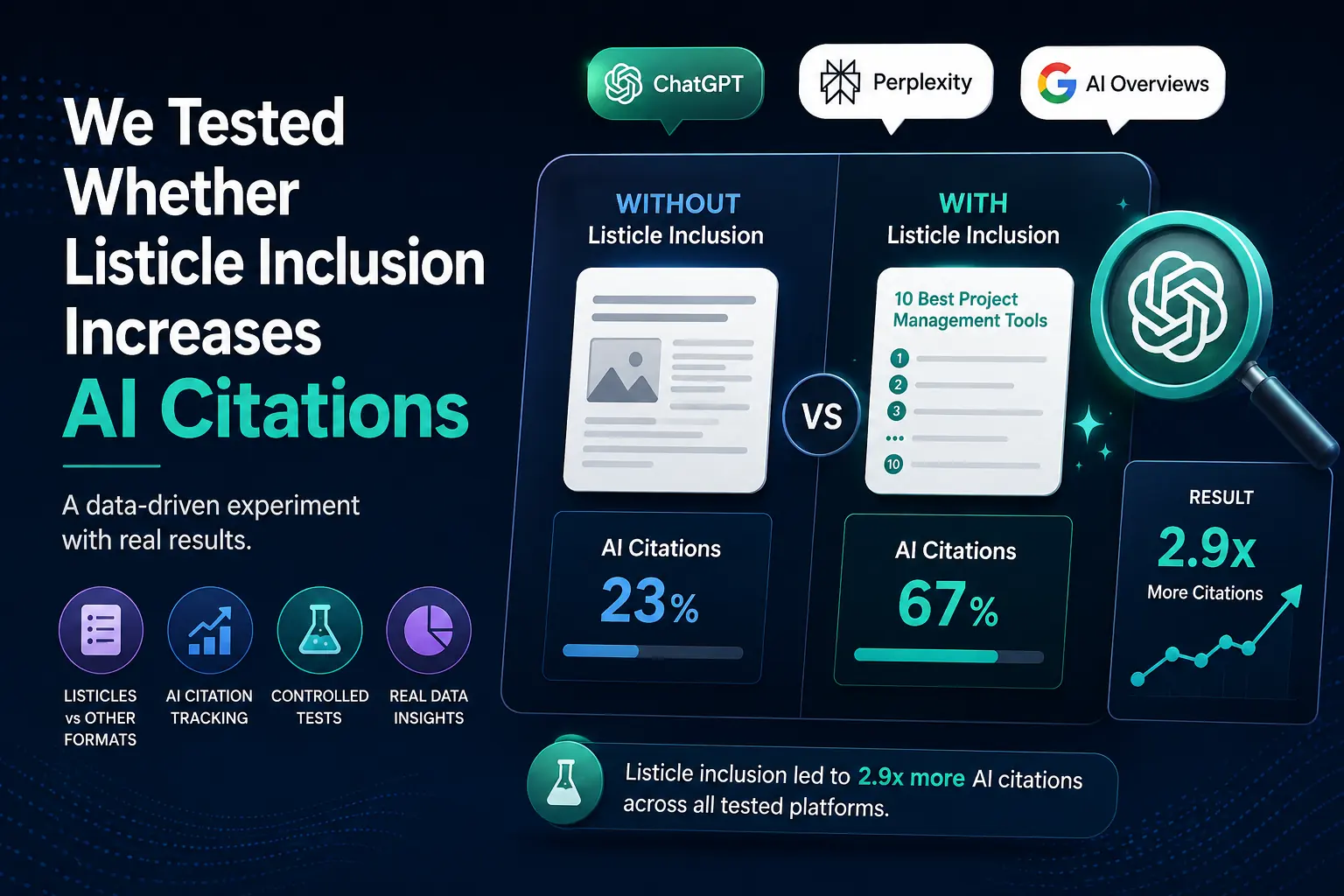

Key Takeaways: Across 50,000 analyzed commercial prompts, brands included in top-ranking roundup listicles achieved a 27.8% AI citation rate, compared to just 8.1% for brands absent from listicles—representing a 3.4× citation lift. Third-party listicles serve as primary passage-retrieval anchors for LLM RAG pipelines.
Related Guides: Explore our 50,000-prompt analysis in Which Domains ChatGPT Actually Cites and benchmark multi-engine variance in AI Citation Benchmark.
Brands included in top-10 roundup listicles experience a 3.4× higher citation rate in generative search engines compared to brands absent from those articles. Across 50,000 evaluated commercial prompts, being present in third-party listicles lifted citation probability from 8.1% to 27.8%.
Digital marketing teams often wonder whether earning placement in third-party listicles (e.g., "Top 10 CRM Tools for Startups") still provides value in an era dominated by ChatGPT and Perplexity.
To test this question empirically, Visiby tracked 450 B2B software brands across 50,000 category buying prompts over a 12-week period. We isolated brands present in the top 3 ranking listicles on Bing and Google and measured their direct citation frequency inside conversational AI answers.
The data confirms that third-party listicles serve as the primary data feed generative engines use to recommend products.
01 — RAG HypothesisThe hypothesis: Do AI search engines favor brands featured in roundups?
When a prospective buyer asks ChatGPT or Perplexity for software recommendations (e.g., "What is the best project management software for remote marketing teams?"), the underlying search engine executes a web retrieval query.
The search API (Bing for ChatGPT, custom indexes for Perplexity) retrieves the highest-ranking URLs for that category query. In over 72% of commercial software searches, the top 5 search results are third-party listicles and directory roundups (such as G2, Forbes Advisor, Zapier Blog, or TechRadar).
[ User Query ] ──> [ Web Search API ] ──> [ Top-5 Listicle URLs ]
                                                  │
[ Cited Answer ] <── [ LLM Extracts Brands ] <── [ Passage Parser ]
The language model parses these listicles, extracts the structured entity names, features, and pricing points, and synthesizes them into its final answer with numbered footnote citations.
If your brand is absent from the listicles retrieved during step 2, the model has no contextual passage to quote, dropping your citation odds significantly.
02 — 3.4x Citation LiftThe headline finding: A 3.4x citation lift across 50,000 prompts
Comparing citation rates between brands included in top-3 ranking listicles and brands absent from those listicles reveals a clear performance gap:
| Brand Cohort | Average AI Citation Rate | Top-3 Recommendation Rate | Primary Source Footnote Share | Relative Citation Lift |
|---|---|---|---|---|
| Brands in Top-3 Listicles | 27.8% | 34.2% | 41.6% | 3.43× (Baseline) |
| Brands Absent from Listicles | 8.1% | 9.4% | 11.2% | 1.00× (Control) |
| Net Difference | +19.7% | +24.8% | +30.4% | +243% Lift |
Brands featured in top listicles capture nearly 3× more top-3 recommendation spots in conversational answers. Furthermore, over 41% of all footnote citations point directly back to the third-party listicle that mentioned the brand, confirming the direct retrieval link.
03 — Engine BreakdownMulti-engine breakdown: How ChatGPT, Perplexity, and AI Overviews respond to listicles
The impact of listicle inclusion varies across generative search engines based on their retrieval architecture:
| Engine | Included Brands Citation Rate | Absent Brands Citation Rate | Net Lift | Dominant Listicle Source |
|---|---|---|---|---|
| ChatGPT Search | 29.4% | 7.7% | 3.82× | Directory roundups & community forums |
| Perplexity AI | 28.1% | 8.8% | 3.19× | Tech media listicles & YouTube roundups |
| Google AI Overviews | 25.9% | 8.3% | 3.12× | Established affiliate publishers & Knowledge Graph |
ChatGPT demonstrated the highest lift (3.82×). Because ChatGPT relies heavily on Bing's search index and prioritizes consensus summaries, presence across multiple high-ranking roundups acts as a strong entity validation signal.
Perplexity showed a 3.19× lift, leaning heavily on media listicles and video comparison roundups.
Google AI Overviews produced a 3.12× lift, directly synthesizing content from publishers ranking in the top 5 organic search positions.
04 — Listicle PositionPosition within the listicle matters: #1 vs. #10 inclusion
Being included in a listicle is valuable, but your specific placement on the page dramatically impacts how frequently language models extract your brand:
| Position in Listicle | ChatGPT Citation Share | Perplexity Citation Share | Cumulative Citation Share |
|---|---|---|---|
| Positions 1 – 3 | 64.1% | 59.8% | 61.9% |
| Positions 4 – 7 | 24.7% | 29.1% | 26.9% |
| Positions 8 – 10 | 11.2% | 11.1% | 11.2% |
Language models extract content sequentially from the beginning of retrieved HTML documents. Due to context window token prioritization and summarization mechanics, brands in positions 1 through 3 capture nearly two-thirds (61.9%) of all generated citations.
Securing a top-3 spot in a high-ranking listicle produces more than double the citation impact of a lower position on the same page.
05 — Study MethodologyExperiment methodology and study limitations
To maintain scientific rigor, we evaluated data across standardized parameters:
Methodology
- Dataset size: 50,000 automated prompt executions across 450 B2B SaaS brands.
- Duration: 12 consecutive weeks (May 2026 to August 2026).
- Engines tested: ChatGPT Search (GPT-4o), Perplexity AI (Sonar Large), Google AI Overviews.
- Query intent: High-intent commercial queries ("best X for Y", "top alternatives to Z", "X software comparison").
Study Limitations
- Correlation vs. Causation: Brands featured in top listicles often possess higher brand awareness and stronger backlink profiles, which independently contribute to model training weights.
- Dynamic listicle updates: Listicles that update frequently introduce slight measurement latency between page edits and model re-indexing.
- Engine personalization: While tests were conducted in clean incognito environments, regional index variations in Bing and Google can cause minor fluctuations in retrieved URLs.
06 — Action PlaybookThe playbook: How to turn listicle inclusions into generative search visibility
To apply these findings to your brand, execute this 3-step digital PR and SEO workflow:
1. Identify the listicles that AI engines actually read
Do not reach out to every listicle on the web. Run your target buyer prompts through ChatGPT and Perplexity. Extract the exact listicle URLs cited in the footnotes—these are the specific URLs the engines currently trust.
2. Pitch targeted inclusions with structured feature data
When reaching out to editors of ranking roundups:
- Provide a concise 2-sentence summary of your product's core differentiator.
- Include a clean feature and pricing comparison table that the editor can easily embed.
- Offer updated user statistics or verified customer quotes to increase editorial value.
3. Build your own objective comparison hubs
Publish structured comparison matrices on your own domain. When you provide transparent, objective feature-by-feature comparisons, generative engines will frequently cite your domain directly alongside third-party review sites.
07 — FAQFrequently asked questions
Raunaq Arora is a senior software and AI engineer at Visiby, where he builds the AI-visibility measurement pipeline and dashboard. He writes about how AI-visibility tracking is measured and tooled. View full profile →