

Key Takeaways: Visiby's 172-prompt benchmark found 1,174 cited domains across three AI engines, with 11% zero source overlap. The right AI visibility vendor tracks all three engines, attributes citations to specific passages, and turns gaps into weekly action plans.
The phrase "agent analytics" used to mean contact-center performance dashboards: call handling times, resolution rates, CSAT scores. In 2026, it means something different. AI agents now sit between your brand and your buyer. ChatGPT, Perplexity, and Google AI Overviews answer purchase questions directly, and the brand they cite is the brand that wins the click. Agent analytics, in this context, is the practice of measuring how those AI agents discover, evaluate, and reference your content.
This article is a buyer's evaluation framework. It will not rank platforms or name winners — the AI Visibility Tools guide does that. Instead, it gives you the criteria to evaluate any vendor yourself, grounded in data from Visiby's own 172-prompt citation benchmark.
What "Agent Analytics" Means in the AI Search Era
Traditional analytics tools count clicks, impressions, and keyword positions. AI agent analytics counts something different: citations. When a user asks ChatGPT "What is the best CRM for healthcare clinics?", the engine pulls source material, synthesizes an answer, and cites specific domains. Your brand either appears in that citation list or it does not.
This shift matters because the traffic pattern has changed. Google's own generative-AI optimization guidance states that content people find genuinely useful influences presence in AI answers more than any markup trick. The metric is no longer "did we rank on page one?" It is "did the AI agent cite us when the buyer asked?"
Measuring that requires a new category of tooling. That category is what this article evaluates.
Why Every Brand Needs an AI Visibility Vendor in 2026
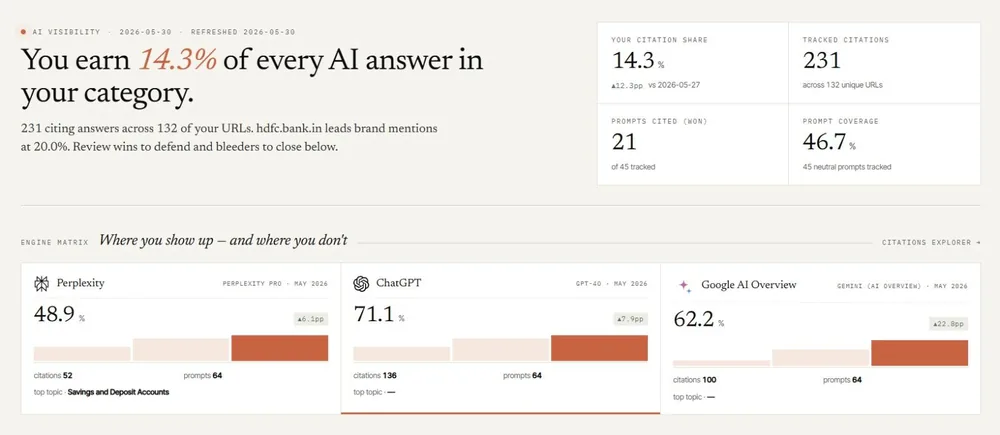
The scale of the shift is measurable. In Visiby's June 2026 benchmark, 172 real buyer prompts were run through ChatGPT, Perplexity, and Google AI Overviews. The three engines produced 3,340 citation events across 2,355 URLs from 1,174 unique domains. ChatGPT answered all 172 prompts; Perplexity answered all 172; Google AI Overviews answered 170.
The finding that should concern every brand: on 11% of prompts where all three engines responded, they shared no source domain at all. Three answers to one question, built on three entirely separate source sets. A brand visible on one engine can be invisible on the other two without knowing it.
This engine divergence means traditional SEO dashboards that track Google SERP positions miss two-thirds of the AI discovery surface. A dedicated AI visibility vendor fills that gap by monitoring all three engines simultaneously and reporting citation share per engine.
The 5 Capabilities That Separate Real Platforms from Dashboards
Not every product calling itself an "AI visibility tool" delivers the same depth. Some display a single score; others trace citations to the paragraph that triggered them. When evaluating vendors, test for these five capabilities:
- Multi-engine crawler monitoring: does the platform track GPTBot, PerplexityBot, and Googlebot access independently?
- Passage-level citation attribution — can it show which paragraph on which page earned a citation, or does it only report at the domain level?
- Competitive share of voice: does it measure your citation rate against named competitors, per engine?
- Content gap analysis: does it identify the specific prompts where competitors are cited and you are not?
- Automated action plans: does it convert gap data into prioritized content fixes, or does it stop at the dashboard?
The sections below unpack each capability and explain what to verify during a trial.
Capability 1: Multi-Engine Crawler Monitoring
AI engines use different crawlers to access your site. GPTBot (OpenAI), PerplexityBot, and Googlebot each have distinct crawl patterns, rate limits, and robots.txt directives. A vendor that monitors only one crawler is reporting on a fraction of your AI accessibility.
During evaluation, ask the vendor to show you a log of crawler visits by engine over the past 30 days. Verify that they distinguish between GPTBot and standard Googlebot traffic — many analytics platforms merge them. If a vendor cannot show you per-engine crawl data, they are likely inferring access rather than measuring it.
The benchmark data illustrates why this matters: Reddit appeared in 45% of ChatGPT answers and 0% of Perplexity answers for the same 172 prompts. If your site blocks PerplexityBot in robots.txt (intentionally or through a misconfigured wildcard), you will lose that engine entirely — and a single-engine monitor will never flag it.
Capability 2: Passage-Level Citation Attribution
Domain-level citation data tells you that your site was cited. Passage-level attribution tells you why. The distinction determines whether you can act on the data or just observe it.
When an AI engine cites your domain, it typically pulls from a specific paragraph — often one containing a named statistic, a direct definition, or a structured list. A vendor with passage-level attribution can show you: this paragraph on this page earned this citation for this prompt on this engine.
Without that granularity, you cannot reproduce success. You know a page was cited, but you do not know which section did the work. Ask the vendor to demonstrate attribution on a live prompt during your trial. If they show you a domain-level count and call it "attribution," that is a flag.
06 — Share of VoiceCapability 3: Competitive Share of Voice
Share of voice in AI search is the percentage of buyer prompts where your brand is cited versus competitors. It is the metric that ties citation tracking to business outcomes.
In Visiby's benchmark, tryprofound.com was cited in 27% of all 172 prompts — built on just 17 URLs and 55 citation events. It scored 10 out of 40 on the CITE-40 domain-authority rubric, one of the lowest among the 25 rated domains. A low-authority domain with focused, specific content out-cited larger competitors. The takeaway: share of voice rewards topical precision, not domain size.
When evaluating a vendor, verify that competitive share of voice is reported per engine. A brand cited in 53% of Perplexity answers for a topic cluster but only 11% of ChatGPT answers for the same cluster (as tryprofound.com was in the benchmark) needs different fixes on each engine. An aggregate score hides the divergence.
07 — Gap AnalysisCapability 4: Content Gap Analysis and Prioritization
Citation tracking becomes actionable when paired with gap analysis. A gap exists when a competitor is cited for a prompt and you are not. The question is: does the vendor show you the gap, the prompt, the competitor's cited passage, and the reason your content missed?
The benchmark found that Perplexity's source universe (573 unique domains) was roughly 40% larger than ChatGPT's (409 unique domains). This means Perplexity surfaces niche domains that ChatGPT ignores — and a gap on Perplexity often has a different root cause than a gap on ChatGPT.
During your trial, request a gap report for 10 prompts in your category. Check whether the vendor identifies the specific content deficiency (missing statistic, no structured answer, blocked crawler) or just lists the gap without diagnosis. Diagnosis separates a platform from a dashboard.
08 — Action PlansCapability 5: Automated Action Plans
The final capability test: does the vendor turn data into a weekly fix list? The cycle should work like this — the platform identifies gaps, diagnoses causes, prioritizes fixes by potential citation impact, and delivers a checklist your content team can execute without re-analyzing raw data.
A 2023 Princeton study (Aggarwal et al., arXiv:2311.09735) tested optimization tactics across 10,000 queries and found that adding statistics, direct quotations, and cited sources were among the strongest moves for earning placement in AI answers, lifting visibility by up to 40%. A good action plan translates those findings into specific edits: "Add a sourced statistic to paragraph 3 of your CRM comparison page" — not "improve content quality."
Platforms like Visiby provide weekly automated loops that check crawler access, map citation drift, and deliver prioritized action plans. Ask any vendor you evaluate to show you an example action plan from a real account. If the action items are generic ("create more content," "improve page speed"), the platform lacks the attribution depth to generate specific fixes.
09 — Validation GapThe Audience Validation Gap: Why AI Models Scan Forums But Cite Websites
One of the most discussed dynamics in generative search is the "validation gap." AI engines like ChatGPT and Perplexity read Reddit discussions to understand user consensus, but they rarely cite Reddit directly in commercial queries.
Instead, they use Reddit to cross-reference product claims. If your brand is mentioned positively on Reddit, the model gains trust in your entity. However, when writing the final response, the model prefers to cite authoritative, structured websites — blogs or documentation pages containing schema markup. The benchmark confirmed this pattern: Reddit appeared in 45% of ChatGPT answers (78 out of 172 prompts) but functioned as a validation source, not as the primary citation target for commercial queries.
This means your off-page presence on forums validates your brand, but your on-page structure wins the actual citation link. A vendor should track both: entity mentions across forums (validation signals) and direct citations on your domain (conversion signals).
10 — Red FlagsRed Flags When Evaluating an AI Visibility Vendor
During your evaluation, watch for these warning signs:
- Single-engine reporting. If the vendor tracks only ChatGPT or only Google AI Overviews, they are missing the majority of citation divergence. The benchmark showed 11% zero-overlap across engines on the same prompts.
- No passage-level attribution. Domain-level citation counts tell you where you stand but not why. Without passage attribution, you cannot build a repeatable citation strategy.
- Vanity metrics without benchmarks. A "visibility score" without a defined methodology or comparative baseline is not actionable. Ask how the score is calculated, what inputs it uses, and how it correlates with actual citation rates.
- Stale data. AI engines update their retrieval behavior frequently. If the vendor refreshes data monthly, you are optimizing against a map that is already outdated. Weekly refresh cycles are the minimum for actionable intelligence.
- Generic action plans. If every recommendation is "create better content" or "add more keywords," the platform lacks the diagnostic depth to connect specific content gaps to specific citation losses.
11 — 30-Day PilotHow to Run a 30-Day Vendor Evaluation
Use this framework to test any AI visibility vendor against real data from your category:
Week 1: Baseline. Provide the vendor with 50 to 100 real buyer prompts from your category. These should be conversational questions, not keyword stubs — the kind of queries users type into ChatGPT or Perplexity. Run them across all three engines and record your citation rate per engine.
Week 2: Attribution depth. Select 10 prompts where a competitor is cited and you are not. Ask the vendor to show passage-level attribution: which paragraph on the competitor's page earned the citation, and what your corresponding page is missing. This tests Capabilities 2 and 4.
Week 3: Action plan execution. Take the vendor's recommended fixes for 5 pages. Execute them. Measure whether citation rates for those specific prompts change in the following week. This tests whether the action plan produces measurable movement.
Week 4: Competitive reporting. Request a full competitive share-of-voice report across all three engines. Verify that the vendor breaks down citation share by engine, not just in aggregate. Compare the numbers to your Week 1 baseline.
If the vendor cannot complete this 30-day cycle, or if the data at Week 4 does not show measurable change from Week 3 fixes, the platform lacks operational depth.
12 — DeploymentImplementation: From Pilot to Production
Once you have selected a vendor through the 30-day evaluation, the rollout follows three phases:
Phase 1: Connect. Integrate the vendor's crawler monitoring with your robots.txt and server logs. Confirm that GPTBot, PerplexityBot, and Googlebot access is correctly detected. Map your existing content library to the vendor's prompt tracking system.
Phase 2: Calibrate. Run your full prompt set (100+ queries) and establish baseline citation rates per engine. Identify the top 20 gaps by potential impact. Assign content owners to each gap.
Phase 3: Operate. Adopt the weekly action plan cycle. Each Monday, the platform delivers prioritized fixes. Each Friday, the content team reports which fixes shipped. The following Monday, updated citation data confirms which fixes moved the needle. This loop compounds — Visiby's benchmark showed that specificity, not volume, drives citation share. A single well-structured paragraph can flip a citation from a competitor to your domain.
13 — ChecklistConclusion: The Buyer's Checklist
Before signing a contract with any AI visibility vendor, verify these items:
- The platform tracks ChatGPT, Perplexity, and Google AI Overviews independently
- Citation attribution operates at the passage level, not domain level
- Competitive share of voice is reported per engine, not aggregated
- Content gap reports identify the specific deficiency, not just the gap
- Action plans contain page-specific, paragraph-specific fixes
- Data refreshes weekly or faster
- The vendor can demonstrate measurable citation movement from executed fixes
- A 30-day pilot is available before commitment
AI search visibility is not a score you check quarterly. It is an operational loop: measure citation share, identify gaps, fix content, re-measure. The vendor you choose should run that loop with you, not hand you a dashboard and walk away. See what an AI visibility team does each week.
14 — FAQFrequently Asked Questions
Virender Singh is the technical lead at Visiby, where he builds the crawling, structured-data, and answer-engine analysis behind the product. He writes about the technical mechanics of answer engine optimization. View full profile →